IntroductionEven in countries where abortion is legal, research on the subject remains complex due to the absence of a single, universal context for reporting its occurrence.
1 Within this scenario, it is essential to differentiate induced abortion, characterized as the voluntary termination of pregnancy, from the clinical outcome of hospitalization for abortion. The latter encompasses everything from complications resulting from unsafe procedures to spontaneous losses and legally permitted interruptions, thereby failing to reflect the totality of occurrences in the community.
2The regulation of abortion is broadly addressed by legislation worldwide, with restrictions varying across countries. Generally, high-income countries tend to adopt more liberal laws, which recognize abortion as part of the reproductive rights and as a healthcare service.
3Globally, between 2015–2019, it is estimated that approximately 73.3 million pregnancies were terminated, of which six out of ten (61%) were unplanned, and three out of ten (29%) resulted from induced abortion.
4 These data highlight the magnitude of the phenomenon and its impact on public health.
In Brazil, induced abortion is permitted under only three circumstances: risk to the woman's life, fetal anencephaly, or pregnancy resulting from sexual violence.
5 Beyond these conditions, clandestinity frequently leads to unsafe procedures, whose main epidemiological indicator is hospitalizations for abortion-related complications.
2National data reinforce the relevance of the topic. The National Abortion Survey (PNA) 2021 demonstrated that abortion is a common event in the early reproductive life of Brazilian women, occurring significantly at younger ages and with evidence of recurrence.
6Previous studies indicated a trend toward stability or reduction in the rates of hospitalization for abortion in Brazil in recent decades.
7,8 However, gaps remain regarding the understanding of the recent spatial distribution of these hospitalizations across the Brazilian territory, as well as their relationship with socioeconomic and health determinants.
The analysis of aggregate data by Federative Units (UF) allows for the identification of current geographic patterns and the recognition of areas with greater vulnerability, thereby supporting the planning of reproductive health actions. It is hypothesized that hospitalizations for abortion demonstrate spatial dependence in Brazil, with the formation of geographic clusters associated with contexts of higher socioeconomic vulnerability and lower coverage of primary healthcare. Thus, the aim of this study was to analyze the spatial distribution and factors associated with hospitalizations for abortion in Brazil, 2020–2023.
MethodsThis is an ecological study in which the units of analysis are the 27 UFs of Brazil. Abortion hospitalizations in Brazil among women aged 10–49 years were analyzed for the period from 2020–2023, as well as their association with socioeconomic and demographic factors, and health indicators. The study followed the Strengthening the Reporting of Observational Studies in Epidemiology (STROBE) guidelines.
The study population comprises hospitalizations for abortion among women aged 10–49 years. These events were defined based on codes O00 to O08 of the International Classification of Diseases, 10th Revision (ICD-10). Since this study utilizes secondary data from a nationwide information system, the complete set of available records for the analyzed period was used; thus, a priori sample power calculations were not required. Additionally, the number of units of analysis (27 UFs) and the set of variables included in the model were defined based on theoretical and epidemiological criteria, with selection and multicollinearity control procedures being adopted to ensure parsimony and reduce the risk of overfitting in the linear regression models.
The study period encompassed the years 2020–2023. The year 2019 was excluded to maintain temporal consistency within the series, as its inclusion — being immediately prior to the coronavirus disease 2019 (COVID-19) pandemic — could introduce bias in temporal comparability, thereby complicating comparisons with the years already impacted by the pandemic context.
Hospitalizations were grouped into three categories in accordance with the ICD-10 stratification: (O03) spontaneous abortion, (O04) medical abortion, and (O00–O02, O05–O08) other pregnancies with abortive outcomes.
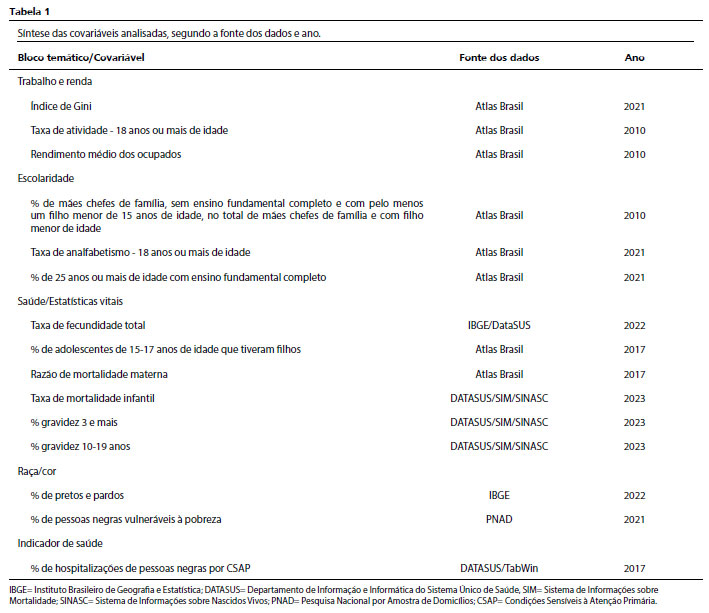
Data were sourced from the Hospital Information System of the Unified Health System (SIH/SUS), maintained by the Ministry of Health and publicly available through the Department of Informatics of the Unified Health System (DATASUS). Resident population data were obtained from the Brazilian Institute of Geography and Statistics (IBGE). Additionally, sociodemographic indicators were collected from various sources, as indicated in Table 1.
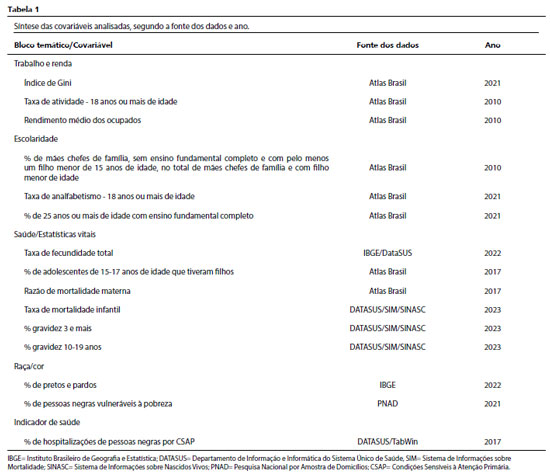
The sociodemographic indicators used as independent variables were obtained from the most recent year available in each database (2010, 2017, 2021, and 2023). The use of covariates from different years is a common practice in ecological studies utilizing secondary data, especially when there are limitations in the temporal availability of socioeconomic indicators. It is acknowledged that the use of secondary data is subject to potential under-reporting biases and inconsistencies; however, official databases and standardized extraction and analysis procedures were employed to minimize potential sources of bias and enhance data comparability.
The selection of independent variables was guided by prior evidence from the literature and conceptual models concerning the socioeconomic and health determinants associated with hospitalizations for abortion, considering their epidemiological relevance and availability within information systems.
To analyze the factors associated with hospitalizations for abortion, the selected covariates were organized into thematic blocks: Labor and income (Gini index; % of formally employed individuals aged 18 years or older; mean income of the employed population); Education (% of female heads of household without completed primary education and with at least one child under 15 years of age relative to total female heads of household with minor children; illiteracy rate among individuals aged 18 years or older; % of individuals aged 25 years or older with completed primary education); Health and vital statistics (total fertility rate; % of adolescents aged 15–17 years who have given birth; maternal mortality ratio; infant mortality rate; % of individuals with 3 or more pregnancies; % of pregnancies among adolescents aged 10–19 years); Race/Color (% of Black and Brown individuals; % of Black individuals vulnerable to poverty); and Health indicators (% of hospitalizations for ambulatory care-sensitive conditions [ACSC] among Black individuals) (Table 1). Data collection was conducted between October and November 2024.
For all regions, abortion hospitalization rates were calculated by using the total number of abortion-related hospitalization events among women aged 10–49 years as the numerator, and the total resident female population within the same age group, location, and corresponding period as the denominator. The result was multiplied by 100,000. It is fundamental to emphasize that the numerator reflects the number of hospital admission records rather than the number of individual women. To reduce random instability in rates across UFs with small populations, they were smoothed using the Local Empirical Bayesian method. Rate calculations were performed using Microsoft Office Excel software.
The exploratory spatial data analysis included cartographic representation of the rates through Local Indicators of Spatial Association (LISA) mapping, used to identify local spatial autocorrelation and its clusters. Spatial clusters were classified according to Local Moran's I values, considering a significance level of 5% (
p<0.05), and categorized as high-high, low-low, low-high, and high-low. For the spatial autocorrelation analysis, a queen contiguity weight matrix was used with a p-value cutoff of 0.001; thus, the neighborhood matrix fully considers vertices and edges, including those sharing minimal borders.
To identify the factors related to hospitalizations for abortion, an exploratory spatial data analysis was initially performed using the Global Moran's I and Local Indicators of Spatial Association (LISA). Subsequently, ordinary least squares (OLS) linear regression models were fitted. The choice of the OLS model was based on Lagrange Multiplier (LM) tests, which showed no statistical significance for the spatial models (Spatial Lag and Spatial Error). As a diagnostic for spatial dependence, the autocorrelation of the residuals from the final models was evaluated using Moran's I. Regression coefficients, standard errors, 95% confidence intervals, and p-values were estimated from the OLS models, using a normal approximation for the confidence interval calculations.
Initially, a bivariate analysis was conducted between the dependent variable and the selected independent variables. Variables demonstrating statistical association were included in the multivariate OLS linear regression model. Final model selection was conducted using a backward elimination procedure based on combined criteria of statistical significance and goodness-of-fit. Although statistical significance (
p<0.05) was considered, variable retention in the model also accounted for the Akaike Information Criterion (AIC), prioritizing more parsimonious specifications with better overall performance. Consequently, certain non-significant variables were retained in the final model because they contributed to improving the model fit—as evidenced by a reduction in the AIC—as well as due to their theoretical relevance and potential role as control variables.
Multicollinearity control was performed by estimating the variance inflation factor (VIF) and the condition number (CN). Variables with a CN greater than 30 were removed. All observed VIF values remained below the cutoff point, indicating the absence of relevant multicollinearity among the variables in the final model. The models were also evaluated for adequacy and parameter stability based on parsimony criteria, aiming to reduce the risk of overfitting. Analyses were conducted using Microsoft Office Excel, QGIS version 3.38.0, and GeoDa version 1.18.
This research exclusively utilized de-identified secondary data and was conducted in accordance with the guidelines and regulations established in Resolution No. 466 of December 12, 2012, of the National Health Council (CNS), which defines the ethical standards for studies involving human participants.
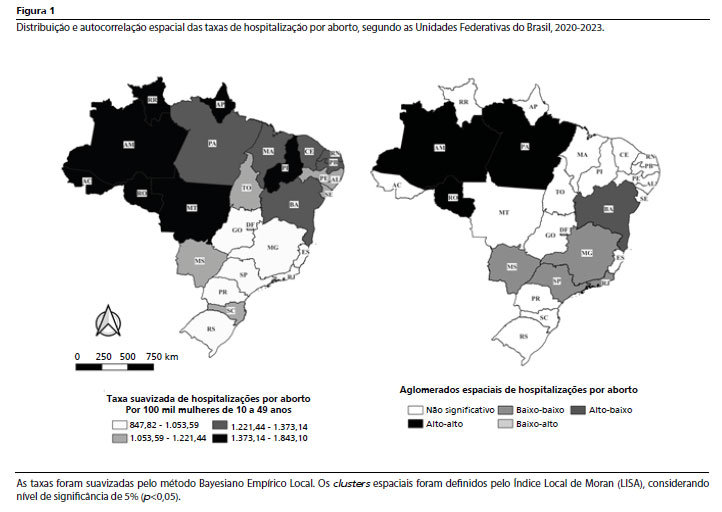
9ResultsA total of 700,926 hospitalizations for abortion among women aged 10–49 years in Brazil were analyzed for the 2020–2023 period, aggregated across the 27 UFs. The highest smoothed abortion hospitalization rates occurred in the states of Roraima, Amazonas, Acre, Rondônia, Mato Grosso, Amapá, and Piauí (ranging from 1,373.14 to 1,843.10 per 100,000 women) (Figure 1).
In the local Moran's I autocorrelation analysis, the local indicators of spatial association (LISA) identified three High-High clusters (Amazonas, Pará, and Rondônia); one High-Low cluster (Bahia); and four Low-Low clusters (Mato Grosso do Sul, Minas Gerais, São Paulo, and Rio de Janeiro). The remaining UFs did not show statistical significance (Figure 1).
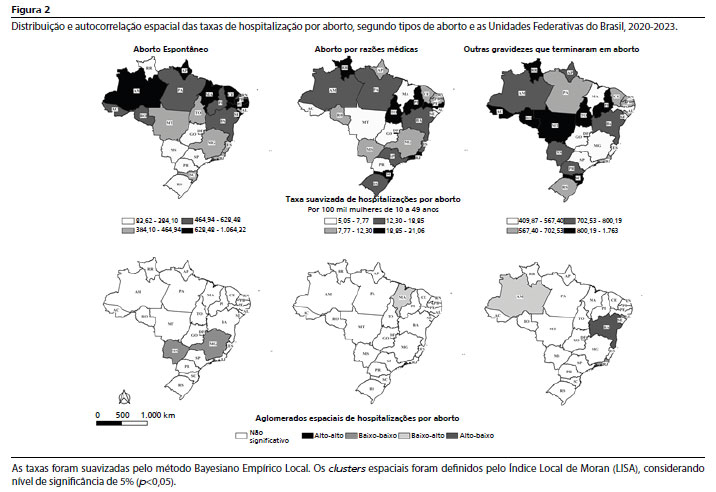
Regarding the spatial distribution and autocorrelation of abortion hospitalization rates by type, distinct distribution patterns were observed depending on the specific category analyzed. For spontaneous abortion, the highest rates occurred in Amazonas, Amapá, Maranhão, Ceará, Paraíba, and Sergipe, ranging from 628.48 to 1,064.32 per 100,000 women.
For medical abortion, the highest rates were observed in Roraima, Tocantins, Piauí, Pernambuco, Rio de Janeiro, and Sergipe, ranging from 18.85 to 31.06 per 100,000 women. Regarding other pregnancies with abortive outcomes, the rates ranged from 800.19 to 1,763.00 per 100,000 women in Roraima, Acre, Rondônia, Mato Grosso, Tocantins, Piauí, and Santa Catarina (Figure 2).
When spatial autocorrelation was analyzed, the clusters identified for spontaneous abortion were Mato Grosso do Sul and Minas Gerais (Low-Low). For medical abortion, Maranhão presented a Low-High cluster. For other pregnancies with abortive outcomes, the clusters were High-Low (Bahia), Low-High (Amazonas), and Low-Low (Alagoas and Rio de Janeiro) (Figure 2).
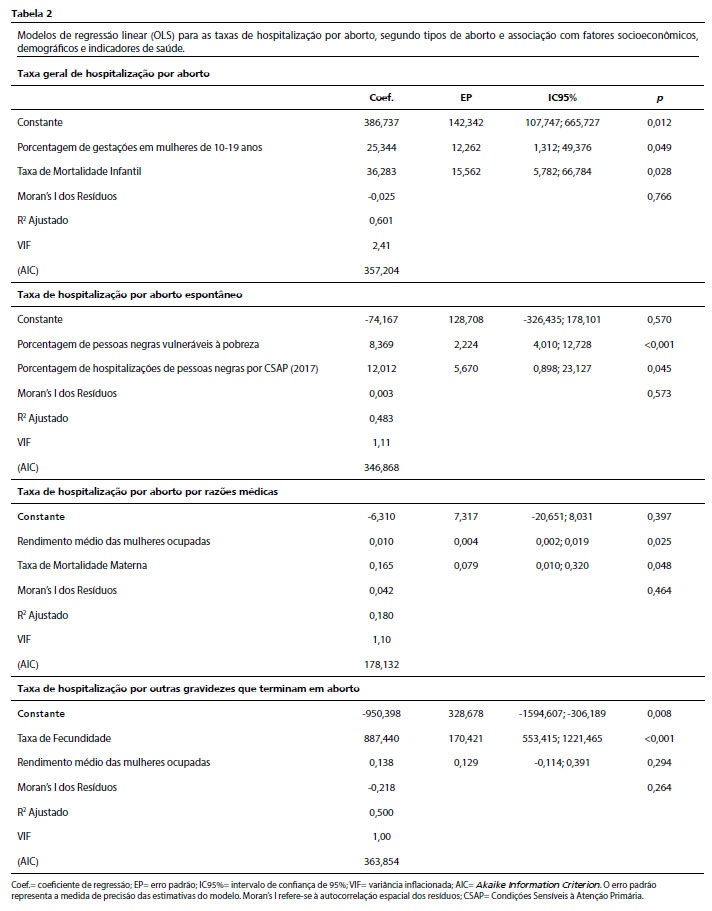
Table 2 presents the coefficients from the ordinary least squares (OLS) linear regression models. For the overall abortion hospitalization rate, significant positive associations were observed with the infant mortality rate (β=36.28;
p=0.028) and the percentage of pregnancies among young women aged 10–19 years (β=25.34;
p=0.049). The model presented an adjusted R
2 of 0.601 and an AIC of 357.20. Moran's I test of the residuals indicated the absence of spatial dependence (
p=0.766).
In the analysis of spontaneous abortion hospitalizations, the percentage of Black individuals vulnerable to poverty (β=8.37;
p<0.001) and the percentage of hospitalizations for ambulatory care sensitive conditions (ACSC) (β=12.01;
p=0.045) showed significant positive associations. The adjusted R
2 was 0.483 and the AIC was 346.86 (Moran's I of the residuals:
p=0.573).
DiscussionThe present study analyzed the spatial distribution and associated factors of abortion-related hospitalizations in Brazil from 2020 to 2023, identifying 700,926 admission events among women aged 10–49 years. The discrepancies observed among the Brazilian states may be related to disparities in social, economic, and demographic conditions, as well as variations in access to healthcare services.
10The spatial distribution demonstrated that the highest abortion hospitalization rates were generally found in the North region. A previous study conducted from 2008 to 2018 also showed that the North region had the highest average rate (49.2) of abortion-related admissions, corroborating the findings of this study.
7 This regional pattern should be interpreted at the population level, considering structural differences in access to healthcare services, the organization of healthcare network, and socioeconomic conditions; thus, it is not possible to directly infer the individual occurrence of abortions.
In this context, a spatiotemporal study on maternal mortality in Brazil identified significant regional disparities, particularly in states located in the North and Northeast regions, which likewise presented high abortion hospitalization rates in the current study.
11 These findings suggest the coexistence of territorial inequalities related to both maternal mortality and abortion-related admissions.
Corroborating our finding, which identified clusters with significantly low rates in the Southeast region, a previous study conducted in Brazil also demonstrated lower abortion-related admission rates in the South and Southeast regions.
7This result is consistent with the hypothesis that socioeconomic inequalities and disparities in access to sexual and reproductive health services may influence abortion hospitalization rates, without implying a direct causal relationship.
8Furthermore, the ordinary least squares (OLS) linear regression results for the overall abortion hospitalization rate showed a positive association with the infant mortality rate. This finding aligns with national literature indicating that both variables may reflect contexts of greater social vulnerability and weaknesses in the healthcare network.
12Regarding spontaneous abortion hospitalizations, the analysis revealed high rates in the North and Northeast regions. This scenario coincides with areas presenting the highest levels of poverty and social inequality in the country.
13 These conditions may be linked to the occurrence of gestational complications and the subsequent need for hospitalization, as well as reflecting disparities in access to healthcare and the quality of care provided.
It is important to emphasize that spontaneous abortion is associated with multiple clinical and sociodemographic factors, including maternal age, pre-existing health conditions, and lifestyle factors.
14 Thus, hospitalizations for spontaneous abortion must be understood as complex events influenced by biological, social, and healthcare-related factors, rather than as an isolated reflection of individual characteristics.
In the association analysis, the proportion of Black individuals living in poverty and the percentage of hospitalizations for ambulatory care sensitive conditions (ACSC) showed positive associations with spontaneous abortion hospitalizations. Previous studies indicate that Black and socially vulnerable populations may face greater barriers to accessing health services.
7,15 These structural inequalities can influence hospital utilization patterns, reflecting the differences observed at the population level.
16Concerning hospitalizations for medical abortion, the highest rates were identified across different regions of the country. This type of hospitalization occurs under specific clinical and legal circumstances, such as risks to maternal life, fetal conditions incompatible with life, or pregnancies resulting from sexual violence.
5 The distribution of these hospitalizations may reflect regional inequalities in access to sexual and reproductive health services and in the organization of abortion care.
8Within this scenario, the data revealed a positive association between the mean income of employed women and the maternal mortality ratio. Despite reductions in maternal mortality in Brazil over recent decades, substantial regional and sociodemographic disparities persist in the country.
17Regarding hospitalizations for other pregnancies with abortive outcomes, these presented a dispersed pattern across the country. This category encompasses cases such as ectopic pregnancy, hydatidiform mole, and other unspecified types, including those resulting from unlawful attempts at voluntary termination. A major analytical challenge is that ICD-10 does not provide a specific code for induced abortions. Nonetheless, research shows that in large urban centers, many women resort to pregnancy termination to preserve anonymity and minimize legal risks, while also taking advantage of the greater availability of healthcare services. Furthermore, the operation of clandestine clinics performing induced abortions contributes significantly to this scenario.
18,19Finally, in the analysis of hospitalizations for other pregnancies with abortive outcomes, the total fertility rate showed a positive association with abortion-related hospitalizations. This association may be linked to the social and public health context in Brazil, including access to contraceptive methods and family planning. The reduced access to contraceptives during the COVID-19 pandemic may have contributed to an increase in unintended pregnancies, which potentially impacted the patterns of abortion hospitalizations related to gestational complications.
20Although this study presents limitations inherent to the use of secondary data from the Hospital Information System of the Brazilian Unified Health System (SIH/SUS) – which is subject to potential underreporting and inconsistencies, and is restricted to SUS-funded hospitalizations – the findings provide valuable insights for understanding the topic. Moreover, differences in private health insurance coverage among states may influence the observed rates, given that admissions occurring exclusively within the private network are not captured by the SIH/SUS. In states with higher private health insurance coverage, such as São Paulo and Rio de Janeiro, hospitalizations may be underestimated, whereas in states more reliant on the SUS, data capture tends to be more comprehensive, which could partially influence the observed regional gradients.
Additionally, the rates used were not age-standardized. Considering that the analyzed age group (10–49 years) is broad and that major demographic differences exist among Brazilian regions – particularly in states within the North region, which have a proportionally younger population – part of the observed differences may reflect the population age structure rather than exclusively variations in the risk of abortion-related hospitalization.
The temporal misalignment between certain covariates and the analyzed outcome period must also be considered. Due to the unavailability of more recent and standardized data for all analyzed variables, some of the socioeconomic indicators employed refer to years preceding the 2020–2023 period. Although this is a frequent limitation in ecological studies using secondary data, this time lag may partially influence the interpretation of the observed associations.
Finally, because this is an ecological study, the observed associations were analyzed at the aggregate level, using states as the units of analysis. Consequently, the findings do not allow for inferences regarding individual behaviors, highlighting the potential for ecological fallacy, and must therefore be interpreted exclusively at the population level.
Additionally, the small number of ecological units (27 states) may limit the stability of the multivariate models, and states with smaller populations may exhibit greater instability in the calculated rates, even when spatial smoothing techniques are applied. Furthermore, given the number of associations tested, the possibility of a Type I error due to multiple comparisons cannot be ruled out. The identified associations must be interpreted with caution, particularly those close to the statistical significance threshold, considering potential violations of residual assumptions in the ecological models. This scenario may increase the risk of overfitting and the identification of spurious statistical associations, especially when multiple variables are tested simultaneously.
There is a notable scarcity of comparative research analyzing the spatial distribution of abortion cases in Brazil across different periods and regions. Moreover, the analyzed timeframe restricts comparisons with the pre-pandemic scenario, as the year 2019 was excluded to maintain the temporal consistency of the series and to avoid biases related to the impact of the COVID-19 pandemic on healthcare services.
Despite these limitations, this study contributes by providing recent evidence on the spatial distribution of abortion-related hospitalizations in Brazil, broadening the understanding of this phenomenon at the population level.
The present study analyzed the spatial distribution of abortion-related hospitalizations in Brazil from 2020 to 2023, identifying priority areas – such as Amazonas, Roraima, Acre, Rondônia, Mato Grosso, Amapá, and Piauí – where the highest rates were observed. These findings allowed for the identification of geographical patterns and regional disparities in the distribution of hospitalizations for abortion.
Furthermore, positive spatial associations were identified between abortion-related hospitalizations and various social and health indicators, such as the infant mortality rate, vulnerability to poverty among Black individuals, the percentage of hospitalizations for ambulatory care sensitive conditions, the average income of employed women, the maternal mortality ratio, and the total fertility rate. Since these are associations observed at the aggregate level, the results should be interpreted with caution, particularly those close to the statistical significance threshold, bearing an exploratory and hypothesis-generating character for future research.
The findings reinforce the need to strengthen public policies focused on sexual and reproductive health, particularly in socially vulnerable territories with greater barriers to accessing healthcare services.
References1. Huntington D, Mensch B, Miller VC. Survey questions for the measurement of induced abortion. Stud Fam Plann. 1996; 27 (3): 155-61.
2. Organização Mundial da Saúde (OMS). Diretrizes sobre cuidados com o aborto. Geneva: OMS; 2022. [
Internet]. [access in 2025 Set 18]. Available from:
https://www.who.int/pt/publications/i/item/97892400451633. Lavelanet AF, Johnson BR, Ganatra B. Global abortion policies database: A descriptive analysis of the regulatory and policy environment related to abortion. Best Pract Res Clin Obstet Gynaecol. 2020; 62: 25-35. doi: 10.1016/j.bpobgyn.2019.06.002
4. Bearak J, Popinchalk A, Ganatra B, Moller A, Tunçalp Ö, Beavin C, et al. Unintended pregnancy and abortion by income, region, and the legal status of abortion: estimates from a comprehensive model for 1990–2019. Lancet Glob Health. 2020; 8 (9): e1152-61. doi: 10.1016/S2214-109X(20)30315-6
5. Supremo Tribunal Federal (STF – BR). Arguição de Descumprimento de Preceito Fundamental nº 54. Diário da Justiça Eletrônico do STF. Brasília (DF): STF; 2012. [
Internet]. [access in 2025 Set 18]. Available from:
https://www.stf.jus.br/arquivo/cms/noticianoticiastf/anexo/adpf54.pdf6. Diniz D, Medeiros M, Madeiro A. Pesquisa Nacional de Aborto – Brasil, 2021. Ciênc Saúde Colet. 2023; 28 (6): 1601-6. doi:10.1590/1413-81232023286.01892023
7. Uliana MD, D'Agostini Marin DF, Silva MB, Giugliani C, Iser BPM. Internações por aborto no Brasil, 2008-2018: estudo ecológico de série temporal. Epidemiol Serv Saúde. 2022; 31 (1): e2021341. doi:10.1590/s1679-49742022000100017
8. Domingues RMSM, Dias MAB, Schilithz AOC, Carmo Leal M. Aborto inseguro no Brasil: revisão sistemática. Cad Saúde Pública. 2020; 36 (Suppl. 1): e00190418. doi:10.1590/0102-311X00190418.
9. Ministério da Saúde (BR). Resolução CNS nº 466, de 12 de dezembro de 2012. Brasília (DF): Ministério da Saúde; 2012. [
Internet]. [access in 2025 Abr 25]. Available from:
https://bvsms.saude.gov.br/bvs/saudelegis/cns/2013/res0466_12_12_2012.html10. Migoto MT, Oliveira RP, Andrade L, Freire MHS. Correlação espacial da mortalidade perinatal com condições sociais, econômicas e demográficas: estudo ecológico. Rev Saúde Pública Paraná. 2020; 3 (1): 75-85. doi:10.32811/25954482-2020v3n1p75.
11. Ferreira RCG, Guedes SC, Moreira RS. Maternal mortality in Brazil: spatio-temporal analysis between 2000 and 2019. Rev Bras Saúde Matern Infant. 2024; 24: e20230231. doi:10.1590/1806-9304202400000231.
12. Silva C, Costa Y, Pantoja X, Pinheiro AKC, Rodrigues IL, Nogueira LMV. Mortalidade infantil associada às iniquidades sociais: revisão de escopo. Rev Eletrôn Enferm. 2022; 24: e71824. doi:10.5216/ree.v24.71824.
13. Instituto Brasileiro de Geografia e Estatística (IBGE). Pobreza cai para 31,6% da população em 2022, após alcançar 36,7% em 2021. Rio de Janeiro: IBGE; 2023. [
Internet]. [access in 2025 Jan 22]. Available from:
https://agenciadenoticias.ibge.gov.br/agencia-noticias/2012-agencia-de-noticias/noticias/38545-pobreza-cai-para-31-6-da-populacao-em-2022-apos-alcancar-36-7-em-202114. Oliveira MTS, Oliveira CNT, Marques LM, Souza CL, Oliveira MV. Factors associated with spontaneous abortion: a systematic review. Rev Bras Saúde Matern Infant. 2020; 20 (2): 361-72.
https://doi.org/10.1590/1806-9304202000020000315. Diniz D, Madeiro A, Medeiros M, Marinho L, Rodrigues IL, Menezes G. Abortion and race in Brazil, National Abortion Surveys 2016 to 2021. Ciênc Saúde Colet. 2023; 28 (11): 3085-92. doi:10.1590/1413-812320232811.14062023
16. Cobo B, Cruz C, Dick PC. Gender and racial inequalities in the access to and the use of Brazilian health services. Ciênc Saúde Colet. 2021; 26 (9): 4021-32. doi:10.1590/1413-81232021269.05732021
17. Leal LF, Malta DC, Souza MFM, Vasconcelos AMN, Teixeira RA, Veloso GA,
et al. Maternal mortality in Brazil, 1990 to 2019: a systematic analysis of the Global Burden of Disease Study 2019. Rev Soc Bras Med Trop. 2022; 55 (Suppl. 1): e0279-2021. doi:10.1590/0037-8682-0279-2021.
18. Cardoso BB, Vieira FMSB, Saraceni V. Aborto no Brasil: O que dizem os dados oficiais? Cad Saúde Pública. 2020; 36: e00188718. doi:10.1590/01002-311X00188718
19. Menezes GMS, Aquino EML, Fonseca SC, Domingues RMSM. Aborto e saúde no Brasil: Desafios para a pesquisa sobre o tema em um contexto de ilegalidade. Cad Saúde Pública. 2020; 36: e00197918. doi:10.1590/0102-311x00197918
20. Reis AP, Góes EF, Pilecco FB, Almeida MCC, Diele-Viegas LM, Menezes GMS,
et al. Desigualdades de gênero e raça na pandemia do Covid-19: implicações para o controle no Brasil. Saúde Debate. 2020; 44 (4): 324-40.
https://doi.org/10.1590/0103-11042020E423AcknowledgmentsThe authors acknowledge the Brazilian Federal Agency for Support and Evaluation of Graduate Education (CAPES) for funding this study, and the State University of Maringá for the institutional and technical support, both essential for the development of this research.
Author's contributionPrates LFL: Conceptualization, Data curation, Formal analysis, Funding acquisition, Investigation, Methodology, Software, Validation, Visualization, Writing – original draft, Writing – review & editing. Oliveira NN: Data curation, Formal analysis, Investigation, Methodology, Software, Visualization. Azevedo LS: Data curation, Formal analysis, Investigation, Methodology, Software, Visualization, and Review. Araújo EAO: Analysis and interpretation of data, critical revision of the manuscript content. Oliveira RR: Data curation, Investigation, Methodology, Project administration, Supervision, Validation, Visualization, Writing – review & editing.
All authors approved the final version of the article and declare no conflicts of interest.
Use of artificial intelligenceThe authors declare the use of generative artificial intelligence (
ChatGPT, OpenAI) for assisting in the textual review.
Data availabilityAll datasets supporting this study are included in the article.
Received on October 20, 2025
Final version presented on June 3, 2026
Approved on June 4, 2026
Associated Editor: Alex Sandro Souza


 ; Natan Nascimento de Oliveira2







 Ler em português
 Download PDF
 Imprimir
 Enviar este artigo por email
 Como citar este artigo
 Enviar um comentário
 Mendeley
 Pocket
 Compartilhar no Facebook
 Compartilhar no Twitter