IntroductionVertical transmission of the human immunodeficiency virus (HIV) is the primary route of HIV infection in children. In these cases, HIV transmission occurs during pregnancy, childbirth, or breastfeeding.
1 In the absence of antiretroviral treatment, vertical transmission typically occurs in up to 45% of cases.
1,2 When not properly diagnosed and treated, infected children experience high morbidity and have a shorter life expectancy.
2Given the necessity to prevent vertical transmission, pregnant women are a priority population for early diagnosis and effective treatment of HIV. When the viral load is suppressed to levels below 50 copies of viral RNA per mL of blood, a level referred to as "undetectable" the rate of vertical transmission of the virus is reduced to less than 1%.
1Therefore, achieving viral suppression is the key factor in preventing vertical transmission. To achieve this, adherence to antiretroviral therapy is essential, as it promotes immune reconstitution, minimizes the risk of resistance mutations, inhibits the clinical progression of the infection to acquired immunodeficiency syndrome (AIDS), and prevents transmission of the virus to the child and to others.
3,4In Brazil, there is a law code number 9,313 of 1996 that had a significant impact on combating the HIV/AIDS epidemic, as it mandated the free distribution of antiretroviral medications through the
Sistema Único de Saúde (SUS)
5(Brazilian Public Health System). However, despite universal access of antiretroviral, gaps in care and regional inequalities in the control of HIV infection are still observed in Paraná and Brazil.
5,6Given the above, this study aims to investigate the factors associated with failure to achieve viral suppression among pregnant women receiving HIV treatment in the State of Paraná, with the goal of providing useful information for the implementation of initiatives focused on maternal and child health.
MethodsThis is an analytical cross-sectional study conducted using secondary data from the
Sistema de Controle Logístico de Medicamentos (SICLOM) (Medication Logistics Control System). This system registrates the dispensing of antiretroviral medications and provides sociodemographic and clinical information on the population receiving HIV treatment. Access to SICLOM is restricted, and data collection was conducted in partnership with the
Centro de Medicamentos do Paraná (CEMEPAR) (Paraná Medicines Center) of the
Secretaria de Estado da Saúde do Paraná (SESA-PR) (Paraná State Department of Health).
The study population consisted of all pregnant women receiving HIV treatment in the State of Paraná between January and April 2024. The variables of interest were viral load, sociodemographic data (age, schooling, skin color), city of residence, gestational age, the
Unidade Dispensadora de Medicamentos (UDM) (Medication Dispensing Unit) where the pregnant women accessed their medications, the start date of HIV treatment, and the treatment regimens in use (first-line treatment or other, more complex regimens).
The State of Paraná has 399 municipalities and a population of 11.44 million, the largest in the South region and the fifth largest in Brazil.
7 Administratively, it is divided into 22 Regional Health Districts. During the study period, there were 77
Unidade Dispensadora de Medicamentos (UDM) (Medication Dispensing Unit) distributed in 22 Regional Health Districts across the State, according to data from the SICLOM management system (
https://azt.aids.gov.br/). These units serve as referral centers to people living with HIV to have access to antiretroviral medications, regardless of whether they present prescriptions from SUS or private providers.
8In this study, pregnant women with HIV were categorized into two groups: those in virological suppression and those experiencing virological failure. Pregnant women with HIV viral load of 50 viral RNA copies/mL of blood or higher were considered to be experiencing virological failure.
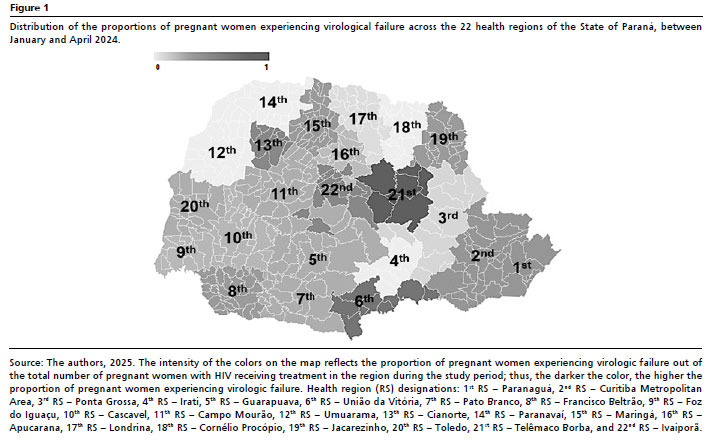
1The proportions of pregnant women with virological failure in each Regional Health District were calculated as the ratio of the number of pregnant women with virological failure to the total number of pregnant women with HIV in the respective districts during the study period. Subsequently, the spatial distribution of these proportions was illustrated on a map available at
https://www.datawrapper.de/To identify factors associated with virological failure, prevalence ratios and their respective 95% confidence intervals were calculated. For this purpose, the Poisson regression model with robust variance was used. In the multivariate model, the following were adopted: The Backward variable selection method, which initially considered all variables and, as the analysis progressed, excluded those with
p>0.20. Associations with a
p-value<0.05 were considered significant. Excel® 2019 and Stata® version 18 were used for data organization and analysis.
This study complied with the recommendations of the Strengthening the Reporting of Observational Studies in Epidemiology (STROBE) guidelines.
9 The study was approved by the Ethics Committee of the
Universidade Federal do Paraná (opinion no. 2,620,673) and the
Secretaria de Estado da Saúde do Paraná (Paraná State Department of Health) (opinion no. 2,674,606) under CAAE number: 82936318.3.3001.5225, valid until December 2027. There was no direct contact between the researchers and the study population, nor was there access to sensitive data that would identify any pregnant women. For these reasons, an Informed Consent Form (ICF) was not required.
Generative artificial intelligence tools and bibliographic reference managers were not used in the writing of this article. To contribute to open science, the study was registered on the Open Science Framework (OSF) platform, accessible via the identifier
https://osf.io/58tueResultsDuring the study period, 198 pregnant women receiving antiretroviral therapy were identified across 72 municipalities in the State of Paraná. Of these women, 56 (28.3%) were experiencing virologic failure, representing a ratio of 2.5 women in viral suppression for every woman experiencing failure.
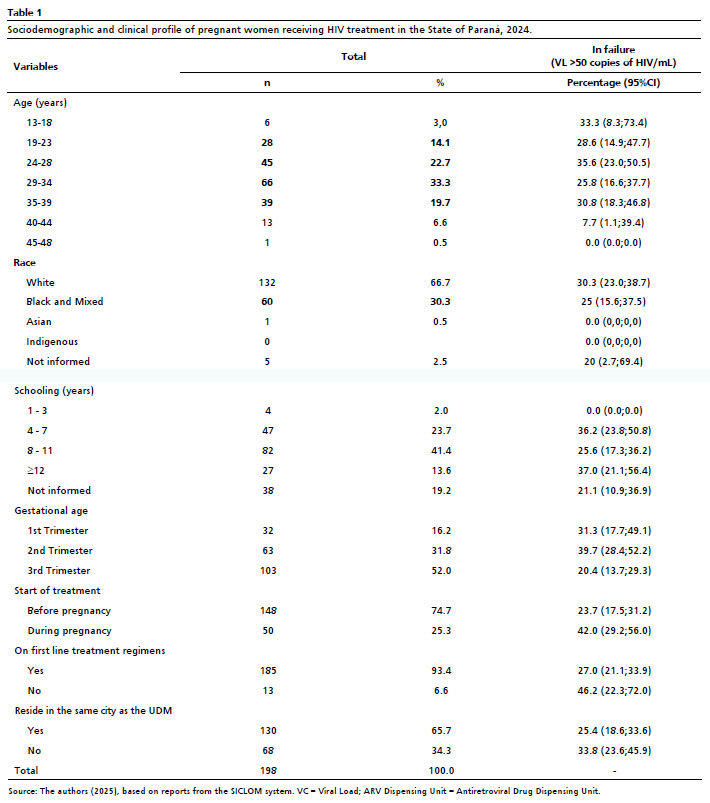
The overall study population consisted predominantly of pregnant women aged 29 to 34 years old (33.3%), white (66.7%), had 8 to 11 years of schooling (41.4%), were in the third trimester of pregnancy (52%), who had been on antiretroviral therapy since before pregnancy (74.7%), who were using first-line antiretroviral regimens (93.4%), and who accessed antiretroviral medications at UHDs located in the same municipalities where they resided (65.7%) (Table 1).
Pregnant women experiencing virologic failure were predominantly 24 to 28 years old (35.6%), white (30.3%), and had 12 or more years of schooling (37.0%), followed by 4 to 7 years (36.2%), were in their second trimester of pregnancy (39.7%), had started HIV therapy during pregnancy (42.0%), were taking medications from second and third line treatment regimens (46.2%), and obtained their medications from UDM facilities in other municipalities (33.8%) (Table 1).
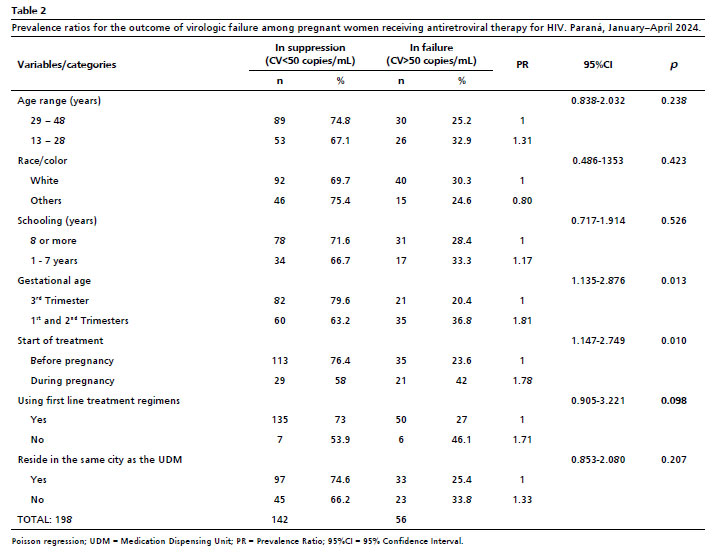
In the bivariate analysis of virological failure and sociodemographic and clinical characteristics, failure was prevalent among young pregnant women aged 13 to 28 years old (31%), white with 1 to 7 years of schooling (17%), and those in the first and second trimesters of pregnancy (81%), who began antiretroviral treatment during pregnancy (78%), who were on complex, second and third line treatment regimens (71%), and who did not reside in the same municipality as the UDM (33%). Among all variables, gestational age and late initiation of antiretroviral therapy were statistically significant in the Poisson regression (Table 2).
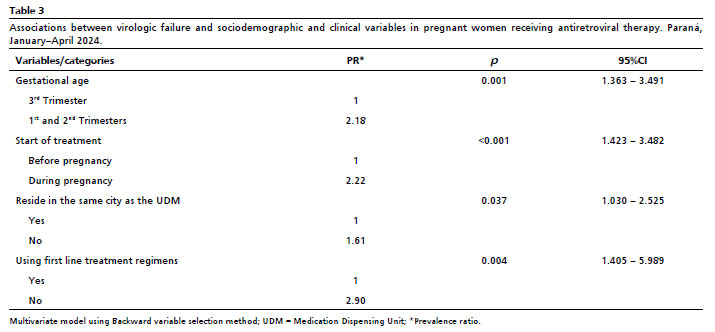
In the adjusted analysis, pregnant women with HIV in the first and second trimesters of pregnancy had a 118% higher prevalence of virologic failure compared to pregnant women in the third trimester (
p=0.001). Initiating treatment during pregnancy was associated with virologic failure, with a 122% increase in probability compared to pregnant women who started treatment before pregnancy (
p<0.001). The need to obtain antiretroviral medications in other cities was associated with virologic failure, with a 61% higher probability compared to pregnant women who obtained their medications at UDMs in the city where they resided (0.037). Pregnant women using complex antiretroviral regimens (second and third line) had a 190% higher probability of virological failure compared to those using first line treatment regimens (
p=0.004) (Table 3).
In the spatial distribution of pregnant women with virological failure across the 22 Regional Health Districts of Paraná, it was observed that the 21
st Regional Health District -
Telêmaco Borba - had the highest proportion of pregnant women with virological failure in the State (1.0), followed by the 6
th Regional Health District -
União da Vitória (0.67), and by the 13
th Regional Health District -
Cianorte and the 21
st Regional Health District -
Ivaiporã (0.5 each) (Figure 1).
DiscussionPregnant women with HIV constitute a priority population for early diagnosis and immediate treatment due to the risk of vertical transmission to their children.
1 During the study period, 198 pregnant women receiving treatment for HIV were identified, of whom 71.7% had suppressed viral loads. Although Brazil and the State of Paraná have made progress in controlling vertical transmission, the proportion observed in this study is lower than the 95% recommended by the
Programa Conjunto das Nações Unidas (United Nations Program) on HIV/AIDS for individuals on antiretroviral therapy.
10This study also identified significant associations with the outcome of failure to control HIV viral load, depending on the sociodemographic and clinical characteristics of the pregnant women, which will be discussed below.
In this study, young pregnant women (aged 13 to 28 years old) were more likely to experience virological failure. Indeed, the scientific literature confirms that young pregnant women are more prone to poor adherence to antiretroviral medications and gaps in prenatal care.
11,12,13 However, the results of this study did not confirm age as a factor significantly associated with failure.
The study population consisted mainly of white pregnant women, including in the group with virological failure. However, skin color showed no significant association with failure, contrary to the known relationship between poor adherence to antiretroviral treatment and non-white pregnant women.
12 Despite the possible influence of the demographic characteristics of the local population (64.6% white),
7,14,15 the existence of a selection bias is strongly suspected, since pregnant women who receive a diagnosis and treatment are those who face fewer barriers to accessing health services. Racial inequities in maternal health in Brazil are well established in the scientific literature and particularly affect black and indigenous pregnant women, who have lower levels of schooling, are more likely to receive inadequate prenatal care, have poorer treatment adherence, and experience higher maternal mortality rates.
13,16,17Low schooling has been related to failures in viral load control among pregnant women with HIV and to a poorer prognosis for vertical transmission.
18,19 However, there was no significant association between low schooling (1 to 7 years) and virologic failure among the pregnant women in this study.
The third trimester of pregnancy is a critical period during which pregnant women need to achieve viral suppression, as the vascular integrity of the placenta is significantly reduced and the risk of vertical transmission of HIV increases.
1,4 This study demonstrated a significant association between the first trimesters of pregnancy and virological failure, which may be related to side effects caused by antiretrovirals, the belief that they would harm the baby, and the fear of disclosing the diagnosis to others.
20 The fact that pregnant women experiencing treatment failure are concentrated in the first trimesters of pregnancy facilitates appropriate management to achieve viral suppression before delivery and prevent mother-to-child transmission.
1,18Prenatal care includes HIV diagnostic testing throughout pregnancy.
1 The coverage provided by the
Rede Mãe Curitibana, Rede Mãe Paranaense, and
Rede Cegonha (Curitiba Mother Network, the Paraná Mother Network, and the Stork Network) (which operates nationwide) significantly contributes to the identification of HIV cases during prenatal care. These programs link pregnant women to health services where they should be tested and treated until delivery.
21 This study revealed that pregnant women who began HIV treatment during pregnancy were highly likely to fail to achieve viral load suppression. The analysis confirmed a significant association between virologic failure and delayed initiation of treatment. For newly diagnosed pregnant women, genotyping is recommended, as the results are essential for selecting the best therapy of drug-resistant viruses.
1 This requires additional time before effective treatment can be initiated and therapeutic results achieved.
Recent studies have shown that the distance between the homes of the patients undergoing HIV treatment and health care services hinders treatment adherence and contributes to virologic failure.
12,22 The present study confirmed a significant association between virologic failure and the need to travel to obtain medications at UDM facilities located in other cities. This finding points to the need to invest in decentralizing access to antiretrovirals, overcoming the operational challenges of this process.
23The pregnant women in this study predominantly used first line antiretroviral regimens, which are the drugs of choice for initiating HIV treatment. These generally consist of combinations of three antiretroviral drugs that are highly effective, well-tolerated, and have a low risk of inducing viral resistance; they can remain in use for many years until viral load control fails.
1 In the event of failure of these first line treatment regimens, there are other rescue drug options (second and third line regimens), enabling control of the infection and prevention of vertical transmission of HIV.
1 Confirming this reasoning, pregnant women treated with complex regimens (second or third line) showed a significant association with virologic failure. This relationship has been frequently discussed in the literature, as second and third line treatment regimens are commonly prescribed for people with a history of viral resistance resulting from poor adherence to therapy.
1,20 The authors emphasize that caution is warranted when interpreting this result. Because this was a cross-sectional study, it was not possible to establish the dates of HIV diagnosis and the start of second or third line treatment, making this result susceptible to reverse causality bias.
The spatial distribution of the proportions of pregnant women with virological failure in the State of Paraná revealed that the 21
st (Telêmaco Borba), 6
th (União da Vitória), and 13
th (Cianorte) health regions showed the most concerning results. These health regions are among the least populous in the State of Paraná, comprising small and medium-sized municipalities with less well-structured health services that rely on external support from health care networks to ensure comprehensive care for the population.
24 This finding suggests the need for adjustments to the city health services to intensify prenatal care efforts, improve retention of pregnant women in the health system, and facilitate local access to antiretroviral medications. Furthermore, these results may reveal situations of social vulnerability characterized by educational, cultural, and income-related barriers.
18Despite the short time period covered by this study, the results obtained are considered relevant for planning interventions to address HIV among pregnant women and for preventing mother-to-child transmission. However, due to the low number of observations and outcomes in the database used, there is a possibility of instability and multicollinearity, requiring caution in interpreting the estimates. On the other hand, the EPV (events per variable) was 14, a value that exceeds the usual cutoff point for observational studies (EPV>10) and enhances the credibility of the results. The authors also acknowledge the limitations on the generalizability of the findings in this study to other Brazilian regions or States, given the differences in the organization of HIV-related services, as well as the specific characteristics of the sociodemographic profile of the population assisted.
References1. Ministério da Saúde (BR). Protocolo clínico e diretrizes terapêuticas para prevenção da transmissão vertical de HIV, sífilis e hepatites virais. Brasília (DF): Ministério da Saúde; novembro de 2020. [access in 2026 Jun 24]. Available from:
https://www.gov.br/saude/pt-br/assuntos/pcdt/p/prevencao-da-transmissao-vertical-do-hiv-sifilis-e-hepatites-virais/view2. World Health Organization (WHO). Mother-to-child transmission of HIV. Geneva: WHO; 2026. [access in 2026 Jun 24]. Available from:
https://www. who.int/teams/global-hiv-hepatitis-and-stis-programmes/hiv/prevention/ mother-to-child-transmission-of-hiv3. Perotta M, Rosa SV, Raymundo GP, Silva ROC, Werneck RI, Orsi JSR, Moysés SJ. Perfil sociodemográfico e aspectos gestacionais de mulheres com HIV/Aids de Curitiba. Rev Gaúcha de Enferm. 2023; 44: e20220202.
https://doi.org/10.1590/1983-1447.2023.20220202.pt4. Bailey H, Zash R, Rasi V, Thorne C. HIV treatment in pregnancy. Lancet HIV. 2018; 5 (8): 457-67. Doi: 10.1016/S2352-3018(18)30059-6
5. Ministério da Saúde (BR). Lei nº 9.313, 13 de novembro de 1996. Dispõe sobre a distribuição gratuita de medicamentos aos portadores de HIV e doentes de AIDS. Brasília (DF): DOU de 14 de novembro de 1996. [access in 2026 Jun 24]. Available from:
https://www.planalto.gov.br/ccivil_03/leis/l9313.htm6. Ministério da Saúde (BR). Secretaria de Vigilância em Saúde. Boletim Epidemiológico: Nº Especial 2022. Brasília (DF): Ministério da Saúde; 2022. [access in 2026 Jun 24]. Available from:
https://www.gov.br/aids/pt-br/central-de-conteudo/boletins-epidemiologicos/2022/hiv-aids/boletim_hiv_aids_-2022_internet_31-01-23.pdf/view7. Instituto Brasileiro de Geografia e Estatística (IBGE). Cidades. [
Internet]. Panorama. 2022. [access in 2026 Jun 24]. Available from:
https://cidades.ibge.gov.br/brasil/pr/panorama8. Secretaria Municipal de Saúde de Curitiba. Unidades Dispensadoras de Medicamentos Antirretrovirais - UDMs. [
Internet]. Prefeitura de Curitiba, Paraná, Brasil; 2026. [access in 2026 Jun 24]. Available from:
https://servicos.curitiba.pr.gov.br/unidades-dispensadoras-de-medicamento-antiretrovirais-udms/9779. Malta M, Cardoso LO, Bastos FI, Magnani MMF, Silva CMFPD. Iniciativa STROBE: subsídios para a comunicação de estudos observacionais. Rev Saúde Pública. 2010;44(3): 559-65.
https://doi.org/10.1590/S0034-8910201000030002110. World Health Organization (WHO). The Joint United Nations Program on HIV/Aids (UNAIDS). Global Aids Strategy 2021–2026 end inequalities. End Aids. [
Internet]. Genebra: WHO; 2021. [access in 2026 Jun 24]. Available from:
https://www.aidsdatahub.org/resource/end-inequalities-end-aids-global-aids-strategy-2021-202611. Ministério da Saúde (BR). Secretaria de Vigilância em Saúde. Boletim Epidemiológico. Nº Especial. Brasília, 2023. Brasília (DF): Ministério da Saúde; 2023. [access in 2026 Jun 24]. Available from:
https://www.gov.br/saude/pt-br/centrais-de-conteudo/publicacoes/boletins/epidemiologicos/especiais/202312. Simões LA, Silva TMR, Ferraz MMD, Veloso GA, Braga MG. Non-adherence to antiretroviral therapy in pregnant women with HIV in Brazil, 2014-2019: a spatial analysis. AIDS Care. 2025; 37 (9): 1423-33. doi: 10.1080/09540121.2025.2534540
13. Cunha AP, Mota JR, Cruz MM, Miranda R, Rosso L, Kruppa M, Santos J, Silva ASP, Faccin G, Schweitzer, Zonta R, Cota VL. Factors associated with the interruption of antiretroviral therapy among people living with HIV/AIDS in Brazilian municipalities between 2019 and 2022. Rev Bras Epidemiol. 2025; 28: e250015. doi: 10.1590/1980-549720250015
14. Paraná. Instituto Paranaense de Desenvolvimento Econômico e Social (IPARDES). Censos Demográficos. [
Internet]. Curitiba, Brasil; 2022. [access in 2026 Jun 24]. Available from:
https://www.ipardes.pr.gov.br/Pagina/Censos-Demograficos15. Dias FA, Höfelmann DA, Rattmann YD. Avaliação do sucesso virológico da terapia antirretroviral em pessoas vivendo com HIV/AIDS no estado do Paraná, Brasil. Einstein Journal. 2021; 19: eAO5800. DOI: 10.31744/einstein_journal/2021AO5800
16. Lins DOA, Silva MTA, Maia LTS. Evolução do acesso ao pré-natal em Pernambuco: a escolaridade materna como marcador das iniquidades em saúde. Rev Bras Saúde Mater Infant. 2025; 25: e20220212.
https://doi.org/10.1590/1806-930420250000021217. Ferreira RCG, Guedes SC, Moreira RS. Mortalidade materna no Brasil: análise espaço-temporal entre 2000 e 2019. Rev Bras Saúde Mater Infant. 2024; 24: e20230231.
https://doi.org/10.1590/1806-930420240000023118. Lannoy LH, Fuentes A, Santos PC, Coelho R, Miranda AE. HIV in pregnant woman and children: Mother-to-child transmission of HIV in the Brazilian border from 2010 to 2021. Int J Gynaecol Obstet. 2024 Jul; 166 (1): 90-8. doi: 10.1002/ijgo.15737
19. Trindade LNM, Nogueira LMV, Rodrigues ILA, Ferreira AMR, Corrêa GM, Andrade NCO. Infecção por HIV em gestantes e os desafios para o cuidado pré-natal. Rev Bras Enferm. 2021; 74 (Supl. 4): e20190784.
http://doi.org/10.1590/0034-7167-2019-078420. Agboeze J, Onwe OE, Onoh R, Nwali MI, Ukaegbe C, Adeoye I. Determinants of Adherence to Antiretroviral Therapy among HIV-Positive Women Accessing Prevention of Mother to Child Transmission Services in Ebonyi State, Nigeria. Ann Med Health Sci Res. 2018; 8: 248-53.
21. Burger M, Pchebilski LT, Sumikawa ES, Sakuraka EMY, Telles TMBB, Parabocz, M.
et al. O impacto do programa mãe curitibana sobre a transmissão vertical do HIV no município de Curitiba entre 2000 e 2009. DST - J Bras Doenças Sex Transm. 2011; 23 (2): 76-83. DOI: 10.5533/2177-8264-201123205
22. Melo GC, Carvalho ACA, Moreira AS, Paixão JTS. Tempo de sobrevida e distância para acesso a tratamento especializado por pessoas vivendo com HIV/Aids no estado de Alagoas, Brasil. Rev Bras Epidemiol. 2021; 24 (Supl. 1): E210019.
http://doi.org/10.1590/1980-549720210019.supl.123. Rocha M, Melo E, Agostini A, Maia AC, Maksud I. A interface entre atenção primária e especializada em cenário de descentralização de cuidados em HIV/Aids. Saúde Debate. 2022; 46 (7): 19-30.
https://doi.org/10.1590/0103-11042022E70124. Paraná. Secretaria de Estado da Saúde do Paraná. Plano Estadual de Saúde: 2024 - 2027 / SESA. 1.ed. Curitiba: SESA, 2024. 228 p. [access in 2026 Jun 24]. Available from:
https://www.saude.pr.gov.br/Pagina/Plano-Estadual-de-SaudeAuthors' contributionsLima HD: data structuring, collection, and interpretation; Dias FA: data structuring and interpretation; Cata-Preta BO: data structuring, analysis, and interpretation; Rattmann YD: study design, conduct, data structuring, and interpretation. All authors approved the final version of the article and declare that they have no conflicts of interest.
Data availabilityThe entire dataset supporting the results of this study was published in the article itself.
Received on July 31, 2025
Final version presented on July 13, 2026
Approved on July 14, 2026
Associated Editor: Melania Amorim


 ; Frederico Alves Dias2






 Ler em português
 Download PDF
 Imprimir
 Enviar este artigo por email
 Como citar este artigo
 Enviar um comentário
 Mendeley
 Pocket
 Compartilhar no Facebook
 Compartilhar no Twitter