IntroductionCesarean section (CS) entails greater risks than vaginal delivery, and its use should be restricted to situations where the benefits of surgical intervention outweigh the risks of vaginal delivery for both mother and fetus.
1 Although the optimal population-level CS rate remains debated, there is broad international consensus that rates exceeding 20% are not associated with additional improvements in maternal or perinatal outcomes and may, instead, increase adverse outcomes for women and newborns.
2In Brazil, CS rates significantly exceed ideal levels, reaching 59.6% for live births. These rates reflect indications that go beyond clinical and obstetric criteria, influenced by multiple interrelated factors: the disparity between the public and private health sectors, where rates in the latter can exceed 84%;
3,4 the prevalent fear of labor pain, often exacerbated by a chronic lack of pharmacological pain management; the convenience of elective scheduling and a "cesarean culture" that frequently perceives the surgery as a higher standard of care; the shortage of appropriate birthing environments and qualified professionals for adequate labor support; the predominance of physician-led deliveries — accounting for over 80% of births in the country — despite evidence that midwife- and obstetric nurse-led care in low-risk pregnancies is associated with reduced CS rates; and institutional barriers such as the practice of defensive medicine to avoid litigation, and the recurring cycle of "
once a cesarean, always a cesarean".
5–7While CS rates in live births are widely debated, CS rates in fetal deaths (FD) are scarcely addressed in the scientific literature. Globally, approximately 3 million FD occurred in 2021, representing 23 FD per 1,000 births, with higher concentrations in low- and middle-income countries.
8 In Brazil, FD rates have remained at approximately 10 per 1,000 births,
9 representing a significant public health challenge and underscoring the need to better understand the obstetric care practices provided to this vulnerable population. When severe fetal heart rate abnormalities are identified during labor at a viable gestational age and with available resources, emergency CS may be performed in an attempt to save the fetus, depending on the stage of labor, maternal clinical condition, and institutional capacity; intrapartum FD is confirmed retrospectively by the absence of vital signs at birth. In cases of confirmed antepartum FD, cesarean section may still be indicated when maternal complications require expedited delivery — such as severe hypertensive disorders — or when vaginal delivery is formally contraindicated, as in cases of placenta previa. However, in the absence of such conditions, vaginal delivery remains the preferred route, given its association with lower maternal morbidity, shorter recovery, and better preservation of future reproductive capacity.
10,11Care for pregnant individuals facing the diagnosis of intrauterine FD presents additional challenges, as pregnancy loss profoundly affects the family, especially the pregnant individual, who faces increased risk of pathological grief, depression, financial impact, trauma, and stigmatization.
12,13Analysis of CS rates for antepartum FD can provide important insights about the Brazilian health system and its capacity to provide adequate obstetric care for this specific group of pregnant individuals. Given this scenario and the scarcity of evidence on the topic, this study aims to describe cesarean section rates among antepartum FD in Brazil from 2014 to 2023, evaluate temporal trends, and compare these rates by sociodemographic, gestational, and place-of-care characteristics.
MethodsThis population-based ecological study with a mixed design combined time-series analysis (Analysis 1) and cross-sectional aggregate analysis (Analysis 2) of Brazilian national secondary data from 2014 to 2023. This study was reported in accordance with the Strengthening the Reporting of Observational Studies in Epidemiology (STROBE) guidelines.
Individual-level microdata from the Mortality Information System (SIM) were downloaded in April 2026 from the DATASUS file transfer platform
https://datasus.saude.gov.br/transferencia-de-arquivos/), specifically the Fetal Death files (SIM-DOFET) for each year of the study period. Data on live births at term were obtained in April 2026 from the Live Birth Information System (SINASC), accessed through TABNET/DATASUS (
https://tabnet.datasus.gov.br/cgi/tabcgi.exe?sinasc/cnv/nvuf.def).
These information systems are populated from birth and death certificates completed by healthcare professionals at delivery facilities, in accordance with national standards established by the Ministry of Health. Although underreporting may occur, all births in Brazil – whether live births or FD – must be registered by national law; completion of a death certificate is mandatory for every birth meeting at least one of the following criteria: gestational age of 22 weeks or more, birth weight of 500 g or more, or crown-heel length of 25 cm or more.
To characterize delivery facilities, data from the National Registry of Health Establishments (
Cadastro Nacional de Estabelecimentos de Saúde, CNES) were obtained via the PCDaS platform (
Plataforma de Ciência de Dados aplicada à Saúde, Fiocruz;
https://pcdas.icict.fiocruz.br/), which indexes monthly CNES competency files through an ElasticSearch infrastructure. For each FD record, the corresponding CNES competency file — matched by establishment code (CODESTAB) and month/year of death — was queried to retrieve the facility's legal nature (public, private, or philanthropic). This approach captures changes in facility classification over the study period.
Municipal Human Development Index (HDI) data for 2010 were obtained from the Atlas do Estado Brasileiro (IPEA;
https://www.ipea.gov.br/atlasestado/consulta/179). The 2010 HDI was used as a proxy for municipal socioeconomic development, as it represents the most recent census-based municipal-level estimate available for Brazil. Each FD record was linked to its municipality of maternal residence using the six-digit IBGE municipal code (CODMUNRES).
The study included all SIM-DOFET records for the period 2014–2023 in which the timing of FD was documented as either antepartum or intrapartum; records with missing timing or classified as postpartum were excluded. This constitutes a near-complete census of registered FDs in Brazil with known timing of death, and no sample size calculation was required. The proportion of antepartum versus intrapartum deaths within this eligible group is reported descriptively.
All subsequent analyses were restricted to antepartum FDs, as this subgroup more reliably reflects obstetric decisions regarding mode of delivery made prior to labor onset, minimizing the influence of intrapartum events on cesarean indication. Records without information on mode of delivery were excluded from all analyses.
For Analysis 1, antepartum FDs were stratified into four gestational age categories: 22–27, 28–31, 32–36, and ≥37 weeks.
For Analysis 2, only antepartum FDs at term (≥37 weeks of gestation, including post-term ≥42 weeks) were selected. This restriction minimizes confounding from clinical indications for cesarean section specific to preterm deliveries that cannot be controlled for using secondary administrative data. FDs occurring outside a hospital setting were excluded from analyses involving facility characteristics. Records with missing covariate values were excluded from the multivariate model; the extent of missingness for each variable is reported in Table 1.
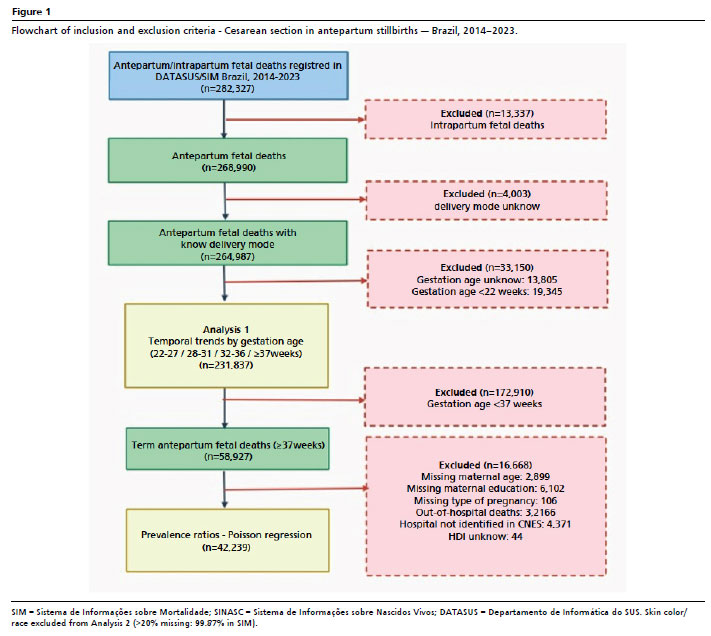
The number of records excluded at each step is presented in a flow diagram to allow assessment of potential selection bias.
The main outcome was the cesarean section rate, defined as (number of cesarean sections / total deliveries) × 100.
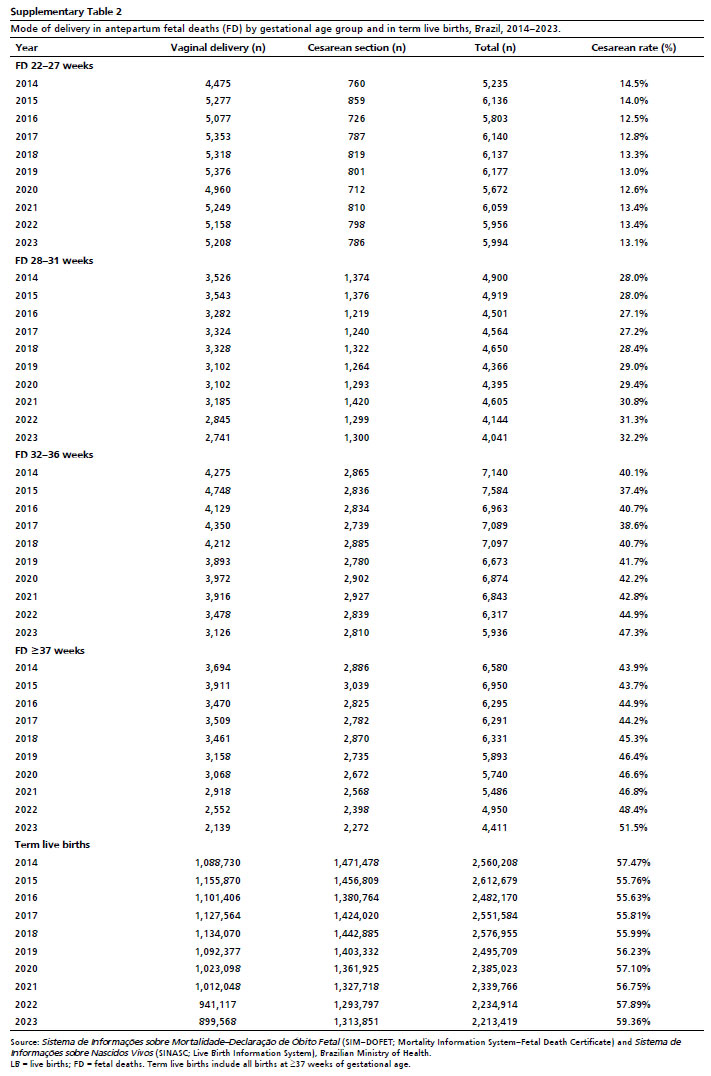
In Analysis 1, the variables of interest were calendar year (2014–2023, treated as continuous in regression models and as categorical for descriptive presentation) and gestational age group (22–27, 28–31, 32–36, and ≥37 weeks). Cesarean section rates were computed separately for each combination of year and gestational age group in antepartum FDs, and also for term live births (≥37 weeks) by year for comparison.
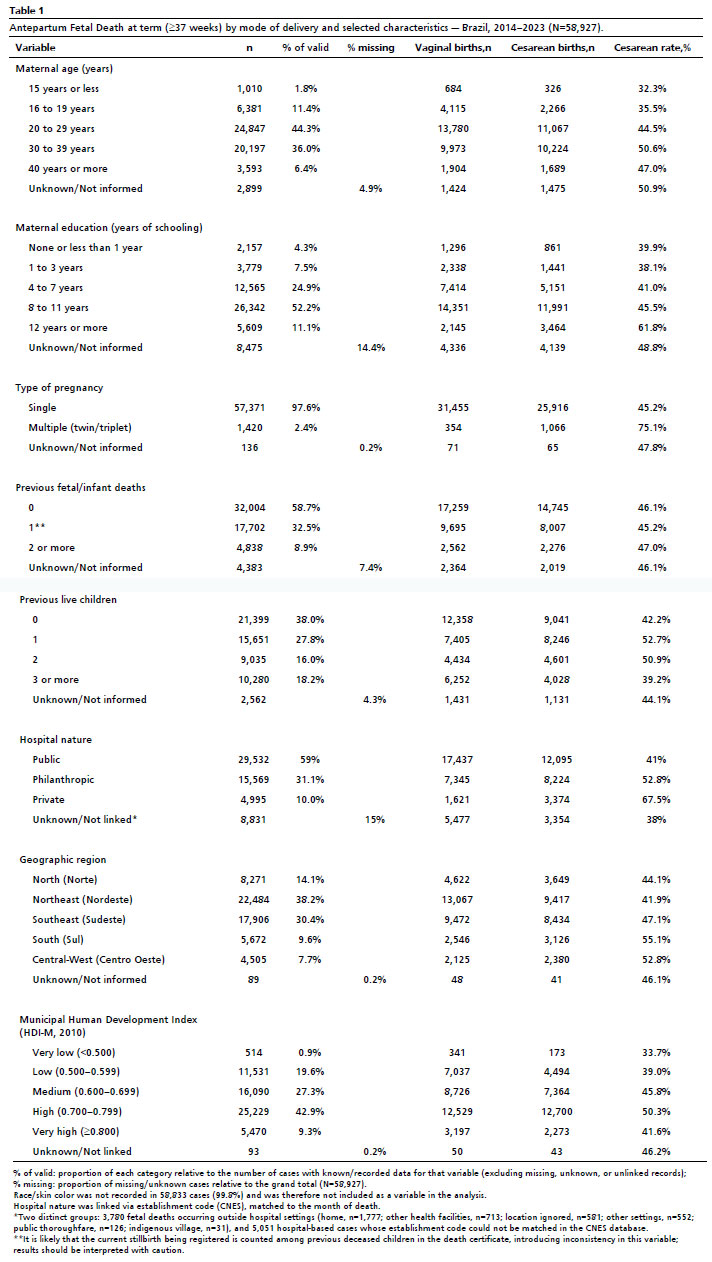
For Analysis 2, the following variables were included in both the crude and adjusted analyses: maternal age (under 20, 20–29 [reference], 30–39, and ≥40 years); maternal education (≤7 years, 8–11 years [reference], and ≥12 years of schooling); type of pregnancy (singleton [reference] or multiple gestation); delivery facility type by legal nature (public [reference], philanthropic, or private); geographic region (North, Northeast [reference], Southeast, South, and Central-West); and Municipal HDI (low/very low <0.600 [reference], medium 0.600–0.699, and high/very high ≥0.700). Race/skin color was not included due to missingness in 99.8% of records. The distribution of the variables in the study population is presented in Table 1, which also includes additional categories for a comprehensive visualization of the dataset's composition.
Two variables were excluded from both crude and adjusted analyses for substantive reasons: number of previous live births, because this variable conflates prior vaginal deliveries with prior cesarean sections — groups with fundamentally different probabilities of repeat cesarean; and number of previous fetal/infant deaths, because the current FD is likely counted among previous deaths in a substantial proportion of records, introducing systematic measurement error.
To minimize confounding from clinical indications for preterm cesarean delivery, Analysis 2 was restricted to term gestations (≥ 37 weeks). Analysis 2 was further restricted to antepartum deaths to reduce the influence of intrapartum events — which may themselves precipitate both the FD and the indication for cesarean section — on the estimated associations. Linkage between SIM and CNES records was based on establishment codes, which may be missing or inconsistently recorded in a minority of cases; this could introduce non-differential misclassification of facility type, likely attenuating the estimated associations. The ecological design precludes individual-level causal inference and prevents adjustment for unobserved clinical indications for cesarean section (ecological fallacy).
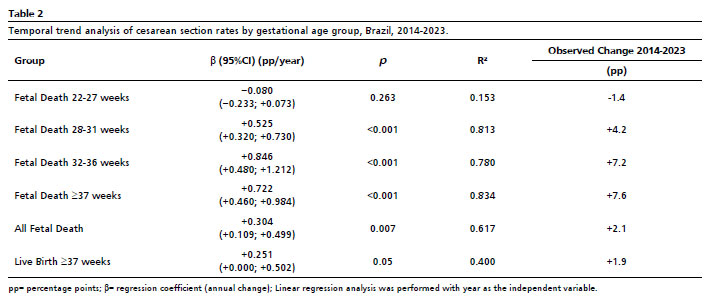
In Analysis 1, cesarean section rates were described year by year for each gestational age category in antepartum FDs, and for term live births. Simple linear regression was used to evaluate temporal trends, with the calendar year treated as a continuous variable (Cesarean rate = β0 + β1 × Year + ε). The coefficient β1 represents the annual percentage-point change in the cesarean rate; R² indicates the proportion of variance explained by the model; and statistical significance was assessed using an ANOVA F-test (α = 0.05). Trends were classified as increasing (β1 > 0,
p < 0.05), decreasing (β1 < 0,
p < 0.05), or stable (
p ≥ 0.05). Results are presented in Table 2.
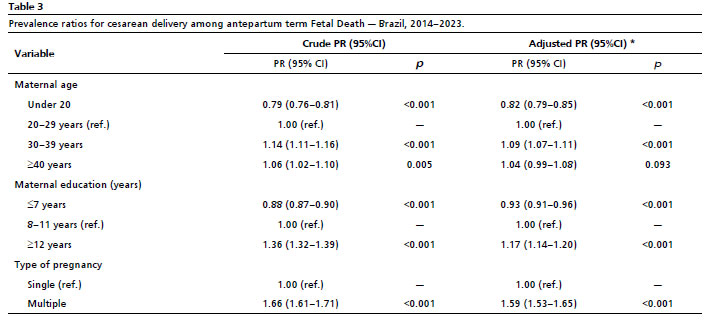
In Analysis 2, data on antepartum term FDs were pooled across the entire study period (2014–2023). Crude and adjusted prevalence ratios (PRs and aPRs) with 95% confidence intervals were estimated using Poisson regression with a log-link function and robust variance estimation (HC3). All variables were entered simultaneously into the multivariate model. Collinearity was assessed using the Variance Inflation Factor (VIF), with values below 5 considered acceptable. Statistical significance was set at
α = 0.05. Results are presented in Table 3.
Missing data were handled by complete-case analysis. The proportion of missing values for each variable is reported in Table 1. Variables with more than 20% missing data were excluded from the multivariate model to minimize information bias.
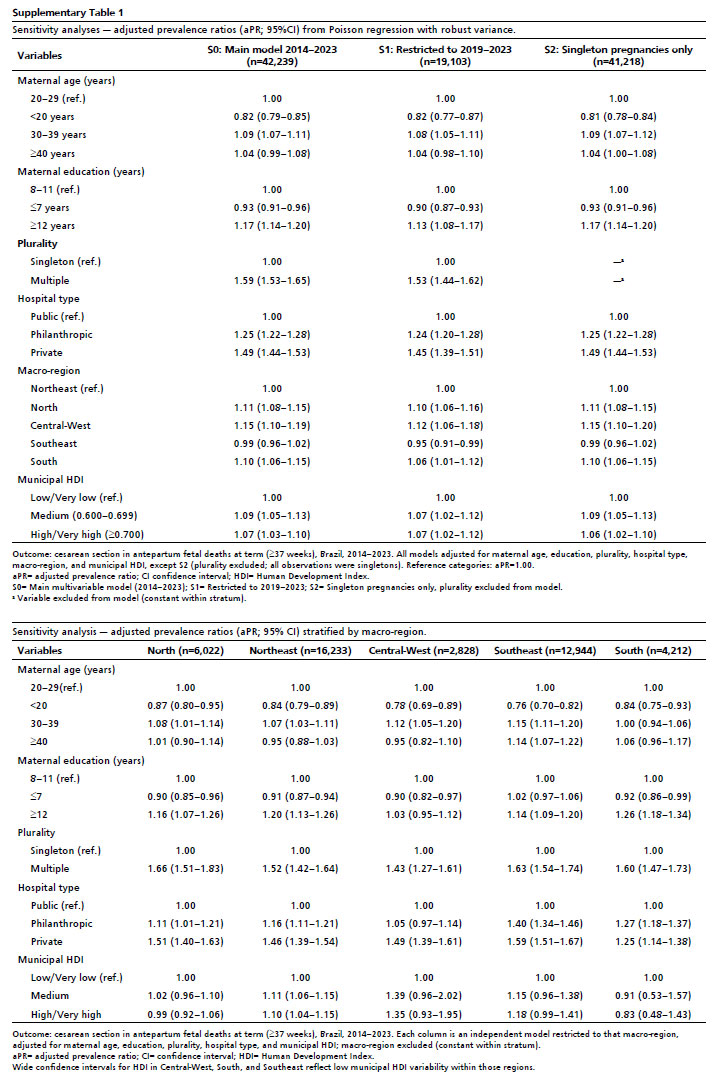
Sensitivity analyses were performed using the same Poisson regression approach: (1) restricted to the 2019–2023 period; (2) restricted to singleton pregnancies; and (3) stratified by macro-region.
All statistical analyses were conducted in R version 4.x (R Core Team, Vienna, Austria), using the following packages: read.dbc, dplyr, tidyr, ggplot2, sandwich, lmtest, and car. As this study uses publicly available, anonymized secondary data without individual identification, approval from a Research Ethics Committee was not required in accordance with Brazilian National Health Council Resolution 510/2016.
Results
Between 2014 and 2023, 282,327 FDs were registered in Brazil, of which 95.3% were diagnosed before delivery. This corresponds to a fetal mortality rate of 10.5 per 1,000 births and 9.49 per 1,000 births when considering only antepartum deaths. The flowchart of the analyzed cases is presented in Figure 1.
No statistically significant temporal trend in fetal mortality rate was observed over the study period. The cesarean section rate in antepartum FDs ranged from 31.3% (in 2017) to 35.2% (in 2023). There was a significant increase in the cesarean section rate during the period (β = +0.3 pp/year;
p = 0.007) (Table 2).
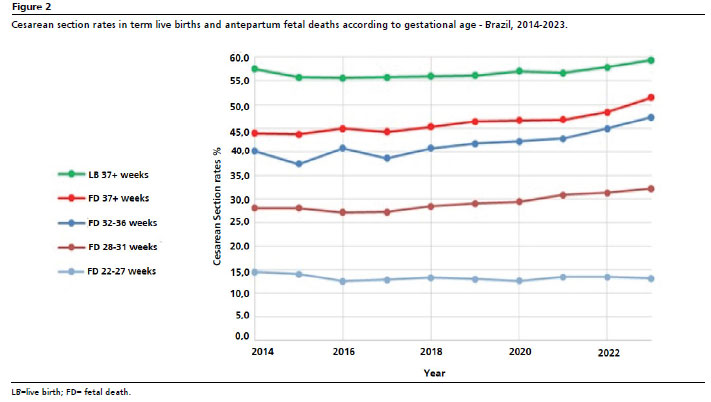
When stratified by gestational age, cesarean section rates varied considerably throughout the study period (Figure 2). In pregnancies of 22 to 27 weeks, the lowest mean cesarean rate was observed (13.3%), with a minimum value of 12.5% in 2016 and a maximum of 14.5% in 2014. In pregnancies of 28 to 31 weeks, the mean rate was 29.1%, ranging from 27.1% in 2016 to 32.2% in 2023. In pregnancies at 32 to 36 weeks, the mean rate was 41.6%, ranging from 37.4% in 2015 to 47.3% in 2023. Term pregnancies (≥37 weeks) presented the highest mean cesarean rate in FDs (46.2%), ranging from 43.7% in 2015 to 51.5% in 2023 (Supplementary Table 1).
The temporal trend of cesarean section in FDs varied according to gestational age group (Figure 2, Table 2). Pregnancies at 22–27 weeks showed a slight, non-significant reduction over the period (β = −0.080 pp/year;
p = 0.263), whereas all other gestational age categories showed significant increases (
p < 0.001). The greatest increments were observed in the two most advanced gestational age groups (32–36 weeks and ≥37 weeks), with models explaining 78%–83% of the temporal variability (R² = 0.780 and 0.834), compared with only 15.3% in pregnancies at 22–27 weeks.
Table 1 presents the distribution of antepartum FD at term according to mode of delivery and selected maternal and institutional characteristics. The completeness of data varied across variables. Race/skin color was unavailable for 99.8% of cases and was therefore excluded from the analysis. Maternal education and hospital nature presented the highest proportions of missing data among the remaining variables (14.4% and 13.9%, respectively), which should be considered when interpreting findings for these variables.
Among the characteristics with complete or near-complete data, cesarean section rates varied markedly. Regarding maternal age, rates increased progressively from 32.3% in adolescents aged 15 years or younger to 50.6% in women aged 30–39 years. A similar gradient was observed for maternal education, with cesarean rates ranging from 38.1% among women with 1–3 years of schooling to 61.8% among those with 12 or more years. Multiple pregnancies were associated with a substantially higher cesarean rate (75.1%) compared to singleton gestations (45.2%). Women with one previous live child had the highest cesarean rate among parity categories (52.7%), whereas those with three or more children had the lowest (39.2%), though this variable does not distinguish between prior vaginal deliveries and cesarean sections.
The variable recording previous fetal or infant deaths showed little variation in cesarean rates across categories; however, the finding that over 40% of cases had at least one previous fetal or infant death recorded suggests a systematic data entry error, likely reflecting the current FD being registered as a prior death, which compromises the reliability of this variable. Regarding hospital nature, cesarean rates increased from 41.0% in public facilities to 67.5% in private hospitals. Marked regional variation was also observed, with the lowest rates in the Northeast (41.9%) and the highest in the South (55.1%) and Central-West (52.8%) regions.
Municipal HDI showed a direct association with cesarean rates, which were higher in municipalities with high and very high HDI compared to those with low or medium HDI; the highest rate was observed in the high HDI category (50.3%), with a slight attenuation in the very high HDI group (41.6%), though still above low and medium HDI levels.
After simultaneous adjustment for all variables, several factors remained independently associated with cesarean delivery in antepartum term FD (Table 3). Younger maternal age, lower education, and delivery in public hospitals were associated with lower probability of cesarean, while older age, higher education, and multiple pregnancy were associated with higher probability. Hospital type showed the strongest association: compared to public hospitals, the probability of cesarean delivery was 25% higher in philanthropic facilities and 47% higher in private hospitals. Among geographic regions, the Southeast did not differ significantly from the Northeast after adjustment, while all other regions showed modestly higher probabilities. Higher municipal HDI was associated with a greater probability of cesarean delivery, though the magnitude was attenuated after adjustment.
Sensitivity analyses yielded consistent results. Restriction to 2019–2023 (n=19,103) and to singleton pregnancies (n=41,218) produced results virtually identical to the main model regarding adjusted PRs for maternal age and education. Regional stratification confirmed that the direction of all associations was preserved across the five macro-regions, with some variation in magnitude (Supplementary Table 2).
The multivariate model included 42,239 of the 58,927 cases in the full dataset. Losses resulted from missing data in key variables – particularly maternal education (14.4%) and hospital type (13.9%) – as well as from the deliberate exclusion of out-of-hospital deliveries, which, by definition, would not include cesarean sections and would therefore introduce systematic bias if retained.
DiscussionMode of delivery in antepartum FD remains one of the most underexplored dimensions of obstetric care quality worldwide. While FD epidemiology has received growing attention – particularly regarding rates, causes, and disparities – the clinical management of delivery in these cases and its variation across health systems have been largely overlooked in the scientific literature. Information on mode of delivery following intrauterine FD is rarely captured in national demographic surveillance systems, limiting the ability to evaluate practices that directly affect maternal safety and the bereavement experience.
11,14 This gap extends to clinical guidance: the American College of Obstetricians and Gynecologists acknowledges that there are limited data to guide clinical practice in managing stillbirth,
15 underscoring that the invisibility of this population in surveillance systems translates directly into uncertainty at the bedside. This study provides a ten-year characterization of cesarean section rates in antepartum FDs in Brazil, using individual-level microdata linked to facility registry data, and its findings suggest that the forces shaping obstetric decision-making in Brazil extend well beyond clinical indication.
Our study identified cesarean rates above 32.5% across all years evaluated, with a significant upward trend over the period. These rates are superior to those described in the United States (16% to 18.9%),
10,16 Ghana (19.3%),
14 other sub-Saharan African countries (Benin, Malawi, Uganda, and United Republic of Tanzania) (19%)
17; they are more comparable to the CS rates reported for FD at 28 weeks or more in Latin America (27.3%).
18 These comparisons should be interpreted with caution: the studies differ in their definitions of stillbirth and FD – particularly regarding gestational age thresholds and the inclusion or exclusion of intrapartum deaths – and several do not distinguish antepartum from intrapartum cases, as the present study does. Nevertheless, even accounting for these methodological differences, Brazil's figures are more closely aligned with those of lower-income settings than with countries at a similar level of economic development, suggesting that system-level factors – rather than clinical case mix alone – drive the observed rates.
The increasing temporal trend in cesarean delivery observed in this study in FD mirrors the well-documented global rise in cesarean rates in live births,
19,20 and parallels trends previously reported in FDs in the United States and Ghana.
14,16 In Brazil, the overall cesarean rate in antepartum FDs increased significantly over the decade (β = +0.304 pp/year;
p=0.007), with the most pronounced increments observed in pregnancies of 32–36 weeks and at term (≥37 weeks). The pattern varied notably by gestational age: while all groups at 28 weeks or more showed significant increases, pregnancies at 22–27 weeks exhibited a slight, non-significant decrease over the period — a distinct trajectory that may reflect the lower feasibility and higher maternal risk of cesarean delivery at periviable gestational ages, as well as greater clinical consensus around vaginal delivery in this group. The cesarean rate in this earliest group (~13%) remains lower than the 16.2% reported for antepartum FD in the United States in 2014,
16 though its stability over time is a relatively favorable finding within an otherwise uniformly increasing picture. The rate was highest among term pregnancies, consistent with the higher prevalence of maternal conditions that may justify surgical delivery at advanced gestational ages – such as severe hypertensive disorders and placental abruption — but also with the greater exposure of term pregnancies to the institutional and cultural pressures that drive cesarean rates in live births.
5,6CS rates in antepartum FD varied systematically according to maternal and socioeconomic characteristics, following gradients strikingly similar to those documented for live births in Brazil.
4,20–23 Maternal age showed a progressive increase in cesarean rates from 32.3% in adolescents aged 15 years or younger to 50.6% in women aged 30–39 years, consistent with patterns observed in live births,
4,21,23 A similar gradient was observed for maternal education: women with 12 or more years of schooling had a cesarean rate of 61.8% – nearly double that of women with fewer than four years of schooling. After multivariate adjustment, this association was attenuated but remained statistically significant (aPR=1.17), suggesting that part of the effect is explained by correlated factors such as age and access to private health care, but that maternal education captures additional dimensions that are not fully accounted for by the model.
20,23,24 Multiple pregnancy was associated with a substantially higher cesarean rate (75.1%; aPR=1.59), slightly lower than the 82% reported for live births in Brazil,
23 though direct comparison is limited as the vital status of the co-fetus at delivery cannot be ascertained.
Race and skin color could not be evaluated, as this information was recorded as unknown in 99.8% of cases in the SIM-DOFet database. This figure is not a technical limitation in the conventional sense — it is a finding in its own right. The near-total absence of race data in the FD certificate represents a structural gap in Brazil's vital statistics system that disproportionately affects a population already rendered invisible by perinatal loss. Racial inequalities in access to obstetric care are well documented in Brazil,
3,4,21 and their assessment in the context of FD is precisely where they would be most informative and most absent.
Hospital ownership is one of the strongest predictors of cesarean rates in live births in Brazil, with rates in the private sector exceeding 84% of deliveries.
3,4,19,20 In our analysis, hospital ownership was the strongest independent predictor of CS delivery in antepartum FD after multivariate adjustment, with rates of 41% in public facilities rising to 52.8% in philanthropic hospitals and 67.5% in private hospitals (aPR=1.25 and 1.47, respectively). The magnitude of the private-sector effect on cesarean rates in a context where fetal well-being is no longer a clinical consideration underscores the degree to which institutional and financial dynamics shape mode-of-delivery decisions independently of obstetric indication. Geographic region showed significant crude variation, with the lowest rates in the Northeast (41.9%) and the highest in the South (55.1%) and Central-West (52.8%); however, after adjustment, regional differences were substantially attenuated and the Southeast lost statistical significance entirely – reflecting the unequal geographic distribution of private hospitals, maternal education levels, and municipal HDI across Brazil, rather than independent regional effects. Municipal HDI showed a direct association with cesarean delivery, with higher rates in municipalities with higher development indices – a pattern mirroring the well-documented socioeconomic gradient in live births,
23 and substantially attenuated after adjustment for hospital type and region, reflecting the geographic concentration of private facilities in wealthier municipalities.
Beyond the rates themselves, this study exposes a structural limitation of Brazil's FD surveillance system that deserves recognition as a substantive finding, not merely a methodological caveat. The FD certificate (
Declaração de Óbito Fetal, DO-Fetal) lacks several variables that are routinely collected in the live birth certificate (
Declaração de Nascido Vivo, DN) and that are essential for understanding mode-of-delivery decisions: prior cesarean delivery, fetal presentation, labor induction, planned versus emergency cesarean, and clinical indication for the procedure. The WHO-endorsed Robson classification,
19,23 could not be applied to this dataset precisely because the DO-Fetal does not capture the variables it requires – most critically, the distinction between prior vaginal deliveries and prior cesarean sections, which is central to the system and which, in the DO-Fetal, cannot be reconstructed from the available fields. This distinction is central to the Robson system: a history of cesarean delivery (Robson Group 5) increases the likelihood of repeat cesarean even in the setting of FD, whereas a history of vaginal delivery (Group 3) is expected to reduce it.
19,23 This structural poverty of the instrument is compounded by the quality problems encountered in practice: extensive missingness and inconsistencies in key fields – most strikingly, the 99.8% absence of race/skin color data – that further narrow the analytical possibilities available to researchers working with these records. The two problems reinforce each other: an instrument that was already poor in obstetric content is further undermined by incomplete and unreliable data collection in the field, resulting in a dataset that renders bereaved women statistically invisible within Brazil's own vital statistics infrastructure, as happens in other countries.
11,12 The absence of detailed obstetric information in fetal death surveillance systems can also be interpreted as part of the historically peripheral position of stillbirth within maternal and perinatal health agendas, despite its substantial epidemiological and psychosocial burden.
We recommend that the Brazilian Ministry of Health consider revising the DO-Fetal instrument to include the obstetric variables already present in the DN. This change would be technically feasible, would impose no additional burden on health professionals beyond what is already required for live births, and would substantially expand the capacity of Brazil's FD surveillance system to evaluate and improve obstetric care for one of its most vulnerable populations.
Beyond surveillance and research, these findings have immediate implications for clinical practice. The systemic, socioeconomic, cultural, and institutional barriers to vaginal birth that are well-documented in Brazil,
3,5,6,19,20 do not disappear when the fetus dies. The same hospitals, teams, and institutional dynamics remain in place – and so does the broader cultural and financial context that sustains them. The hospital ownership model, the higher exposure of women in private settings to cesarean delivery, and the institutional incentives of the private sector continue to shape obstetric decision-making even in the absence of a live birth.
In antepartum FD, the clinical rationale for cesarean section is substantially narrowed: fetal well-being – one of the most common justifications for surgical delivery – is no longer a factor, and vaginal delivery carries the lowest maternal risk and better preserves future reproductive capacity. In this context, the maternal consequences of unnecessary cesarean delivery acquire particular ethical relevance, since the short- and long-term reproductive risks of surgery are incurred without the possibility of fetal benefit. Cesarean section should therefore be reserved for cases with formal maternal or obstetric indications.
10,15,25 Beyond individual clinical decisions, persistently high cesarean rates in antepartum FD may also reflect broader structural changes in obstetric practice, including possible reductions in professional familiarity with complex labor management, limited availability of continuous labor support, and growing reliance on surgical delivery as the dominant mode of birth – trends that may gradually erode institutional capacity to support vaginal delivery even when it is the preferred option.
In addition to these structural determinants, the context of FD introduces specific layers that may further contribute to surgical delivery: difficulties in communicating with bereaved families; uncertainty and moral distress among care teams regarding the most appropriate mode of delivery, including the misperception – however compassionate in intent – that vaginal delivery may be cruel or inappropriate for a grieving patient; and the discomfort or sense of perceived therapeutic failure experienced by healthcare professionals when supporting bereaved families through labor.
26–28Addressing these barriers requires institutional and interpersonal responses. Care teams should be equipped with communication skills to discuss mode-of-delivery options clearly and compassionately – providing honest information about risks and benefits, eliciting preferences, and supporting autonomy without abandoning clinical guidance.
12,13,27,28 In the emotionally charged context of FD, where families may be particularly vulnerable to deference, ensuring that shared decision-making is genuine rather than nominal becomes even more critical. Institutional protocols for the management of antepartum FD – including access to continuous labor support, effective pharmacological analgesia, psychological and bereavement counseling, and multidisciplinary team coordination – are essential to creating conditions in which vaginal delivery is not only clinically indicated but genuinely accessible; when adequately supported, it may also play a meaningful role in grief processing and mental health outcomes for bereaved families.
28,29Families bereaved by pregnancy loss frequently report feeling deprioritized in obstetric care compared to those with live births
27 – and this neglect appears to be mirrored in the scientific literature. Little is known about the preferences of women and families regarding mode of delivery in this context, the extent to which those preferences are elicited and respected, the attitudes and barriers that shape care team decisions, or the consequences of delivery route for grief and bereavement outcomes. A future research agenda centered on the perspectives and autonomy of women and families facing antepartum FD is urgently needed. The indicator proposed here – cesarean section rate in antepartum FDs – could be integrated into existing frameworks for monitoring obstetric care quality in Brazil, alongside established measures such as Robson group-specific cesarean rates and severe maternal morbidity indicators. Ensuring access to evidence-based and respectful care after fetal death should also be understood as part of the broader framework of reproductive rights and obstetric justice.
This study has several limitations inherent to the use of secondary administrative data, including underreporting and incomplete recording. The exclusion of intrapartum FDs and out-of-hospital deliveries limits generalizability to institutional antepartum FDs. Missing data limited the multivariate analysis to 71.7% of term cases, introducing potential selection bias if missingness is non-random; furthermore, it made it impossible to use race/ethnicity, as discussed above. The DO-Fetal lacks key obstetric variables – including prior cesarean delivery, fetal presentation, labor induction, and clinical indication for cesarean. The ecological design precludes individual-level causal inference.
Several methodological strengths distinguish this study from prior work in the field. The use of individual-level microdata from Brazil's national mortality information system – covering a ten-year period and linked to facility registry data from CNES – allowed adjustment for hospital type by ownership, a variable that is rarely available in studies of this kind and that proved to be the strongest independent predictor of CS in the multivariate model.
The restriction of multivariate analyses to antepartum term FDs minimized confounding from gestational-age-specific clinical indications. Sensitivity analyses across time periods, pregnancy types, and macro-regions confirmed the robustness of the main findings. Beyond its specific results, this study makes a broader contribution: it proposes CS rate in antepartum FDs as an indicator of obstetric care quality that is both measurable with existing data systems and clinically meaningful – one that reflects the capacity of health institutions to support vaginal delivery even when the most common justification for surgical intervention, fetal well-being, is no longer present. Incorporating this indicator into national monitoring frameworks, alongside efforts to expand the analytical content of the DO-Fetal instrument, would strengthen Brazil's ability to evaluate and improve care for one of the most vulnerable and underserved groups in obstetric practice.
Artificial intelligence useIn accordance with current recommendations for transparency in scholarly publishing, the authors declare that a generative artificial intelligence tool – Claude (Anthropic, San Francisco, CA, USA) – was used during the preparation of this manuscript as an editorial and technical assistance tool. Its use was restricted to the following purposes: correction of spelling, grammar, and syntax errors; improvement of fluency and clarity of academic English prose; support in the selection and application of statistical methods, including the choice of regression models, correlation coefficients, and criteria for variable inclusion – all of which were executed exclusively by the authors using validated statistical software (R version 4.x R Core Team, Vienna, Austria), utilizing the packages read.dbc, dplyr, tidyr, ggplot2, sandwich, lmtest, and car; cross-checking of reported statistical values (β coefficients,
p-values, R², adjusted prevalence ratios, 95% confidence intervals, and percentage-point changes) for internal consistency with the results tables and text; verification of item-by-item compliance with the STROBE (Strengthening the Reporting of Observational Studies in Epidemiology) checklist and preparation of the associated supplementary material; and review of manuscript structure and reference list formatting for consistency with journal guidelines.
The AI tool was not involved in any of the following: study design or conceptualization; data collection, extraction, or management; execution of statistical analyses; literature search or selection of references; formulation of scientific conclusions; or any component of the intellectual content of the manuscript.
All intellectual content, scientific analyses, interpretation of findings, and conclusions presented in this manuscript are entirely the work of the human authors and remain their sole responsibility. The final version of the manuscript was reviewed and approved by all authors prior to submission. Consistent with current guidance from the International Committee of Medical Journal Editors (ICMJE) and the Committee on Publication Ethics (COPE), the AI tool is not listed as an author, as authorship requires accountability that cannot be attributed to a software tool.
References1. Sandall J, Tribe RM, Avery L, Mola G, Visser GH, Homer CS,
et al. Short-term and long-term effects of caesarean section on the health of women and children. Lancet. 2018; 392 (10155): 1349-57. doi:10.1016/S0140-6736(18)31930-5
2. Ayres-de-Campos D, Simon A, Modi N, Tudose M, Saliba E, Wielgos M,
et al. European Association of Perinatal Medicine, European Midwives Association Joint position statement: Caesarean delivery rates at a country level should be in the 15-20 % range. Eur J Obstet Gynecol Reprod Biol. 2024; 294: 76-8. doi:10.1016/j.ejogrb.2024.01.005
3. Dias BAS, Leal MC, Esteves-Pereira AP, Nakamura-Pereira M. Variations in cesarean and repeated cesarean section rates in Brazil according to gestational age at birth and type of hospital. Cad Saúde Pública. 2022; 38: e00073621. Doi:
https://doi.org/10.1590/0102-311XEN0736214. Martinelli KG, Gama SGN, Almeida AHV, Nakamura-Pereira M, Santos ET. Prelabor cesarean section: the role of advanced maternal age and associated factors. Rev Saúde Pública. 2020; 55: 9. doi:10.11606/s1518-8787.2021055002530
5. Braga A, Sun SY, Zaconeta ACM, Junior AT, Luz AG, Osanan G,
et al. Increase in cesarean sections in Brazil – a call to reflection. Rev Bras Ginecol Obstet. 2023; 45 (03): 109-12. doi:10.1055/s-0043-1768454
6. Ojong SA, Temmerman M, Nsahlai CJF, Gidion D, Kihara A. Why do cesarean delivery rates persistently rise despite evidence-based efforts to reduce them? Am J Obstet Gynecol. 2026; 233 (6 Suppl): S569–80. Doi:10.1016/j.ajog.2025.08.014
7. Sandall J, Soltani H, Gates S, Shennan A, Devane D. Midwife-led continuity models versus other models of care for childbearing women. Cochrane Database Syst Rev. 2016; 4 (4): CD004667. Doi:10.1002/14651858.CD004667.pub5
8. GBD 2021 Global Stillbirths Collaborators. Global, regional, and national stillbirths at 20 weeks' gestation or longer in 204 countries and territories, 1990–2021: findings from the Global Burden of Disease Study 2021. Lancet. 2024; 404 (10466): 1955–88. doi:10.1016/S0140-6736(24)01925-1
9. Rent S, Rocha T, Silva L, Souza JVP, Guinsburg R, Filho AC,
et al. The Impact of Time, Region, and Income Level on Stillbirth and Neonatal Mortality in Brazil, 2000-2019. J Pediatr. 2023; 262: 113613. doi:10.1016/j.jpeds.2023.113613
10. Boyle A, Preslar JP, Hogue CJR, Silver RM, Reddy UM, Goldenberg RL,
et al. Route of Delivery in Women With Stillbirth: Results From the Stillbirth Collaborative Research Network. Obstet Gynecol. 2017; 129 (4): 693–8. Doi:10.1097/AOG.0000000000001935
11. Zethof S, Christou A, Benova L, van Roosmalen J, van den Akker T. "Too much, too late": data on stillbirths to improve interpretation of caesarean section rates. Bull World Health Organ. 2022; 100 (4): 289–91. doi:10.2471/BLT.21.287539
12. Heazell AEP, Siassakos D, Blencowe H, Burden C, Bhutta ZA, Cacciatore J,
et al. Stillbirths: economic and psychosocial consequences. Lancet. 2016; 387 (10018): 604–16. doi:10.1016/S0140-6736(15)00836-3
13. Arach AAO, Kiguli J, Nankabirwa V, Nakasujja N, Mukunya D, Musaba MW,
et al. "Your heart keeps bleeding": lived experiences of parents with a perinatal death in Northern Uganda. BMC Pregnancy and Childbirth. 2022; 22 (1):491. doi:10.1186/s12884-022-04788-8
14. Zethof S, Christou A, Benova L, Beyuo TK, van Roosmalen J, van den Akker T. Out of sight, out of mind? Evidence from cross-sectional surveys on hidden caesarean sections among women with stillbirths in Ghana, 2007 and 2017. BMJ Glob Health. 2023; 8 (6): e011591. doi:10.1136/bmjgh-2022-011591
15. American College of Obstetricians and Gynecologists, Society for Maternal-Fetal Medicine in collaboration with, Metz TD, Berry RS, Fretts RC, Reddy UM,
et al. Obstetric Care Consensus #10: Management of Stillbirth: (Replaces Practice Bulletin Number 102, March 2009). Am J Obstet Gynecol. 2020 Mar; 222 (3): B2–20. doi:10.1016/j.ajog.2020.01.017
16. Rossi RM, Hall ES, DeFranco EA. Mode of delivery in antepartum stillbirths. Am J Obstet Gynecol MFM. 2019; 1 (2): 156-64.e2. doi:10.1016/j.ajogmf.2019.03.008
17. Alsina M del R, Benova L, Kandeya B, Abeid M, Agossou C, Orsini N,
et al. Caesarean section for stillborn babies, Benin, Malawi, Uganda and United Republic of Tanzania. Bull World Health Organ. 2025; 103 (9): 550–62. doi:10.2471/BLT.24.292424
18. Mucio B, Sosa C, Colomar M, Mainero L, Cruz CM, Chévez LM,
et al. The burden of stillbirths in low resource settings in Latin America: Evidence from a network using an electronic surveillance system. PloS One. 2023; 18 (12): e0296002. doi:10.1371/abori.pone.0296002
19. Pires RCR, Leal MC, Silva AAM. Recent temporal trends in cesarean section rates in Brazil according to the Robson classification system. Cad Saúde Pública. 2025; 41 (8): e00154024. doi: 10.1590/0102-311XEN154024
20. Boerma T, Ronsmans C, Melesse DY, Barros AJD, Barros FC, Juan L,
et al. Global epidemiology of use of and disparities in caesarean sections. Lancet. 2018; 392 (10155): 1341–8. doi: 10.1016/S0140-6736(18)31928-7
21. Gama SGN, Schilithz AOC, Leal MC, Carmo TT, Theme-Filha MM, Barros DC,
et al. Maternal and perinatal outcomes in adolescents and women with advanced maternal age. Rev Saúde Pública. 59 (Suppl. 1): e9s. doi:10.11606/s1518-8787.2025059006538
22. Faruk MO, Arafat ME, Shanta SH. Socioeconomic, demographic, and cultural determinants of delivery by caesarian section in Ethiopia: Evidence from Ethiopia Mini Demographic and Health Survey 2019. PloS One. 2023; 18 (7): e0288022. doi:10.1371/journal.pone.0288022
23. Paixao ES, Bottomley C, Smeeth L, da Costa MCN, Teixeira MG, Ichihara MY,
et al. Using the Robson classification to assess caesarean section rates in Brazil: an observational study of more than 24 million births from 2011 to 2017. BMC Pregnancy Childbirth. 2021; 21: 589. doi:10.1186/s12884-021-04060-5
24. Domingues RMSM, Dias MAB, Pereira MN, Torres JA, D'Orsi E, Pereira APE,
et al. Processo de decisão pelo tipo de parto no Brasil: da preferência inicial das mulheres à via de parto final. Cad Saúde Pública. 2014; 30 (sup): S101–16. doi:
https://doi.org/10.1590/0102-311X0010511325. Garabedian C, Sibiude J, Anselem O, Attie‐Bittach T, Bertholdt C, Blanc J,
et al. Fetal death: Expert consensus of the French College of Obstetricians and Gynecologists. Int J Gynaecol Obstet. 2025 Mar; 168 (3): 999-1008. doi:10.1002/ijgo.16079
26. Persson M, Hildingsson I, Hultcrantz M, Kärrman Fredriksson M, Peira N, Silverstein RA,
et al. Care and support when a baby is stillborn: A systematic review and an interpretive meta-synthesis of qualitative studies in high-income countries. PloS One. 2023; 18 (8): e0289617. doi:10.1371/journal.pone.0289617
27. Kuforiji O, Mills TA, Lovell K. Women's experiences of care and support following perinatal death in high burden countries: A metasynthesis. Women and Birth. 2023 Mar; 36 (2): e195–202. doi:10.1016/j.wombi.2022.07.170
28. Warland J, Pollock D, Collier A, Horey D, Boyle F. Parents' descriptions of laboring with an antepartum fetal death: Findings from the Birthing in Grief study. Aust N Z J Obstet Gynaecol. 2024; 64 (2): 133-40. doi:10.1111/ajo.13759
29. Höglund B, Hildingsson I. Is it possible for parents to endure a stillbirth? Initial experiences, perceptions and strategies: individual in-depth interviews in Sweden 2021-2023. BMC Pregnancy Childbirth. 2025 Jan; 25 (1): 4. doi:10.1186/s12884-024-07055-0
Authors' contributionsKnobel R and Back ME: participated in all phases of the study, including conception and design, data collection and analysis, interpretation of results, and drafting of the manuscript.
Todeschini TC: data collection, drafting, and critical review of the manuscript.
Trapani Júnior A, Magalhães CG, and Andreucci CB: drafting of the manuscript, critical review, and data analysis.
All authors approved the final version of the article and declare conflicts of interest.
Data availabilityDatabases that support this study are publicly available at
https://datasus.saude.gov.br/
Received on April 10, 2026
Final version presented on June 13, 2026
Approved on June 16, 2026
Associated Editor: Melania Amorim


 ; Maria Eliza Back2







 Ler em português
 Download PDF
 Imprimir
 Enviar este artigo por email
 Como citar este artigo
 Enviar um comentário
 Mendeley
 Pocket
 Compartilhar no Facebook
 Compartilhar no Twitter