IntroductionThe worldwide surge of developmental and behavioral disorders among children creates an urgent need for competency-based medical education to prepare pediatricians effectively. Recent studies demonstrate that developmental and behavioral disorders stand out among the most prevalent chronic conditions in pediatric practice, affecting 15% to 20% of children worldwide.
1-4 If let unaddressed, these disorders affect children's educational performance, the social functioning, and long-term mental health outcomes, emphasizing the critical importance of early detection and identification by pediatricians, who are the main point of contact for most families.
2,5,6Entrustable Professional Activities (EPAs) have emerged as a key framework in medical education, connecting theoretical competence with clinical performance. EPAs are units of professional practice entrusted to trainees who demonstrate adequate competence.
7,8 Unlike abstract competence frameworks, EPAs offer concrete and observable activities that integrate multiple competencies in clinical contexts.
9 The international adoption of EPAs has accelerated diverse specialties, with the United States implementing EPAs for pediatrics and developmental and behavioral pediatrics subspecialities,
10 while European countries have adopted them for primary pediatric care.
11 This reflects the efficacy of the framework in standardizing training while allowing local adaptation.
Despite the international progress, Brazil faces a gap in competency-based education in developmental and behavioral pediatrics in residency training. Although the Brazilian National Curriculum Guidelines require curricula aligned with the Unified Health System (SUS) and adapted to local contexts,
12 there is no specific framework for child developmental and behavioral competencies. This is concerning, given the landscape of Brazilian healthcare, where pediatricians frequently act as the sole providers of developmental and mental health services, particularly in underserved zones.
13 The existing international EPAs require substantial adaptation to address the Brazilian healthcare model, the cultural context, and the reality that generalist pediatricians provide most developmental and behavioral care.
13,14Thus, the main objective of this study was to develop and establish comprehensive EPAs for child development and behavior, adapted to Brazilian pediatric residency training with validity evidence. Instead of merely translating preexisting frameworks, our objective was to create EPAs that reflected the context of Brazilian healthcare, while aligning with international standards. This involved the contribution of educators and clinicians from all Brazilian regions to ensure that the framework would address the diverse needs of the pediatrics workforce and the children served.
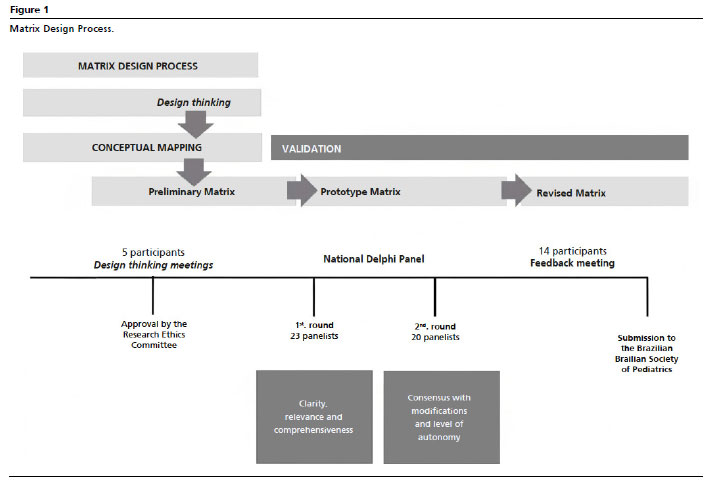
MethodsThis study employed a sequential design of framework development and validation, starting with the design thinking phase and proceeding with the two-round modified Delphi panel to develop and validate Entrustable Professional Activities (EPAs) for child development and behavior training in Brazilian pediatric residency programs. Phase 1 (February to May 2024) involved the initial development of the EPAs using a design thinking methodology. Phase 2 (August to December 2024) focused on validation through a modified Delphi process and concluded with a consensus meeting (Figure 1).
This study followed the checklist recommendations of the Guidance on Conducting and REporting DElphi Studies (CREDES) to ensure methodological rigor and transparency in reporting.
15We adopted Messick's unified validity framework to guide the development of the EPAs.
16,17 This approach conceptualizes validity as the degree to which evidence supports score interpretations for intended uses. In accordance with this framework, this study collected evidence based on content, response process, and internal structure. Evidence regarding relations to other variables and consequences of testing was not evaluated in this phase.
Five researchers participated in the initial development phase. All of them were board-certified in pediatrics (with over 15 years of experience), held current academic positions with residency teaching responsibilities, and demonstrated expertise in child development/behavior or medical education. None of the researchers participating in the design thinking phase (Phase 1) served on the Delphi panel (Phase 2), ensuring independence between initial construction and consensus-based validation.
Using the design thinking methodology
18, the group operated a five-stage process: (1) Empathize – understanding the needs of Brazilian pediatric residents; (2) Define – identifying competency gaps; (3) Ideate – generating potential EPAs; (4) Prototype – creating the initial framework; (5) Test – iterative refinement based on feedback.
The theoretical foundation was based on three premises: pediatricians function as promoters, protectors, and caregivers of child development;
19 child development science constitutes the fundamental knowledge base of pediatrics;
20 and early childhood represents a critical window of intervention.
5 The resulting framework aligns with the Brazilian National Curriculum Guidelines and international competency models.
In phase 2, we employed purposive sampling via Brazil's Lattes Platform to identify panelists who met the following expertise criteria: (a) a minimum of 10 years of clinical practice in developmental and behavioral pediatrics and/or expertise in health professions education; (b) at least 3 indexed publications in the field over the past 5 years; or (c) active coordination of a pediatric residency program. Following Delphi panel recommendations,
21 we invited 30 experts through multiple contact attempts. The Delphi process utilized an online data capture platform
22 for data collection. Participants received orientation materials, including explanatory videos and relevant articles.
8,11,15 Round 1 evaluated eight EPAs and 23 nested EPAs using 5-point Likert scales for clarity, relevance, and comprehensiveness. Items achieving more than 80% agreement (scores of 4–5) were retained, while others were revised based on qualitative feedback.
Round 2 presented the revised matrix with highlighted modifications. Participants compared versions using a 5-point scale and evaluated the expected levels of autonomy for each residency year. We managed participant attrition between rounds by providing comprehensive support materials and conducting separate analyses for continuous versus new participants.
Consensus was defined as a content validity index (CVI) ≥ 0.80 and an interquartile range (IQR) of less than 1.00. For items failing to meet these criteria, we conducted polar agreement analysis. Qualitative comments were subjected to thematic analysis to inform revisions. The thematic analysis of qualitative comments from Round 1 was independently conducted by two researchers with experience in medical education, utilizing initial open coding followed by focused coding. Three main themes were identified to guide matrix modifications for Round 2: (1) content overlap between promoting and protecting EPAs (particularly EPAs 1, 2, and 3); (2) the need for greater clarity in the definitions of "early childhood" and temporal delimitation of competencies; (3) differing interpretations regarding the expected level of autonomy for pediatric residents. These themes were synthesized into a report shared with all panelists prior to Round 2.
As a complementary exploratory analysis, Cronbach's alpha was calculated exclusively for the clarity dimension, considering the scores of the eight EPAs as items. The coefficient was not estimated for relevance and comprehensiveness due to the low response variability across these dimensions. This result should be interpreted exclusively as a descriptive indicator of response consistency on the scale, rather than as evidence of unidimensionality or the internal structure of the matrix.
A final online meeting in December 2024 with panelists and researchers provided additional validation through real-time online survey feedback, combining quantitative ratings with qualitative discussion.
The study received approval from the Research Ethics Committee of the Federal University of Ceará under protocol number 77160823.5.0000.5054, in accordance with the principles outlined in Resolution 466/12 of the Brazilian National Health Council. All participants provided informed consent, with data securely stored and anonymity maintained throughout the process.
ResultsPhase 1: Initial EPA Development - Five researchers participated in the initial development phase between February and May 2024. Using the design thinking methodology, they created a conceptual map and developed a preliminary matrix containing 8 EPAs and 23 nested EPAs, based on three fundamental premises regarding the pediatrician's role as a promoter, protector, and caregiver of child development.
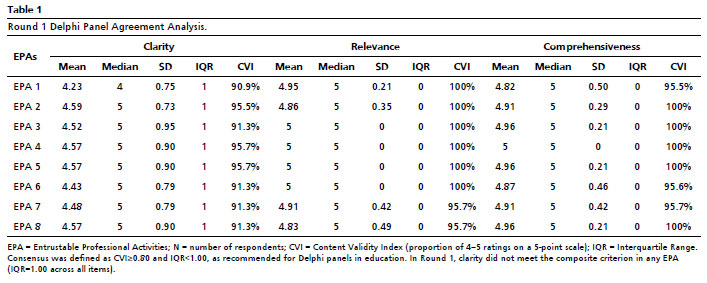
Phase 2: Modified Delphi Validation - In Round 1, of the 30 invited panelists, 23 (76.6%) participated in the first round. Participants were predominantly female (70%), aged 56–65 years (48%), and had over 20 years of pediatric experience. Regional representation included the Northeast (43%), Southeast (35%), South (13%), and Midwest (9%) regions. Despite inviting 5 specialists from the North Region, there was no engagement from these participants due to scheduling unavailability, which limited full geographic coverage. The preliminary matrix was evaluated for clarity, relevance, and comprehensiveness. All criteria achieved a CVI > 0.80 across the eight EPAs, except for clarity. Relevance and comprehensiveness reached consensus across all EPAs (CVI between 95.5% and 100%), whereas clarity ranged from 90.9% to 95.7% and failed to meet the compound consensus criterion in any EPA, given the IQR ≥ 1.00 on all items (Table 1). As an exploratory analysis, Cronbach's alpha for the clarity dimension was 0.93, indicating score consistency across evaluated items without representing, however, construct unidimensionality or consensus among panelists.
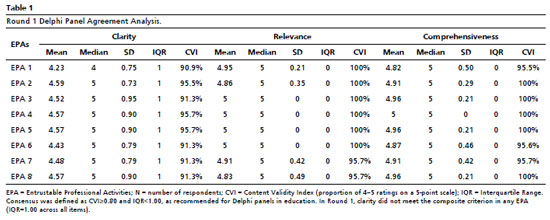
The median score was 5 for all EPAs, except for the clarity of EPA 1 (median=4). Consensus was achieved in relevance and comprehensiveness (IQR < 1.00); however, for clarity, the IQR≥1.00 indicated disagreement among panelists. Based on qualitative feedback, most EPAs were revised, although the titles of EPAs 4, 5, and 8, as well as the descriptions of EPAs 3 and 8, were maintained. Nested EPAs 3.2 and 3.3 were merged into nested EPAs 4.3 and 4.4, as they addressed similar activities (Table 1).
Round 2 Results: The panel maintained a stable composition between rounds: of the 23 specialists who participated in Round 1, 20 (87.0%) remained in Round 2, with three dropouts due to scheduling unavailability. No new panelists were included between rounds, preserving the independence and collective memory of the iterative process. To assess attrition bias, we compared the profile of the three non-returning participants (region, field of expertise, years of experience) with that of the 20 remaining ones, identifying no systematic differences that could compromise the validity of the consensus. The majority were female (75%), aged 56–65 years (48%), and all had over 20 years of pediatric experience. Regional distribution included the Northeast (55%), Southeast (35%), South (5%), and Midwest (5%).
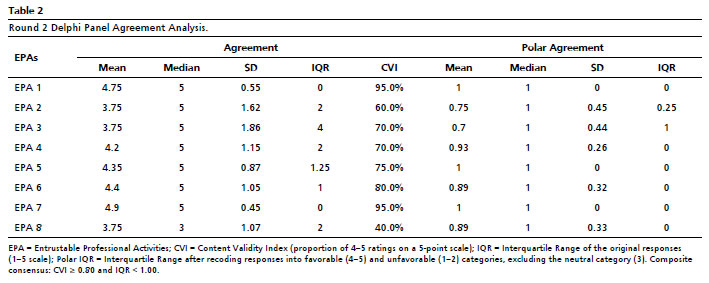
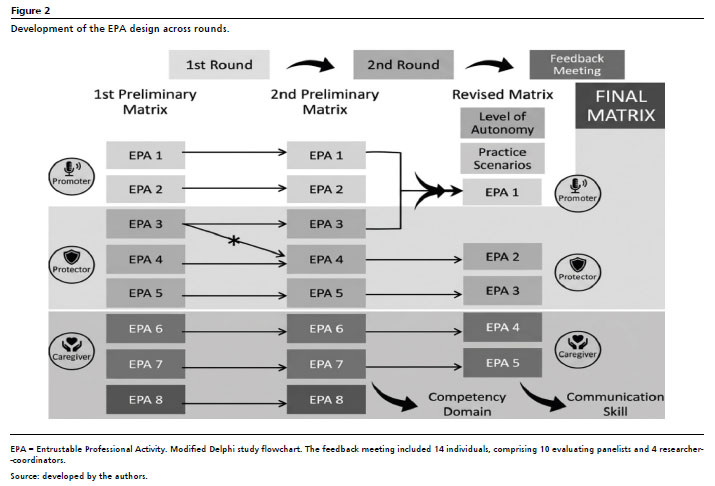
In the analysis of changes from the first to the second matrix, 100% of participants agreed with the modifications in EPA 1, whereas agreement was lower for EPA 2 (60%). Only EPAs 1 and 7 achieved both a CVI≥0.80 and an IQR<1.00; EPAs 2, 3, 4, 5, 6, and 8 presented an IQR ≥ 1.00, indicating response variability among panelists. Specifically, EPA 2 obtained a CVI = 0.60, a value below the 0.80 criterion, while EPA 3 showed 70% agreement and registered an IQR = 4, representing extreme polarization—that is, a distribution between opposite extremes on the 5-point Likert scale, with responses concentrated at the favorable and unfavorable poles without concentration in the center. This disagreement may reflect differing conceptual interpretations among panelists regarding the delimitation between promoting (EPAs 1 and 2) and protecting (EPA 3) child development activities. The thematic analysis of qualitative comments from Round 1 provided important clarification: many panelists recognized and explicitly mentioned content overlap among these three EPAs, suggesting that the operational distinction between them might not be clear enough to justify three separate items. This qualitative feedback was interpreted as complementary to the quantitative indicator of low agreement. Given this finding—combining quantitative indicators of disagreement with qualitative feedback on overlap—the researchers made the decision to merge EPAs 2 and 3 into EPA 1, which was reformulated as "Promotion of Child Development from Pregnancy to Early Childhood." Nested EPAs 1.4 and 1.5 were created specifically to preserve the originally separated concepts regarding behavior and promotion that had been assigned to EPAs 2 and 3. This decision was based on four criteria: (1) conceptual cohesion—all these activities reflect the pediatrician's role as a promoter of development; (2) qualitative feedback—panelists identified content overlap; (3) the principle of parsimony—keeping the matrix manageable rather than fragmented; (4) subsequent qualitative validation in a synchronous meeting with confirmation of 100% agreement among the participating panelists (Table 2).
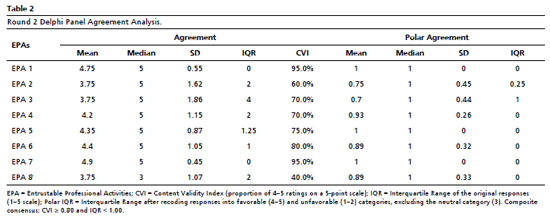
In Round 2, the composite consensus was defined by the simultaneous combination of a CVI ≥ 0.80 and an IQR < 1.00, a criterion achieved only by EPAs 1 and 7. For the six EPAs that did not meet this criterion (EPAs 2, 3, 4, 5, 6, and 8), a complementary polar agreement analysis was conducted by recoding responses into two extreme categories (favorable: 4–5; unfavorable: 1–2) and excluding the central category, in order to investigate whether the observed dispersion reflected polarization between opposite extremes or disagreement distributed across the scale. EPA 3 presented the highest polar IQR (= 1) among the six, indicating more pronounced polarization, whereas in the others the polar IQR ranged from 0 to 0.25. In this round, there were no EPAs with a CVI<0.80 and an IQR<1.00 simultaneously—a situation that, had it occurred, would also not have constituted a composite consensus, since both criteria are required together. Based on these results, EPAs 2 and 3 were subsequently incorporated into EPA 1 in the final matrix, preserving their specific concepts through nested EPAs 1.4 and 1.5 (Table 2).
EPA 8 was excluded because its description corresponded to a competency domain rather than a professional activity (Figure 2).
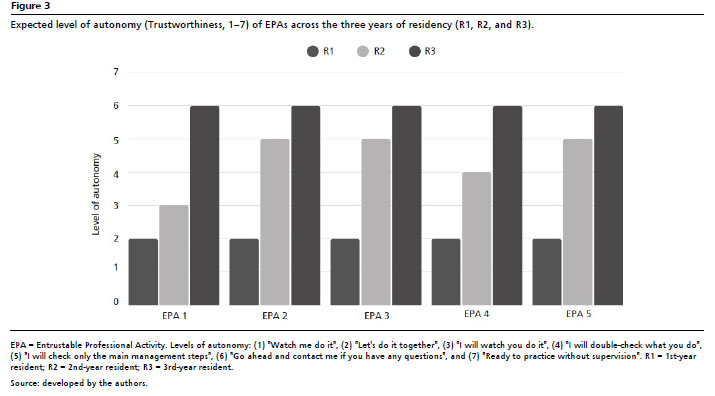
There was 100% agreement on the levels of autonomy at the end of R1 (Level 2) and R3 (Level 6) for all EPAs. In R2, the levels of autonomy (competence reliability) varied according to complexity (Figure 3). All panelists agreed that residents must reach Level 6 of autonomy by the 5th semester of residency.
Phase 3: Delphi Feedback Meeting and Final Validation - In December 2024, a synchronous online meeting brought together 10 of the 11 invited panelists who had agreed to participate and four researchers, based on the review of the previously distributed matrix. One of the 11 panelists, despite confirming attendance, could not attend due to an unexpected last-minute emergency; this panelist was a woman from the Southeast region with over 20 years of experience in pediatrics. Among the 10 participants present, four were from the Northeast region, three from the Southeast region, one from the South region, and one from the Midwest region. The majority were female (70%), and all had over 20 years of experience in pediatrics. The meeting was conducted as a complementary non-anonymous qualitative validation stage, neither constituting nor being considered equivalent to a third Delphi round, and its purpose was to qualitatively discuss and validate the results obtained in the previous two rounds.
The feedback process was structured in two stages: (1) a 15-minute presentation by the researchers describing matrix development, modifications made, and the rationale for merging EPAs 2 and 3; (2) real-time data collection via Google Forms using a 1–5 Likert scale for four specific questions: clarity of the final matrix (mean 4.8), relevance of each EPA (mean 4.9), appropriateness of autonomy levels (mean 4.7), and applicability across diverse Brazilian contexts (mean 4.6), followed by a 45-minute open qualitative discussion. Quantitative results were immediately aggregated and shared on screen for discussion, achieving 100% agreement on the final 5-EPA structure.
Following the feedback, the final matrix was constructed with 5 EPAs and 20 nested EPAs for early childhood development and behavior. It included competencies, autonomy levels, and practice settings adapted to multi-regional Brazilian contexts.
DiscussionThis study developed a matrix with five Entrustable Professional Activities, with 20 nested EPAs for training in development and behavior in early childhood in Brazilian pediatric residency programs, while generating content validity evidence through expert consensus. This comprehensive framework addresses a critical gap in pediatric education, as the global prevalence of developmental and behavioral disorders continues to rise, with approximately 250 million children under five years of age (43%) at risk of failing to reach their developmental potential.
24 The urgency of this study is underscored by the scarcity of services and specialized professionals in developmental and behavioral pediatrics across both Latin America and Brazil, where pediatricians frequently act as the sole care providers in this field.
13Our findings align with international efforts to strengthen developmental and behavioral pediatrics training through competency-based medical education. Although the American Board of Pediatrics developed 17 EPAs for general pediatrics, including EPA 9 for mental health and behavioral competencies,
23,24 and European countries have established EPAs for pediatric primary care,
11 no comprehensive framework exists for the Brazilian context. Our matrix addresses this gap by incorporating Brazil's health model, where generalist pediatricians provide the majority of developmental and behavioral care within the Unified Health System (SUS).
The development process provided insights into pediatric practice. Following Richmond's 1967 assertion
20 that child development is the basic science of pediatrics, our framework positions developmental and behavioral competencies as foundational rather than supplementary. This challenges the traditional biomedical model, which frequently relegates developmental concerns to subspecialty care instead of integrating these competencies across all practice settings.
The matrix addresses specific challenges within Brazil's health system through its three-tier structure, reflecting the roles of pediatricians as promoters, protectors, and caregivers of child development. This framework resonates with the SUS principles of comprehensive care, prevention, and health promotion. EPA 1, which focuses on developmental promotion from pregnancy to early childhood, directly supports Brazil's National Policy for Comprehensive Child Health Care (PNAISC), while EPAs 2 and 4 address the critical scarcity of developmental screening and intervention services, particularly in underserved regions.
The emphasis on early childhood (0–6 years) reflects both neuroscientific evidence regarding critical periods of development and Brazil's socioeconomic realities. The PESMIC study in Ceará revealed that 9.2% of children exhibited developmental delays, with strong associations with socioeconomic conditions.
25 By training pediatricians to identify and address these issues early, this matrix has the potential to support strategies aimed at reducing long-term educational, social, and economic disparities, depending on its future implementation and evaluation.
Our EPAs differ from US and European frameworks in several key aspects. While the ABP EPA 9 focuses primarily on managing 'common mental health/behavioral problems',
26 our framework explicitly emphasizes prevention and promotion across all five EPAs. This preventive orientation reflects both the Brazilian health system's emphasis on primary care and the recognition that early intervention yields the highest return on investment, as demonstrated by James Heckman's work on early childhood development.
27Unlike European EPAs, which frequently presume robust subspecialist referral networks, our framework recognizes that Brazilian pediatricians often work in isolation, particularly in the North and Northeast regions. Therefore, our EPAs include competencies to coordinate care across sectors (health, education, and social services) and advocate for children's rights based on Brazil's Statute of the Child and Adolescent, reflecting the broader social determinants of health impacting Brazilian children.
One aspect that warrants discussion is the assignment of a single level of autonomy to EPAs that encompass tasks of heterogeneous complexity, such as EPA 4, which ranges from evaluating typical development to indicating and prescribing pharmacological treatments for childhood mental disorders. The expectation of full autonomy by the end of residency must be understood in light of Brazilian healthcare realities, in which generalist pediatricians frequently assume care for development, behavior, and child mental health problems, especially in regions with a scarcity of subspecialists. In this context, training residents capable of recognizing these conditions, establishing therapeutic indications, and, when necessary, initiating pharmacological treatment for prevalent conditions can help address a relevant care gap in the health system.
Nevertheless, the assessment of autonomy was conducted at the level of each EPA as a whole, rather than individually for each nested EPA. This approach does not capture potential differences in complexity among activities contained within the same EPA—for example, between recognizing red flags during screening and prescribing pharmacological treatment. This limitation stems from the granularity adopted in the Delphi design, since autonomy levels were defined by expert panel consensus for each EPA as a whole, rather than for its nested activities. Future validation and refinement studies of the matrix may investigate, through new assessments, whether higher-complexity subcomponents within the same EPA justify differentiated levels of autonomy or intermediate stages of supervision and consultation prior to fully independent practice.
The process of refining the matrix from 8 to 5 EPAs illustrates a methodological challenge inherent to Delphi studies: the balance between conceptual granularity and operational parsimony. The disagreement observed in Round 2 for EPAs 2 and 3—particularly the extreme polarization (IQR = 4)—does not necessarily represent a flaw in the process, but rather an opportunity for conceptual refinement. In Delphi studies, consensus is not merely a statistical indicator, but an iterative process of building shared understanding. The merger of EPAs 2 and 3 into EPA 1, preserving their concepts through nested EPAs, reflects an approach that prioritizes conceptual cohesion and practical applicability over theoretical distinctions that, from the panelists' perspective, did not translate into significant operational differences within the context of Brazilian pediatric training. The extreme polarization observed in EPA 3 (IQR = 4) may reflect not only content overlap, but legitimate conceptual divergence among specialists regarding the operational boundaries between development promotion and protection, especially in resource-limited primary care settings. This decision also reflects the reality that Brazilian pediatricians frequently integrate multiple roles (promoter, protector, caregiver) into a single childcare consultation, particularly in primary care, where the fragmentation of competencies into excessively granular EPAs could hinder curricular implementation. The transition from quantitative to qualitative validation in the final phase, although representing a study limitation, is defensible in the context of educational framework development studies, where the ultimate goal is practical utility and stakeholder acceptance, rather than abstract psychometric rigor alone.
The EPAs developed in this study provide important contributions for clinical educators training pediatric residents. The matrix serves as a structured roadmap for curriculum development, enabling residency programs to organize educational activities progressively, aligned with residents' professional development. Drawing on international experiences, challenges are anticipated.
Successful EPA implementation requires structural changes in residency design and assessment methods. The matrix provides a clear framework integrating knowledge, skills, and attitudes for competent practice. Educators can use the five EPAs as curricular organizers, distributing activities across the three years of residency according to the proposed autonomy levels. This allows for a logical progression, beginning with supervised observation through to independent practice. Longitudinal training with continuity clinics will be essential, enabling residents to follow families over time and observe child development.
Assessment strategies must extend beyond traditional knowledge-based examinations to workplace-based assessments that capture residents' competence in clinical settings. Trustworthiness scales provide a framework for autonomy, but programs require specific assessment tools with validity evidence.
Many faculty members may lack confidence in developmental and behavioral domains. Faculty development programs must prepare preceptors to teach effectively. Programs should include workshops on EPAs, direct observation assessment, feedback, and interdisciplinary care.
Finally, the implementation of this matrix can contribute to an educational culture shift, moving from a disease-centered model to one that values healthy development and prevention. This requires curricular and learning environment changes, creating spaces for compassionate, family-centered, and culturally sensitive care.
28This study presents limitations that must be considered in the interpretation and application of results, pointing to important directions for future validation and implementation research. Although the sample size of 23 panelists in a Delphi panel is considered appropriate for relatively homogeneous populations,
29 the absence of expert participation from the North Region throughout all study phases represents a significant gap in regional representativeness. Brazil's North Region presents epidemiological, demographic, cultural, and pediatric service organization characteristics that differ substantially from other macro-regions, including greater geographic dispersion, lower specialist density, higher prevalence of indigenous and riverine populations, and specific logistical challenges in the provision of child health services. Although the study established content validity evidence among experts from the remaining regions, the generalization of results to distinct practice contexts requires contextual adaptation. Future implementations of the matrix must involve consultation with local experts and specific evaluation of the applicability and relevance of the proposed EPAs for regional contexts.
Moreover, the Delphi panel composition was predominantly composed of academic experts (70% of panelists) with demonstrated expertise in medical education or child development and behavior. Although this composition strengthened content validity from the perspective of educational and scientific expertise, the inclusion of perspectives from primary care generalist pediatricians—who constitute the majority of providers of child development and behavior care in Brazil and will be the primary users of the matrix following residency completion—could have provided different insights into curricular priorities, contextual applicability in resource-limited services, and the practical feasibility of the proposed EPAs. Future implementation studies could deliberately include this broader spectrum of stakeholders, including residents, primary care preceptors, and residency program coordinators with different resource profiles, as well as investigate their relationship with clinical outcomes, resident assessment performance, and impact on longitudinal care, consolidating evidence of predictive and consequential validity.
This study developed and established content validity evidence for a structured framework of five Entrustable Professional Activities with 20 nested EPAs for child development and behavior training in Brazilian pediatric residency programs. The matrix was developed through a modified Delphi study, with a preliminary design thinking phase followed by two Delphi rounds, establishing consensus among 23 experts from various institutions and regions of Brazil.
The framework fills a critical gap in Brazilian pediatric education by incorporating the context and principles of the Unified Health System (SUS) and recognizing that generalist pediatricians frequently act as the sole care providers for developmental and behavioral care, particularly in resource-limited regions. This reality distinguishes the Brazilian context from international models that presume robust subspecialist referral networks. The matrix organizes competencies around the pediatrician's three fundamental roles—promoter, protector, and caregiver of child development—offering a framework that can contribute to structured curriculum development in residency programs. This framework was explicitly aligned with the principles of comprehensive care, prevention, and health promotion that characterize the Unified Health System, reflecting a perspective of medical education centered on health promotion and preventive care from training onward. However, the true value of the matrix will critically depend on its implementation, adoption, and effectiveness evaluation across different residency settings. Future research should focus on: (1) implementation studies in programs with diverse resource and context characteristics, including socioeconomically vulnerable regions; (2) validation of the matrix in unrepresented regional contexts; (3) development and validation of clinical context-based assessment tools for these specific EPAs; (4) evaluation of the impact on training quality, resident and preceptor satisfaction, and, most importantly, the improved identification and early intervention in child developmental and behavioral problems.
The matrix developed offers content validity evidence through expert consensus, placing developmental and behavioral competencies as the structural axes of pediatric training. Its implementation and effectiveness will depend on contextual adaptation, assessment in services with different resource profiles, and validation in unrepresented regions. The authors submit the framework to the Brazilian Society of Pediatrics (
Sociedade Brasileira de Pediatria) and the National Commission for Medical Residency (
Comissão Nacional de Residência Médica – CNRM) as technical input for curricular discussion, with the understanding that each program must adapt it to its local realities.
References1. Cooper S, Valleley RJ, Polaha J, BEgeny J, Evans JH. Running out of time: physician management of behavioral health concerns in rural pediatric primary care. Pediatrics. 2006; 118: e132–8. doi: 10.1542/peds.2005-2612
2. Agazzi H, Dickinson S, Plant RM. Helping Our Toddlers, Developing Our Children's Skills: Innovative Behavioral Management Training for Pediatric Residents. Adv Pediatr. 2022; 69: 13–21. doi: 10.1016/j.yapd.2022.03.007
3. Voigt RG, Accardo PJ. Formal Speech-Language Screening Not Shown to Help Children. Pediatrics. 2015; 136: e494–5. doi: 10.1542/peds.2015-0211
4. Noer C, Halpern R. The pediatrician and the promotion of child development: optimizing the assessment. Resid Pediátr. 2018; 8 (3): 156-62. DOI: 10.25060/residpediatr-2018.v8n3-12
5. Shonkoff JP. Protecting brains, not simply stimulating minds. Science 2011; 333: 982–983.
6. World Health Organization (WHO). Improving Early Childhood Development: WHO Guideline. Geneva: WHO; 2020. [access in 2026 Abr 8]. Available from:
https://www.who.int/publications/i/item/978924000209867. ten Cate O. An Updated Primer on Entrustable Professional Activities (EPAs). Rev Bras Educ Med. 2019; 43 (Supl. 1): 712-20.
https://doi.org/10.1590/1981-5271v43suplemento1-201902388. ten Cate O, Chen HC, Hoff RG, Peters H, Bok H, van der Schaaf M. Curriculum development for the workplace using Entrustable Professional Activities (EPAs): AMEE Guide Nº. 99. Med Teach. 2015; 37: 983–1002. doi: 10.3109/0142159X.2015.1060308
9. Kerth J-L, van Treel L, Bosse HM. The Use of Entrustable Professional Activities in Pediatric Postgraduate Medical Education: A Systematic Review. Acad Pediatr. 2021; 22: 21-8. doi: 10.1016/j.acap.2021.07.007
10. Carney PA. A New Era of assessment of entrustable professional activities applied to general pediatrics. JAMA Netw Open. 2020; 3: e1919583. doi: 10.1001/jamanetworkopen.2019.19583
11. European Confederation of Primary Care Paediatricians (ECPCP). ECPCP Curriculum Working Group 2020. Entrustable Professional Activities in Primary Care Paediatrics. Lúa Ediciones 3.0; 2020. [access in 2026 Abr 8]. Available from:
https://www.ecpcp.eu/_files/ugd/64f60b_d09da212c6d94e8685837fd1c3597e2d.pdf12. Brasil. Resolução Nº 3 DE 20 DE JUNHO DE 2014, 2014. Institui as Diretrizes Curriculares Nacionais do Curso de Graduação em Medicina e dá outras providências.
13. Paula CS, Lauridsen-Ribeiro E, Wissow L, Bordin IAS, Evans-Lacko S. How to improve the mental health care of children and adolescents in Brazil: actions needed in the public sector. Braz J Psychiatry. 2012; 34: 334-51. doi: 10.1016/j.rbp.2012.04.001
14. Scheffer M, Guilloux AGA, Miotto BA, Almeida CJ. Demografia Médica no Brasil 2023. São Paulo: FMUSP AMB; 2023. [access in 2026 Abr 8]. Available from:
https://web.fm.usp.br/fmusp/conteudo/DemografiaMedica2023.pdf15. Jünger S, Payne SA, Bringer J, Radbruch L, Brearley SG. Guidance on Conducting and REporting DElphi Studies (CREDES) in palliative care: recommendations based on a methodological systematic review. Palliat Med. 2017; 31 (8): 684-706. doi: 10.1177/0269216317690685
16. Messick S. Validity of psychological assessment: Validation of inferences from persons' responses and performances as scientific inquiry into score meaning. Am Psychol. 1995; 50: 741-9.
https://doi.org/10.1037/0003-066X.50.9.74117. Cook DA, Brydges R, Ginsburg S, Hatala R. A contemporary approach to validity arguments: a practical guide to Kane's framework. Med Educ. 2015; 49: 560-75. doi: 10.1111/medu.12678
18. Plattner H, Meinel C, Leifer L. Design Thinking Research: Making Design Thinking Foundational. Springer; 2015.
19. Perrin JM, Flanagan P, Katkin J, Barabell G, Price J; Committee on Child Health Financing. The unique value proposition of pediatric health care. Pediatrics. 2023; 151 (2): e2022060681. DOI: 10.1542/peds.2022-060681.
20. Shonkoff CJ, Green M. Child development: a basic science for pediatrics, by Julius B. Richmond, MD, Pediatrics, 1967; 39: 649-58. Pediatrics. 1998; 102: 243–245.
21. Nasa P, Jain R, Juneja D. Delphi methodology in healthcare research: How to decide its appropriateness. World J Methodol. 2021; 11: 116-29. doi: 10.5662/wjm.v11.i4.116
22. Harris PA, Taylor R, Minor BL, Elliott V, Fernandez M, O'Neal L,
et al. The REDCap consortium: Building an international community of software platform partners. J Biomed Inform. 2019; 95: 103208. doi: 10.1016/j.jbi.2019.103208
23. American Academy of Pediatrics (AAP). The future of pediatrics: Mental health competencies for pediatric primary care. In: Pediatric Clinical Practice Guidelines & Policies. American Academy of Pediatrics; 2018. p. 1243.
24. The American Board of Pediatrics. Entrustable Professional Activities for General Pediatrics. [access in 2026 Apr 8]. Available from:
https://www.abp.org/content/entrustable-professional-activities-general-pediatrics25. Correia LL, Rocha HAL, Sudfeld CR, Rocha SGMO, Leite ÁJM, Campos JS,
et al. Prevalence and socioeconomic determinants of development delay among children in Ceará, Brazil: a population-based study. PLoS One. 2019; 14 (11): e0215343.
https://doi.org/10.1371/journal.pone.021534326. Black MM, Walker SP, Fernald LCH, Andersen C, Digirolamo AM, Lu C,
et al. Early childhood development coming of age: science through the life course. Lancet. 2017; 389: 77-90. 2017. DOI: 10.1016/S0140-6736(16)31389-7
27. Garca JL, Heckman JJ, Leaf DE,Prados MJ. Quantifying the life-cycle benefits of an influential early-childhood program. J Polit Econ. 2020; 128: 2502-41. doi: 10.1086/705718
28. Wurster Ovalle V, Martini A, Tanguay S, Carraccio C, Schumacher DJ. Implementing the Behavioral and Mental Health Entrustable Professional Activity: Insights for a Path Forward. Acad Pediatr. 2020; 21: 178–184. doi: 10.1016/j.acap.2020.07.002
29. Manyara AM, Purvis A, Ciani O,Collins GS, Taylor RS. Sample size in multistakeholder Delphi surveys: at what minimum sample size do replicability of results stabilize? J Clin Epidemiol. 2024; 174: 111485. doi: 10.1016/j.jclinepi.2024.111485
AcknowledgementsThe authors gratefully acknowledge the National Council for Scientific and Technological Development (
Conselho Nacional de Desenvolvimento Científico e Tecnológico – CNPq) for the financial support provided through the 2023 MCTIC/CNPq Universal Call (406410/2023-2).
Authors' contributionXimenes RBB: conceptualization, data curation, formal analysis, funding acquisition, investigation, methodology, project administration, resources, validation, visualization, writing – original draft, writing – review and editing.
Almeida NMGS: formal analysis, funding acquisition, project administration, resources, validation, visualization, writing – original draft, writing – review and editing.
Ximenes JCM, Resegue RM: formal analysis, validation, visualization, writing – original draft, writing – review and editing.
Carmo e Sá HL: conceptualization, data curation, formal analysis, investigation, methodology, supervision, validation, visualization, writing – original draft, writing – review and editing.
Leite AJM: conceptualization, data curation, formal analysis, funding acquisition, investigation, methodology, project administration, resources, supervision, validation, visualization, writing – original draft, writing – review and editing.
All authors approved the final version of the article and declare no conflicts of interest.
Statement on Artificial Intelligence UseGenerative artificial intelligence (AI) tools were not used to draft the article texts or the EPA matrix. AI tools were used solely for spelling and grammatical proofreading of the manuscript in both Portuguese and English, with subsequent review by native speakers of each language. This article represents the original intellectual analysis of the authors, in compliance with the editorial guidelines for methodological transparency of the RBSMI.
Data availabilityThe datasets used in this study, including the list of panelists and experts, are available from the corresponding author upon request.
Received on March 19, 2026
Final version presented on August 20, 2026
Approved on August 21, 2026
Associated Editor: Melania Amorim


 ; Nádia Maria Girão Saraiva de Almeida2






 Ler em português
 Download PDF
 Imprimir
 Enviar este artigo por email
 Como citar este artigo
 Enviar um comentário
 Mendeley
 Pocket
 Compartilhar no Facebook
 Compartilhar no Twitter