The model of childbirth care has undergone substantial transformations over recent decades, driven by the increasing emphasis on evidence-based practice and the pursuit of more humanized, safe, and woman-centered care.
1 Within this context, the role of physical therapists in obstetrics has emerged as an effective strategy for supporting women during labor.
2,3 However, despite the growing body of scientific evidence supporting this field, the presence of physical therapists in Brazilian maternity hospitals remains limited and uneven.
3Obstetric physical therapy is currently supported by a robust body of evidence demonstrating its effectiveness during labor.
2,3 Interventions such as therapeutic exercise, thermotherapy, breathing techniques, massage, maternal positioning, Swiss ball exercises, peanut ball positioning, and other non-pharmacological approaches have shown consistent benefits for labor progression and maternal experience.
4-9Recently, a systematic review and meta-analysis
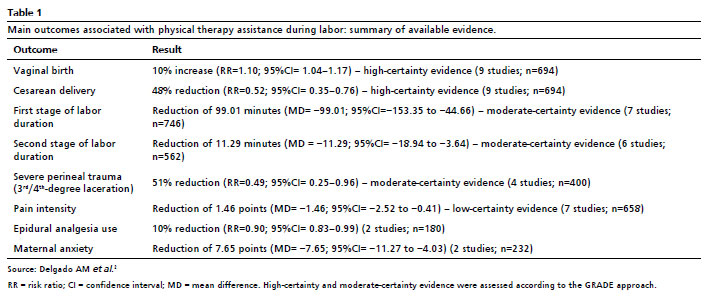
2 demonstrated that physical therapy assistance during labor is associated with increased rates of vaginal birth, reduced cesarean delivery rates, shorter first and second stages of labor, and lower levels of maternal pain and anxiety. Additionally, reductions in severe perineal trauma and pharmacological analgesia use were observed, with no evidence of increased adverse maternal or neonatal outcomes (Table 1).
Despite these findings, the integration of physical therapists into Brazilian maternity services remains inconsistent.
10 While some institutions have successfully incorporated these professionals into multidisciplinary obstetric teams, most maternity hospitals across the country still do not provide continuous physical therapy support in labor and delivery units.
3,10 This reality contrasts with contemporary recommendations for intrapartum care and limits women's access to safe, effective, and evidence-based interventions.
1The underutilization of physical therapists in childbirth care does not appear to result from a lack of scientific evidence. Rather, it reflects challenges related to healthcare service organization, limited awareness of the scope and competencies of obstetric physical therapy, and the absence of public policies ensuring the inclusion of these professionals within maternity care settings. Although Women's Health Physical Therapy has been recognized and regulated as a professional specialty in Brazil through COFFITO Resolutions Nº. 372/2009
11 and Nº. 401/2011,
12 respectively, with subsequent updates introduced by Resolution Nº. 628/2025,
13 this regulatory framework has not yet translated into the routine inclusion of physical therapists within maternity care services. This represents a significant gap in maternal healthcare that deserves attention from healthcare managers, policymakers, and healthcare institutions.
In recent years, important advances have been made in advocacy efforts aimed at expanding the presence of physical therapists in Brazilian maternity hospitals. Scientific and professional organizations, particularly the Brazilian Association of Physical Therapy in Women's Health (ABRAFISM), have played a leading role in disseminating scientific evidence, promoting professional training, and engaging policymakers and healthcare administrators to improve women's access to physical therapy services throughout the perinatal period.
2,10Reflecting this growing movement, Federal Bill Nº. 4631/2024 is currently under consideration in the Brazilian National Congress.
14 The proposal aims to formally include physical therapists within maternity care teams, recognizing their contribution to safer, more humanized, and evidence-based childbirth care. This initiative follows legislative advances already implemented at the state level, including State Law Nº. 7,723/2022 in Piauí, which requires the continuous availability of physical therapists in public and private maternity hospitals performing at least 1,000 births annually
15; State Law Nº. 11,447/2023 in Rio Grande do Norte, which requires the presence of at least one physical therapist in public and private maternity hospitals, hospitals, and healthcare institutions performing at least 1,000 births annually
16; and State Law Nº. 12.893/2025 in Maranhão, promulgated in 2026, which requires 24-hour physical therapy coverage in public and private maternity hospitals as well as adult, pediatric, and neonatal intensive care units.
17 These legislative initiatives represent important steps toward translating well-established scientific knowledge into effective public health policies and expanding women's access to physical therapy during labor and childbirth.
Ensuring access to physical therapy during labor should not be viewed as a future innovation but as a current healthcare necessity. The scientific evidence is already available. The challenge now is to translate this knowledge into routine clinical practice by expanding the presence of physical therapists in maternity hospitals and strengthening multidisciplinary maternal healthcare. The challenge is no longer to demonstrate effectiveness, but to ensure equitable access to this evidence-based intervention across Brazilian maternity hospitals.
References1. World Health Organization (WHO). WHO recommendations: intrapartum care for a positive childbirth experience. Geneva: WHO; 2018. [access in 2026 Ago 8]. Available from:
https://www.who.int/publications/i/item/97892415502152. Delgado AM, Lemos A, Marinho G, Melo RS, Pinheiro F, Amorim M. Physical therapy assistance in labor: a systematic review and meta-analysis. Braz J Phys Ther. 2025; 29 (2): 101169. doi: 10.1016/j.bjpt.2024.101169.
3. Pitangui ACR, Beleza ACS, Oliveira C, Jorge CH, Santana LS, Mamede L,
et al. Papel do fisioterapeuta nas maternidades [
Internet]. Ribeirão Preto (SP): Associação Brasileira de Fisioterapia em Saúde da Mulher; 2025. [access in 2026 Ago 8]. Available from:
https://img1.wsimg.com/blobby/go/5fd0b5a6-04fa-4f9f-bd18-972cd09451f1/downloads/27bc274f-73eb-47f3-890d-2b39344d1610/E-book%20ABRAFISM%20-%20PAPEL%20DO%20FISIOTERAPEUTA%20NAS%20.pdf?ver=17671413754814. Delgado A, Maia T, Melo RS, Lemos A. Birth ball use for women in labor: a systematic review and meta-analysis. Complement Ther Clin Pract. 2019; 35: 92-101. doi: 10.1016/j.ctcp.2019.01.015
5. Silva RCB, Delgado A, Marinho GA, Lemos A. Effectiveness of a physical therapy program using peanut ball positions during the first stage of labor on maternal and neonatal outcomes: randomized clinical trial. Braz J Phys Ther. 2026; 30 (3): 101580. DOI: 10.1016/j.bjpt.2026.101580
6. Gallo RBS, Santana LS, Marcolin AC, Duarte G, Quintana SM. Sequential application of non-pharmacological interventions reduces the severity of labour pain, delays use of pharmacological analgesia, and improves some obstetric outcomes: a randomised trial. J Physiother. 2018; 64 (1): 33-40. doi: 10.1016/j.jphys.2017.11.014
7. Delgado A, Amorim MM, Oliveira ADAP, Amorim KCS, Selva MW, Silva YE,
et al. Active pelvic movements on a Swiss ball reduced labour duration, pain, fatigue and anxiety in parturient women: a randomised trial. J Physiother. 2024; 70 (1): 25-32. doi: 10.1016/j.jphys.2023.11.001
8. Nunes Neta J, Amorim MM, Guendler J, Delgado A, Lemos A, Katz L. Vocalization during the second stage of labor to prevent perineal trauma: a randomized controlled trial. Eur J Obstet Gynecol Reprod Biol. 2022; 275: 46-53. doi: 10.1016/j.ejogrb.2022.06.007
9. Delgado A, Marinho G, Melo RS, Pinheiro F, Lemos A. Effectiveness of breathing exercises during first stage of labor: a systematic review and meta-analysis. Eur J Integr Med. 2024; 68: 102370. doi: 10.1016/j.eujim.2024.102370
10. Associação Brasileira de Fisioterapia em Saúde da Mulher (ABRAFISM); Ferroli-Fabricio AM, Ferreira CHJ, Rios LA, Mascarenhas LR, Oliveira NFF. Por Mais Fisioterapeutas nas Maternidades: regulamentação, suporte científico e campanha ABRAFISM. Belém (PA): ABRAFISM; 2020. [access in 2026 Ago 8]. Available from:
https://www.crefito1.org.br/uploads/ebook_abrasfim.pdf 11. Conselho Federal de Fisioterapia e Terapia Ocupacional (BR). Resolução nº 372, de 6 de novembro de 2009. Reconhece a Saúde da Mulher como especialidade do profissional fisioterapeuta e dá outras providências. Brasília (DF): DOU nº 228, de 30 de Nov 2009; Seção 1:101. [
Internet]. [access in 2026 Aug 3]. Available from:
https://www.coffito.gov.br/nsite/?p=313512. Conselho Federal de Fisioterapia e Terapia Ocupacional (BR). Resolução nº 401, de 18 de agosto de 2011. Disciplina a especialidade profissional de Fisioterapia na Saúde da Mulher e dá outras providências. Brasília (DF): COFFITO; 2011. [
Internet]. [access in 2026 Aug 3]. Available from:
https://www.coffito.gov.br/nsite/?p=316413. Conselho Federal de Fisioterapia e Terapia Ocupacional (BR). Resolução nº 628, de 30 de julho de 2025. Dispõe sobre a revogação dos §§ 1º e 2º do art. 5º das Resoluções-COFFITO nº 394/2011, nº 400/2011 e nº 401/2011. Brasília (DF): DOU nº 178, de 18 de Set 2025. [
Internet]. [access in 2026 Aug 3]. Available from:
https://www.coffito.gov.br/nsite/wp-content/uploads/2025/09/resolucao-628.pdf14. Brasil. Câmara dos Deputados. Projeto de Lei nº 4.631, de 2024. Altera a Lei nº 8.069, de 13 de julho de 1990 (Estatuto da Criança e do Adolescente), para assegurar a participação de fisioterapeutas nas equipes multidisciplinares dos serviços de saúde onde são realizados partos. Brasília (DF): Câmara dos Deputados; 2024. [
Internet]. [access in 2026 Aug 3]. Available from:
https://www.camara.leg.br/proposicoesWeb/fichadetramitacao?idProposicao=247396315. Piauí. Lei nº 7.723, de 6 de janeiro de 2022. Dispõe sobre a permanência do profissional fisioterapeuta nas maternidades públicas e privadas do Estado do Piauí. Teresina (PI): Diário Oficial do Estado do Piauí, 6 de Jan 2022. [
Internet]. [access in 2026 Aug 3]. Available from:
https://sapl.al.pi.leg.br/norma/511916. Rio Grande do Norte. Lei nº 11.447, de 30 de maio de 2023. Dispõe sobre a obrigatoriedade de permanência de fisioterapeuta nas maternidades públicas e privadas, no âmbito do Estado do Rio Grande do Norte, e dá outras providências. Nata (RN): Diário Oficial do Estado do Rio Grande do Norte, 30 de Maio 2023. [
Internet]. [access in 2026 Aug 3]. Available from:
https://leisestaduais.com.br/rn/lei-ordinaria-n-11447-2023-rio-grande-do-norte-dispoe-sobre-a-obrigatoriedade-de-permanencia-de-fisioterapeuta-nas-maternidades-publicas-e-privadas-no-ambito-do-estado-do-rio-grande-do-norte-e-da-outras-providencias17. Maranhão. Lei nº 12.893, de 26 de maio de 2026. Dispõe sobre a obrigatoriedade da presença de fisioterapeutas, durante 24 horas, nas maternidades públicas e privadas e nas unidades de terapia intensiva neonatal, pediátrica e adulto do Estado do Maranhão. Diário Oficial do Estado do Maranhão, 26 de Maio 2026. [
Internet]. [access in 2026 Aug 3]. Available from:
https://crefito16.gov.br/site/2026/05/26/lei-12-893-26-que-garante-a-presenca-obrigatoria-do-fisioterapeuta-por-24h-nas-utis-e-maternidades-do-maranhao-e-promulgada-na-alema/?utm_source=chatgpt.comAuthor's contributionAll authors conceived the manuscript and declare no conflict of interest related to this article.
Data availabilityNo datasets were generated or analyzed during the preparation of this opinion article. Therefore, data sharing is not applicable.
Received on July 7, 2026
Final version presented on August 8, 2026
Approved on August 10, 2026
Invited by the Editor-in-Chief: Melania Amorim


 ; Patrícia Driusso2







 Ler em português
 Download PDF
 Imprimir
 Enviar este artigo por email
 Como citar este artigo
 Enviar um comentário
 Mendeley
 Pocket
 Compartilhar no Facebook
 Compartilhar no Twitter