IntroductionIt is estimated that 48% of the pregnancies, worldwide, are unplanned.
1 In Brazil, studies report prevalence rates ranging from 55% to 67%.
2,3 Unplanned pregnancy is associated with adverse maternal and perinatal outcomes, including delayed prenatal care and poorer indicators of maternal mental health.
4The London Measure of Unplanned Pregnancy (LMUP) allows pregnancies to be classified on a continuous scale from 0 to 12 points.
5 The Brazilian version, validated by Borges
et al.,
6 demonstrated adequate internal consistency (Cronbach's alpha 0.81). Brazilian studies using the LMUP identified the following associated factors with unplanned pregnancy: Black or mixed race/skin color, lower schooling, absence of a stable partner, and higher parity.
2,7,8 Gallardo-Alvarado
et al.,
9 in 534 pregnant women in São Paulo, found an association with race (OR=1.68), schooling (OR=1.61), and marital status (OR=5.23). However, these studies investigated schooling—measured in years of schooling—without distinguishing a specific role of sexual education received throughout life.
The
Base Nacional Comum Curricular (BNCC)
10 (National Common Curriculum Base) and the
Programa Saúde na Escola (PSE)
11 (Health Program in Schools) advocate for addressing sexuality in Brazilian schools. However, implementation remains inconsistent, and there is a lack of evidence regarding the association between formal sexual education and pregnancy planning as measured by validated instruments. International evidence is ambiguous: a Cochrane review
12 concluded that the available evidence was insufficient to establish the effect of educational interventions on unintended pregnancy, and the JACK trial
13 did not demonstrate a significant difference in the primary outcome. These studies, however, evaluated one-time interventions with short follow-up, distinct from the cumulative exposure investigated in this study.
The objective of this study was to analyze the association between sources of sexual education and pregnancy planning among pregnant women in public and private maternities in Curitiba, Paraná, using the LMUP.
MethodsA cross-sectional analytical study conducted at two maternity hospitals in Curitiba, Paraná:
Maternidade Mater Dei (Public Maternity Hospital)
Sistema Único de Saúde (SUS) (Public Health System) and
Nossa Senhora das Graças Hospital (private health plan). Data collection took place between March and May 2025 via a self-administered questionnaire on Google Forms, the link to which was provided on the pregnant women's cell phones while they waited for prenatal appointments. Pregnant women ≥27 weeks in prenatal care agreed to participate via informed consent were included. The 27-week gestational window was defined for practical reasons (higher frequency of appointments in the third trimester, maximizing recruitment opportunities). For those under 18 years of age, parental consent was required. Of 394 forms, 391 were eligible (374 adults and 17 under 18 years of age, the latter aged 14 to 17 were all from the SUS). It was not possible to calculate a refusal rate because the form was open-access. This study follows the STROBE guidelines.
14The Brazilian version of the LMUP
6 was used, with a score ranging from 0 to 12. The primary outcome was dichotomized at a cutoff of 9/10 (≤9 = unplanned; ≥10 = planned). Dichotomization was adopted for three reasons: (a) direct comparability with Gallardo-Alvarado et al.,
9 the most recent methodological reference that employed an equivalent cutoff in a Latin American population; (b) greater statistical power for multivariate models compared to the tripartite categorization preserved by Borges
et al.,
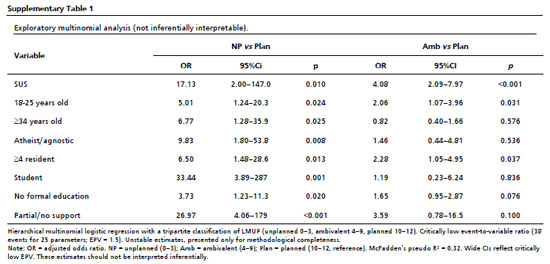
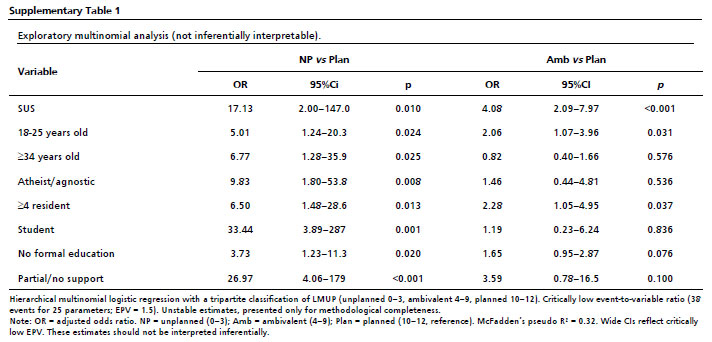
6 particularly relevant given the sample size (n=391) and the number of covariates in the final model; (c) direct clinical interpretability of the exposure-outcome relationship as a binary variable that is easily communicable for policy translation and clinical practice. We acknowledge that the tripartite categorization preserves dimensional information on ambivalence, and therefore we present the complementary multinomial analysis in the supplementary material (Supplementary Table 1). The question on sexual education was phrased as: "How did you learn about sex, sexuality, and contraceptive methods?", with multiple-choice options: school, mother, father, other family members, friends, the internet, doctors or healthcare professionals, on my own. The variable "formal sexual education" was defined as reporting at least one formal source (school and/or doctors or health professionals). It was also analyzed as a dose variable with four levels: no formal source (n=137), school only (n=154), health professional only (n=31), and both (n=69).
The independent variables were organized into three blocks according to Victora
et al.
15: (a) distal—type of maternity care, age (<18, 18–25, 26–33 [reference], ≥34 years), color/race (self-reported: White [reference], Mixed-race, Black, Asian), religion, marital status, household members, schooling (completed higher education [reference], incomplete higher education, completed secondary education, incomplete primary/secondary education), and occupation; (b) intermediate—formal sexual education, informal sexual education (friends and/or the internet), and knowledge of contraceptive methods (score ranging from 0 to 15, based on knowledge of methods including male/female condoms, diaphragm, oral contraceptive pill, morning-after pill, implant, vaginal ring, injection, patch, copper IUD, hormonal IUD, rhythm method, withdrawal, tubal ligation, and vasectomy, categorized into tertiles: low ≤5, medium 6–11, high >11); (c) proximal — previous contraceptive use, number of children, and support from the baby's father.
Given the high prevalence of the outcome (52.2%), prevalence ratios (PR) were estimated using Poisson regression with Huber-White robust variance, as recommended for cross-sectional studies with a frequent outcome.
16,17 The main confirmatory analysis used a hierarchical model in three blocks without partner support—this variable was excluded from the main analysis due to conceptual overlap with item 5 of the LMUP (partner agreement), indicating potential endogeneity. The blocks were included progressively (Model 1: distal; Model 2: distal + intermediate; Model 3: distal + intermediate + proximal without support), with coefficients between models compared using the likelihood ratio test.
The following exploratory and sensitivity analyses were performed: (a) model with partner support (secondary analysis); (b) parsimony model with five variables selected a priori based on theoretical plausibility; (c) model with income replacing type of maternity hospital; (d) LMUP recalculated without item 5 (score 0–10, cutoff 7/8), directly testing for potential endogeneity; (e) analysis stratified by type of maternity and age group; (f) E-value to assess robustness to residual confounding.
18 Family income was excluded from the main model due to multicollinearity with type of maternity (Cramer's V = 0.60). Although the analyses were not pre-registered, the main model was specified prior to examining the results, based on the conceptual framework described. The remaining analyses are exploratory.
Race/ethnicity did not meet the eligibility criterion in the bivariate analysis (
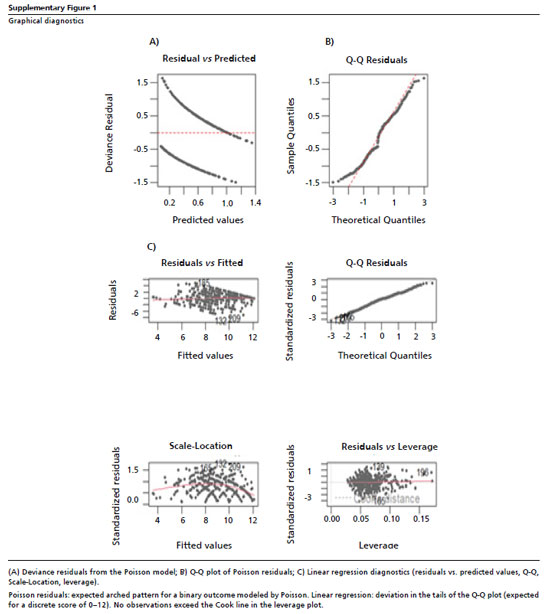
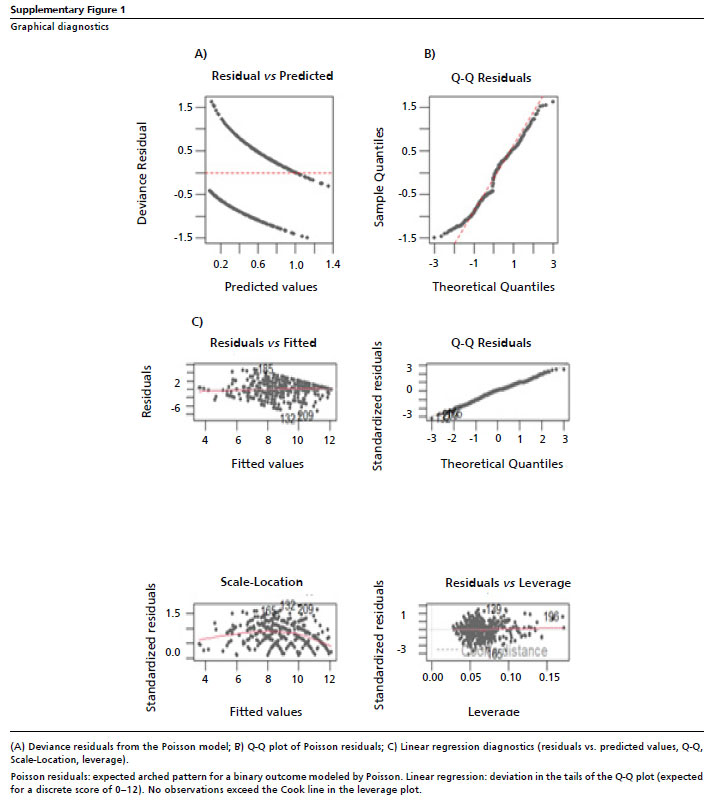
p=0.20) and was not included in the multivariate models. The 16 missing data points for number of children (4.1%), resulting from categories not provided for in the instrument (4 or more children), were handled using complete case analysis, assuming a Missing Completely at Random (MCAR) mechanism. The analyses were performed in R version 4.5.3, using the sandwich and lmtest packages. Details on variable coding, the collinearity matrix, model diagnostics, and exploratory multinomial analysis are available in the supplementary material (Supplementary Tables 1 and 2, Supplementary Figure 1). The sample size was calculated a priori for proportion estimation, considering a 95% confidence level, a 5% margin of error, and an estimated proportion of 50%, resulting in a minimum sample size of 385 pregnant women. A total of 391 participants were included, exceeding the calculated minimum.
In accordance with ethical guidelines, the study was approved by the Research Ethics Committee of PUC-PR (Opinion N
o.: 7.235.779; CAAE: 84172124.7.0000.0020). All participants signed informed consent forms.
ResultsA total of 391 pregnant women participated (260 in the SUS, 131 in private health plan). The predominant age group was 26–33 years (37.3%), with 17 participants under 18 years of age (4.3%), all of whom were in the SUS. Most identified themselves as white (61.9%) and were married or in a stable union (72.6%). The mean LMUP score was 8.9 (SD=2.6), with a non-normal distribution (Shapiro-Wilk
p<0.001). Based on the 9/10 dichotomization, 187 pregnancies were planned (47.8%) and 204 were unplanned (52.2%) (Table 1). The proportion of unplanned pregnancies was 68.8% in the SUS and 19.1% in private health plan (
p<0.001). Race/ethnicity was not associated with the outcome in the bivariate analysis (
p=0.20): white 48.8% unplanned, mixed-race 60.7%, black 48.1%, Asian 50.0%.
Hierarchical sequential models:
Model 1 (distal block) had a pseudo R
2 = 0.106. The addition of the intermediate block (Model 2) did not significantly improve the fit (LR χ
2 = 1.18; df = 4;
p=0.881; pseudo R
2 = 0.108). The addition of the proximal block without partner support (Model 3, main analysis) also did not significantly improve the fit (LR χ
2=2.49; df=3;
p=0.478; pseudo R
2=0.112); Model 3 was retained as the complete hierarchical model specified a priori according to the framework of Victora
et al.15 The PR for formal sexual education remained stable between Models 2 and 3 (1.15 → 1.17; 1.8% variation), as did that of the SUS (2.49 → 2.49), indicating that the inclusion of the proximal block does not distort the estimate of the central exposure.
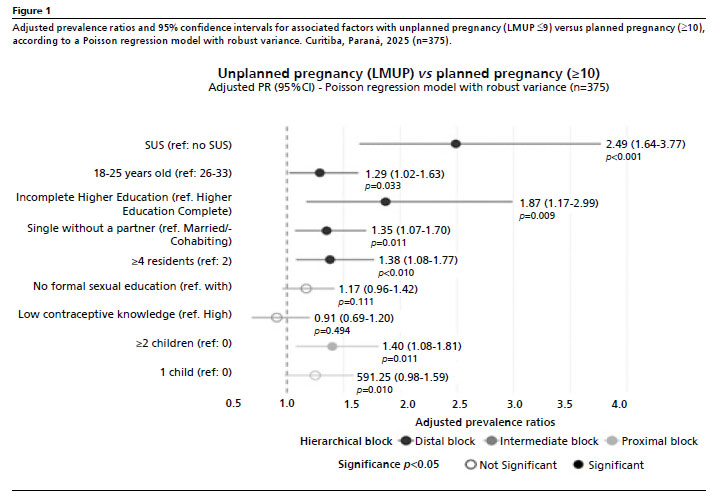
In Model 3 (Table 2, Figure 1), the associated factors with unplanned pregnancy were: care in the SUS (PR=2.49; 95%CI=1.64–3.77;
p<0.001), age 18–25 years (PR=1.29; 95%CI=1.02–1.63;
p=0.033), being single without a partner (PR=1.35; 95%CI=1.07–1.70;
p=0.011), living with ≥4 people (PR=1.38; 95%CI=1.08–1.77;
p=0.010), incomplete higher education (PR=1.87; 95%CI 1.17–2.99;
p=0.009), and having ≥2 children (PR=1.40; 95%CI=1.08–1.81;
p=0.011). The absence of formal sex education had an PR=1.17 (95%CI=0.96–1.42;
p=0.111). Contraceptive knowledge (terciles) and prior contraceptive use were not significant (
p>0.49 for all). The AUC of the model was 0.829 (95%CI=0.788–0.871).
Table 3 presents the PR for formal sexual education across eight specifications. The direction was consistently protective across all specifications (PR>1.0 for absence of formal education), significant in two (parsimony + income:
p=0.037; subgroup ≥ 26 years:
p=0.027), and borderline in three (
p=0.058–0.070). The E-value of the estimated point was 1.61, indicating that an unmeasured confounder would need to have a simultaneous association ≥1.61 with both exposure and outcome, on a risk scale, to reverse the finding.
18 The interpretation of robustness should be made with caution because the confidence interval of the main estimate (PR=1.17; 95%CI=0.96–1.42) includes unity, and therefore the E-value of the CI formally corresponds to 1.00.
Assessment of potential circularity: partner support × item 5 of the LMUP
The LMUP recalculated without item 5 (partner agreement) showed a correlation of 0.978 with the original score. In the model without partner support as a covariate and without item 5 in the outcome, the _PR for formal sexual education was 1.22 (95%CI=0.99–1.51;
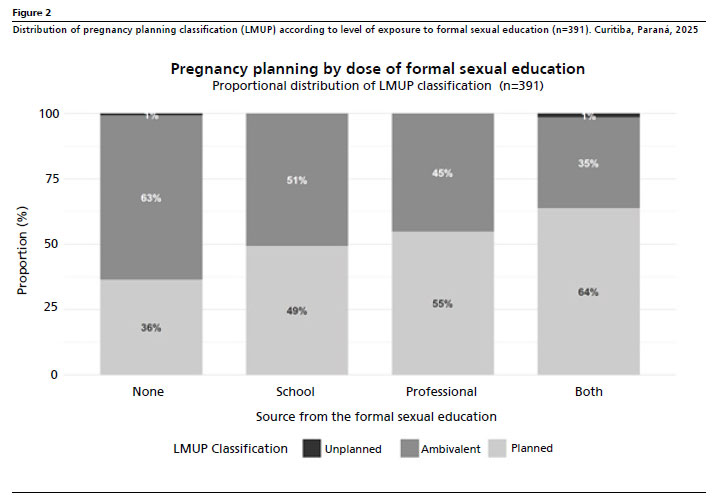
p=0.059) — a 4.6% variation compared to the model with the original LMUP. This result suggests stability of the estimate in the face of potential circularity between partner support and item 5 of the LMUP, although the stability test does not formally establish the absence of endogeneity. The proportion of unplanned pregnancies decreased with the level of exposure to formal sexual education: 63.5% (no source), 50.6% (school), 45.2% (health professional), and 36.2% (both). However, after adjusting for covariates in the Poisson model, the trend test did not reach significance (incremental PR=0.94;
p=0.237), suggesting that a substantial portion of the crude gradient may be attributable to confounding by covariates (Figure 2).
In the ≥26 years subgroup (n=241), formal sexual education had an PR=1.42 (95%CI=1.04–1.93;
p=0.027), while in the ≤25 years subgroup (n=150), PR=0.99 (
p=0.89). The interaction test was not significant (LR
p=0.181), but the exploratory difference suggests a possible long-term cumulative effect. In the SUS subgroup (n=260), the PR was 1.07 (
p=0.48), indicating that the association in the total sample arises from the contrast between SUS and non-SUS populations. Excluding the 17 participants under 18 years of age did not alter the main estimate (PR=1.20; 95%CI=0.98–1.47;
p=0.076).
DiscussionThis study investigated the association between formal sexual education and pregnancy planning using prevalence ratios estimated by Poisson with robust variance—an appropriate measure for the observed prevalence of 52.2%.
16,17 The absence of formal sexual education showed a modest association (PR 1.17) with a consistent direction across eight model specifications, significant in two and borderline in three. The estimated point E-value (1.61) quantifies the magnitude of residual confounding required to reverse the point prevalence ratio.
18 However, since the confidence interval of the main estimate crosses the unit (95%CI=0.96–1.42), the E-value does not establish the absence of confounding, but only quantifies the magnitude that such confounding would need to assume. The test using the LMUP recalculated without item 5 suggests stability of the estimate in the face of potential circularity between partner support and item 5 of the score—although we acknowledge that the test does not formally establish the absence of endogeneity, but only stability in the face of one of the potential sources of circularity.
The prevalence of unplanned pregnancy (52.2%) is consistent with the national estimate of 55.4% by Theme-Filha
et al.
2 and with the 65.7% reported by Gallardo-Alvarado
et al.
9 and 67.5% by Nilson
et al.
19 The difference may be attributed to the inclusion of pregnant women with supplementary health in the present sample.
The lack of association between contraceptive knowledge and pregnancy planning is the most robust finding of this study. The tertiles of contraceptive method knowledge were not associated with the outcome in any of the eight specifications tested, nor was prior contraceptive use. In contrast, formal sexual education showed a consistent, albeit modest, association. This dissociation suggests that knowledge of methods does not automatically translate into pregnancy planning, and that formal sexual education may operate through mechanisms that transcend the informational dimension—a hypothesis that requires investigation in studies with appropriate designs. UNESCO's International Technical Guidance on Sexuality Education
20 distinguishes components of comprehensive sexuality education that go beyond biomedical content: values and attitudes, communication and decision-making skills, and reproductive agency.
Gallardo-Alvarado
et al.
9 reported that schooling (OR=1.61) was associated with unplanned pregnancy and suggested that access to higher education is important for information on sexual and reproductive health. In the present study, schooling (incomplete higher education) reached significance as a distal variable (PR=1.87;
p=0.009), but formal sexual education, in the intermediate block, added an independent association with a stable direction. The PR for formal education remained stable between Models 2 and 3 (variation of 1.8%), indicating that the addition of proximal variables did not substantially mediate this association.
In the ≥26-year-old subgroup, the association was significant (PR=1.42;
p=0.027), while in the ≤25-year-old subgroup it was null (PR=0.99). This exploratory finding is plausible: older women had more time for sexual education they received to influence reproductive trajectories, and their schooling occurred prior to recent discussions about restricting sexual education in schools. It should be noted that the absence of formal interaction (
p=0.181) precludes a definitive conclusion.
International evidence on sexual education and unintended pregnancy is ambiguous. The Cochrane review
12 concluded that the evidence was insufficient—with substantial heterogeneity and low quality—to establish an effect, not that the effect was absent. The JACK trial
13 found no effect on the primary outcome but identified relevant secondary effects. These studies evaluated one-time interventions with short follow-up. The difference between a one-time intervention and cumulative exposure over a lifetime may explain why the present study identifies a signal that those studies did not detect. In the secondary analysis with partner support, this variable showed an PR of 1.31 (
p=0.034), consistent with findings by Hoga and Manganiello
21 on the importance of the relational bond, and with Gallardo-Alvarado
et al.
9 The interpretability of this estimate is limited by overlap with item 5 of the LMUP.
The observed limitations were: first, the cross-sectional design precludes causal inference. Second, the variable for formal sexual education is based on retrospective self-report, subject to differential recall bias—pregnant women with planned pregnancies may more easily recall the sexual education they received, inflating the association. However, the opposite hypothesis (rumination effect—pregnant women with an unwanted outcome revisit their history more often) is also plausible, and the direction of the bias cannot be determined empirically in this design. Third, data collection via Google Forms may have underrepresented pregnant women with lower digital literacy; the plausibility of this hypothesis stems from the correlation between digital literacy, schooling, and access to formal sexual education, although the magnitude of the bias cannot be determined. Fourth, the measure of formal sexual education is dichotomous and heterogeneous, with no details regarding content, duration, quality, or timing of exposure. A single lecture at school and a continuous comprehensive sex education program (as defined by UNESCO)
20 are classified identically, which may attenuate the observed association. Fifth, residual confounding by socioeconomic status cannot be ruled out, although the E-value of 1.61 indicates that a confounder would need to be moderately strong to nullify the finding. Sixth, the association was not significant in the SUS subgroup (PR=1.07;
p=0.48), suggesting that the effect observed in the total sample depends on the contrast between populations with distinct socioeconomic profiles. Seventh, the 16 missing data points on the number of children (4.1%) were treated as complete cases, assuming MCAR. Eighth, the data collection design—using a freely accessible digital form via a link provided while waiting for prenatal appointments—makes it impossible to accurately quantify the number of pregnant women were approached for participation who chose not to access the form. This operational limitation prevents the calculation of the refusal rate and calls for caution in interpreting the generalizability of the findings to all pregnant women attended at the maternities during the data collection period. We acknowledge that this limitation may introduce unmeasurable selection bias, particularly if the pregnant women who agreed to participate differed systematically from those who did not access the form in characteristics associated with exposure (formal sexual education) and the outcome (pregnancy planning). Future studies on this topic should consider active-recruitment designs with recording of refusals to allow for formal assessment of selection bias.
The strengths were: the use of Poisson prevalence ratios with robust variance, appropriate for the prevalence of the outcome; the presentation of eight model specifications with E-values allows the reader to assess the robustness of the association regardless of analytical choices; the test using LMUP recalculated without item 5 is, to our knowledge, unprecedented in the Brazilian literature and directly addresses concerns regarding the endogeneity of partner support; the demonstration that contraceptive knowledge is robustly unassociated with pregnancy planning constitutes a relevant conceptual contribution.
Implications: if confirmed by longitudinal studies, the association between formal sexual education and pregnancy planning would support the relevance of policies that combine information on methods with broader components of comprehensive sex education—as recommended by the BNCC
10 ,the PSE
11 and UNESCO guidelines.
20 The lack of a strong association between contraceptive knowledge and family planning suggests that policies focused exclusively on disseminating information about methods may be insufficient.
References1. Bearak J, Popinchalk A, Ganatra B, Moller AB, Tunçalp Ö, Beavin C,
et al. Unintended pregnancy and abortion by income, region, and the legal status of abortion: estimates from a comprehensive model for 1990–2019. Lancet Glob Health. 2020 Sep; 8 (9): e1152–61. doi:10.1016/S2214-109X(20)30315-6
2. Theme-Filha MM, Baldisserotto ML, Fraga ACSA, Ayers S, Gama SGN, Leal MC. Factors associated with unintended pregnancy in Brazil: cross-sectional results from the Birth in Brazil National Survey, 2011/2012. Reprod Health. 2016 Oct; 13 (S3): 118. doi:10.1186/s12978-016-0227-8
3. Moreira LR, Ewerling F, Santos IS, Wehrmeister FC, Matijasevich A, Barros AJD,
et al. Trends and inequalities in unplanned pregnancy in three population-based birth cohorts in Pelotas, Brazil. Int J Public Health. 2020 Dec 13; 65 (9): 1635-45. doi:10.1007/s00038-020-01505-0
4. Gariepy AM, Lundsberg LS, Miller D, Stanwood NL, Yonkers KA. Are pregnancy planning and pregnancy timing associated with maternal psychiatric illness, psychological distress and support during pregnancy? J Affect Disord. 2016 Nov; 205: 87-94. doi:10.1016/j.jad.2016.06.058
5. Barrett G, Smith SC, Wellings K. Conceptualisation, development, and evaluation of a measure of unplanned pregnancy. J Epidemiol Community Health (1978). 2004 May; 58 (5): 426-33. doi:10.1136/jech.2003.014787
6. Borges ALV, Barrett G, Santos OA, Nascimento NC, Cavalhieri FB, Fujimori E. Evaluation of the psychometric properties of the London Measure of Unplanned Pregnancy in Brazilian Portuguese. BMC Pregnancy Childbirth. 2016 Dec 24; 16 (1): 244. doi:10.1186/s12884-016-1037-2
7. Prietsch SOM, González-Chica DA, Cesar JA, Mendoza-Sassi RA. Gravidez não planejada no extremo Sul do Brasil: prevalência e fatores associados. Cad Saúde Pública. 2011 Oct; 27 (10): 1906-16. doi:10.1590/S0102-311X2011001000004
8. Vieira CS, Braga GC, Cruz Lugarinho PT, Stifani BM, Bettiol H, Barbieri MA,
et al. Sociodemographic factors and prenatal care behaviors associated with unplanned pregnancy in a Brazilian birth cohort study. Int J Gynecol Obstet. 2020 Nov; 151 (2): 237–43. doi:10.1002/ijgo.13305
9. Gallardo-Alvarado N, Antunes Lopes J V., Cecatti JG, Camas-Castillo M, Souza RT, Bahamondes L. Sociodemographic and reproductive characteristics of pregnant women with unplanned pregnancy residing in the state of São Paulo, Brazil: a cross-sectional study. The European Journal of Contraception & Reproductive Health Care. 2025 May 4; 30 (3): 137–43. doi:10.1080/13625187.2025.2457082
10. Ministério da Educação (BR). Base Nacional Comum Curricular: educação é a base. Brasília (DF): MEC; 2018 [access in 2026 Abr 10]. Available from:
http://basenacionalcomum.mec.gov.br/11. Ministério da Saúde (BR), Ministério da Educação (BR). Portaria Interministerial nº 1.055, de 25 de abril de 2017. Redefine as regras e os critérios para adesão ao Programa Saúde na Escola. Brasília (DF): Diário Oficial da União; 26 abr 2017. [access in 2026 Abr 10]. Available from:
https://bvsms.saude.gov.br/bvs/saudelegis/gm/2017/pri1055_26_04_2017.html 12. Oringanje C, Meremikwu MM, Eko H, Esu E, Meremikwu A, Ehiri JE. Interventions for preventing unintended pregnancies among adolescents. Cochrane Database of Systematic Reviews. 2016 Feb 3; 2016 (2). doi:10.1002/14651858.CD005215.pub3
13. Lohan M, Brennan-Wilson A, Hunter R, Gabrio A, McDaid L, Young H, et al. Effects of gender-transformative relationships and sexuality education to reduce adolescent pregnancy (the JACK trial): a cluster-randomised trial. Lancet Public Health. 2022 Jul; 7 (7): e626–37. doi:10.1016/S2468-2667(22)00117-7
14. von Elm E, Altman DG, Egger M, Pocock SJ, Gøtzsche PC, Vandenbroucke JP. The Strengthening the Reporting of Observational Studies in Epidemiology (STROBE) statement: guidelines for reporting observational studies. J Clin Epidemiol. 2008 Apr; 61 (4): 344–9. doi:10.1016/j.jclinepi.2007.11.008
15. Victora CG, Huttly SR, Fuchs SC, Olinto MT. The role of conceptual frameworks in epidemiological analysis: a hierarchical approach. Int J Epidemiol. 1997 Feb 1; 26 (1): 224–7. doi:10.1093/ije/26.1.224
16. Barros AJ, Hirakata VN. Alternatives for logistic regression in cross-sectional studies: an empirical comparison of models that directly estimate the prevalence ratio. BMC Med Res Methodol. 2003 Oct 20;3 (1):21. doi:10.1186/1471-2288-3-21
17. Zou G. A Modified Poisson Regression Approach to Prospective Studies with Binary Data. Am J Epidemiol. 2004 Apr 1;159 (7): 702–6. doi:10.1093/aje/kwh090
18. VanderWeele TJ, Ding P. Sensitivity Analysis in Observational Research: Introducing the E-Value. Ann Intern Med. 2017 Aug 15;167 (4): 268–74. doi:10.7326/M16-2607
19. Nilson TV, Amato AA, Resende CN, Primo WQSP, Nomura RMY, Costa ML,
et al. Gravidez não planejada no Brasil: estudo nacional em oito hospitais universitários. Rev Saude Publica. 2023 Jun 12; 57 (1): 35. doi:10.11606/s1518-8787.2023057004449
20. UNESCO. International technical guidance on sexuality education: an evidence-informed approach; 2018. doi:10.54675/UQRM6395
21. Hoga LAK, Manganiello A. Male behaviours towards unplanned pregnancy: experiences of Brazilian low‐income women. Int Nurs Rev. 2007 Dec 22; 54 (4): 346–53. doi:10.1111/j.1466-7657.2007.00513.x
Authors' contributionsRogeski KG: conceptualization, data curation, research, methodology, manuscript drafting.
Grillo FL: formal analysis, methodology, project management, software, validation, visualization, manuscript drafting.
Santos AL, Moreira Terra Silva B: data curation, research, methodology, manuscript drafting.
Pereira Lopes B, Ogasavara Beggiato CMS, Mandalis SS: data curation, visualization, manuscript drafting.
Sviesk Sprung L: conceptualization, methodology, supervision, manuscript drafting.
All authors approved the final version of the article and declare that there is no conflict of interest.
Data availabilityThe entire dataset supporting the results of this study has been published in the article itself.
Received on April 29, 2026
Final version presented on June 4, 2026
Approved on June 8, 2026
Associated Editor: Melania Amorim


 ; Felipe Lopes Grillo2







 Ler em português
 Download PDF
 Imprimir
 Enviar este artigo por email
 Como citar este artigo
 Enviar um comentário
 Mendeley
 Pocket
 Compartilhar no Facebook
 Compartilhar no Twitter