IntroductionMetachromatic leukodystrophy (MLD) is a rare autosomal recessive lysosomal storage disease, with an estimated incidence ranging from 1:40,000 to 1:160,000 live births.
2 It is caused by a deficiency in the lysosomal enzyme Arylsulfatase A (ARSA), which leads to sulfatide accumulation in the central and peripheral central nervous systems and the progressive destruction of the myelin sheath.
1,2The late-infantile form, accounting for 50% to 60% of cases, manifests between six and 30 months of age, with psychomotor regression, spasticity, seizures, and loss of speech and gait, evolving to spastic tetraplegia.
2 Diagnosis combines neuroimaging, measurement the Arylsulfatase A activity, and genetic analysis – frequently via exome sequencing – although isolate molecular confirmation may be sufficient in the presence of a characteristic clinicoradiological phenotype.
3Given the progressive and incurable nature of the late-infantile form, palliative pediatric care (PPC) constitutes the central management strategy, ideally integrated from the time of diagnosis.
4,5 However, its early implementation depends on recognizing clinical milestones, progressive communication with families in the face of anticipatory grief, and overcoming institutional barriers.
This study reports the case of a child with late-infantile MLD followed in a Brazilian public healthcare service, with the aim of describing the clinical trajectory, elucidating the decision-making milestones that guided the formal integration of PPC, and providing applicable lessons for pediatric clinical practice.
DescriptionA 3-year-11-month-old male patient was admitted to a public referral hospital in the interior of the state of São Paulo, with a confirmed diagnosis of metachromatic leukodystrophy.
On physical examination: The patient was pale, dehydrated (1+/4+), edematous (1+/4+), and hypotonic, with absent deep tendon reflexes. He had a tracheostomy (on continuous nebulization at 1 L/min), a Port-A-Cath, a gastrostomy tube (G-tube), and a sacral pressure injury with areas of hyperemia and necrosis. Clinically, he was in respiratory distress with transmitted rhonchi and a prolonged expiratory phase. Weight: 11.4 kg.
Medications: Clonazepam (2 mg q12h), phenytoin (100 mg q12h), gabapentin (300 mg q8h), baclofen (10 mg q12h), salbutamol inhaler (100 mcg, 5 puffs q4h), atropine (0.25 mg/mL q6h), fluticasone (250 mcg, 1 puff/day), and continuous intravenous morphine infusion (30 mcg/kg/h). Diet: Filtered water (80 mL q4h) and elemental infant formula (100 mL q4h) via G-tube.
Fourth child of non-consanguineous parents: the first pregnancy resulted in fetal demise at the fifth month, the second in an early miscarriage, and the third in a healthy girl. During the fourth pregnancy, prenatal care was regular, complicated by gestational hypertension from the fourth month, which was controlled with methyldopa. He was born at term (38 weeks and 1 day) via cesarean section, weighing 3,670 g, with a length of 50 cm, a head circumference of 35 cm, and Apgar scores of 8 and 9. Newborn screening was unremarkable.
Neuropsychomotor development: Development was appropriate until 1 year of age, with head control at 3 months, sitting unsupported at 6 months, first meaningful words at 8 months, walking with support at 9 months, and walking unsupported at 1 year of age.
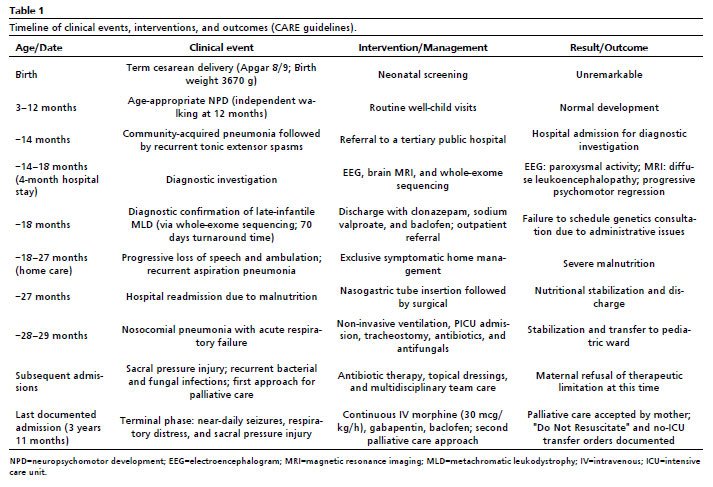
At 14 months of age, following an episode of pneumonia treated in his hometown, he developed recurrent and progressive extensor spasms of the limbs (lasting approximately 5 minutes per episode). He was transferred to the referral hospital, where he remained admitted for 4 months. Diagnostic workup revealed paroxysmal activity on electroencephalography (EEG) and diffuse leukoencephalopathy on magnetic resonance imaging (MRI). Psychomotor regression following normal initial development, combined with diffuse leukoencephalopathy, prompted a differential diagnosis of infantile-onset leukodystrophies – metachromatic leukodystrophy, Krabbe disease, Canavan disease, and X-linked adrenoleukodystrophy. Exome sequencing, requested during this admission, was completed 70 days after sample collection and confirmed MLD. This diagnosis was considered sufficient given the characteristic clinicoradiological presentation and phenotypic concordance, without the need for leukocyte Arylsulfatase A assay or urinary sulfatide screening. Molecular confirmation relied on the demonstration of biallelic pathogenic variants in ARSA. In this context, distinguishing these from ARSA pseudodeficiency alleles – common variants that reduce enzymatic activity without causing the disease – is a crucial step. This highlights that an exclusively molecular confirmation, lacking biochemical corroboration, is a recognized limitation.
2 During this period, psychomotor regression progressed, culminating in the loss of speech and gait.
He was discharged on clonazepam, sodium valproate, and baclofen, with instructions for outpatient genetics follow-up – an appointment that was not scheduled due to logistical challenges within the healthcare service. Over the subsequent 9 months, he remained under exclusive home care provided by his mother, presenting with complete loss of speech and gait, progressive dysphagia, and recurrent aspiration. Oral intake became unfeasible even for liquids, culminating in severe malnutrition that required readmission.
During readmission, a nasogastric tube was inserted, followed by a surgical gastrostomy. One month after discharge, he returned with diarrhea (six episodes/day) and vomiting, later developing pneumonia. This required noninvasive ventilation and transfer to the pediatric intensive care unit (PICU), where he received antibiotic and antifungal therapy. One week later, due to respiratory deterioration, a tracheostomy was indicated. Following partial stabilization, he was discharged but soon returned to the emergency department presenting with vomiting and bloody stools.
Throughout consecutive admissions, the anticonvulsant regimen was adjusted, with phenytoin replacing sodium valproate due to inadequate seizure control. The patient developed a hard-to-heal sacral pressure injury – secondary to prolonged immobility – and recurrent bacterial and fungal infections, predisposed by the use of invasive devices and continuous antibiotic therapy.
During this final admission, the multidisciplinary team reopened discussions regarding palliative care. Initially, the mother refused any therapeutic limitations. Upon the second approach, after establishing rapport with the palliative care physician and discussing the irreversible nature of the disease, she understood the goals of palliative care—comfort and quality of life. She accepted the proposed management, documenting her agreement in the medical record with a do-not-resuscitate (DNR) order and withholding transfer to the ICU. Invasive procedures and diagnostic tests were discontinued.
During one of their final conversations, the palliative care physician asked, "Do you think your son is happy?" The mother replied, "He used to be. I don't think he is anymore, because he can no longer smile." This exchange illustrates the trust built throughout the process and the mother's willingness to actively participate in decision-making regarding her son's care.
At the end of the documented period, the patient remained hospitalized under palliative care, managed by a multidisciplinary team (pediatricians, a geneticist, nursing staff, a dietitian, and a physical therapist). The father was absent from the patient's care. The 10-year-old, apparently healthy sister was a source of concern for the mother regarding emotional support, as the mother focused her attention entirely on the patient. The medical team later learned of the patient's passing, which occurred after the follow-up period; the exact date and circumstances could not be retrieved.
DiscussionThis case report was prepared in accordance with the CARE (CAse Report) guidelines.
6 The completed CARE checklist is provided as a supplementary material, and Table 1 presents the clinical timeline, addressing item 7.
Late-infantile MLD is classified under Group 3 of the conditions eligible for PPC—progressive diseases without curative options from the time of diagnosis.
5 Recognizing this category has direct clinical implications: the formal integration of PPC should occur at the time of diagnostic confirmation, adopting an early model concurrent with active symptom management. This approach is superior to the traditional model – which is restricted to the terminal phase – regarding quality of life, symptom control, and family support.
7Although disease-modifying therapies for MLD exist, their applicability is critically dependent on the disease stage. Allogeneic hematopoietic stem cell transplantation (HSCT) offers limited benefit, which varies by disease form and stage, showing better outcomes in later-onset variants during the presymptomatic phase.
8 Gene therapy with atidarsagene autotemcel (arsa-cel) – approved by the European Medicines Agency (2020) and the U.S. Food and Drug Administration (2024) for early-onset variants – preserves motor and cognitive functions as well as myelination.
9,10 Both therapies rely on a presymptomatic window, which was unfeasible in this case, as the diagnosis was established after psychomotor regression had already occurred. This limitation reinforces PPC as the central strategy and highlights the crucial role of newborn screening for presymptomatic detection, which has not yet been incorporated into the Brazilian National Newborn Screening Program.
Three clinical milestones indicated the need for formal PPC integration but were progressively overlooked: (i) genetic confirmation via exome sequencing, establishing the diagnosis of a progressive and fatal neurodegenerative disease; (ii) the irreversible loss of speech and gait during the diagnostic admission, indicating the rapid pace of neurological deterioration; and (iii) dysphagia and aspiration during home care, signaling advanced bulbar involvement and an imminent risk of respiratory complications. Each milestone, in isolation, constitutes a recognized trigger for structured goals-of-care discussions.
11Pharmacological management followed current recommendations. Analgesia was based on the World Health Organization (WHO) two-step approach for pediatric pain, which recommends avoiding weak opioids – such as codeine and tramadol – and, when non-opioids are insufficient, directly initiating low-dose strong opioids.
12 In this context, a low-dose continuous morphine infusion (30 mcg/kg/h) was used for refractory pain. Gabapentin was employed as an adjuvant analgesic, a category distinct from the analgesic ladder itself. The combined regimen – clonazepam and phenytoin as anticonvulsants, and baclofen as a muscle relaxant – effectively controlled seizures and spasticity, which are characteristic of advanced-stage MLD.
2Communication with the family followed a well-described pattern in pediatric PPC: initial refusal followed by progressive acceptance after establishing rapport with the palliative care team. The mother, the sole caregiver following the father's absence, initially rejected any therapeutic limitations – an expected response given the anticipatory grief and the stigma of abandonment often associated with palliative care. Acceptance was fostered through dialogues centered on her perception of her son's quality of life, exemplified by the question regarding his happiness. This is a technique that clarifies family values and enables shared decision-making.
11The decisions to withhold ICU transfer and to establish a do-not-resuscitate (DNR) order in the event of cardiopulmonary arrest – agreed upon with the mother and documented in the medical record – embody the core principles of PPC: comfort, dignity, family autonomy, and the limitation of futile interventions in the context of irreversibility.
The sacral pressure injury, aside from being a complication of prolonged immobility, should be interpreted as an indicator of the terminal phase in bedridden children with progressive diseases. It signals the need to intensify comfort measures, frequent repositioning, topical wound care, and the reassessment of goals of care.
Contextual factors shaped the patient's clinical trajectory. Palliative care provision within the Brazilian Unified Health System (SUS) has remained heterogeneous and dependent on individual institutional initiatives for decades, which delayed formal access in this case.4 In May 2024, the Ministry of Health Ordinance GM/MS No. 3.681 established the National Palliative Care Policy within the SUS,
13 a milestone that may facilitate early integration, although its effective implementation depends on local healthcare facility authorization. Maternal burden – exacerbated by the father's absence and a lack of support networks – and the impact on the 10-year-old sister reinforce the need to extend care to the entire family unit.
11,14This report has limitations inherent to its design: it is a single-center study; the patient's perspective was inaccessible due to his age and terminal stage, making the mother the primary source of subjective data. It was not possible to obtain follow-up after the documented hospitalization, nor to compare the clinical course with other cases. Strengths include the diagnostic confirmation via exome sequencing, the detailed documentation following the CARE guidelines, and the record of the family's perspective.
Written informed consent for the publication of this case report, including clinical data, images, and the course of care, was obtained from the patient's mother as his legal guardian, following approval by the Research Ethics Committee (i.e., Institutional Review Board) of FCMS/PUC-SP (protocol number 7.929.648; CAAE: 92246125.0.0000.5373). The signed informed consent form is available to the editors upon request, in accordance with privacy safeguards established by the Brazilian National Health Council (Resolution CNS 466/2012) and the General Data Protection Law (Law No. 13.709/2018).
Clinical lessonsFive key lessons apply to pediatric practice: (i) in children with progressive neurodegenerative diseases without curative options—such as late-infantile MLD – PPC must be integrated into the care plan at the time of diagnosis, rather than deferred to the terminal phase; (ii) initial family resistance to palliative care is predictable and does not contraindicate the approach, representing an opportunity to establish a therapeutic alliance; (iii) in the presence of psychomotor regression, dysphagia, or bulbar involvement, discussions regarding alternative nutritional support, respiratory management, and goals of care must precede acute clinical deterioration; (iv) analgesic management should follow the WHO two-step approach, transitioning directly from non-opioids to low-dose strong opioids; and (v) in bedridden children with progressive diseases, pressure injuries serve as indicators of the terminal phase, necessitating an intensification of comfort measures and a reassessment of therapeutic goals.
ConclusionThis report highlights the trajectory of a child with late-infantile MLD and the challenges of integrating PPC. The sequential identification of clinical milestones – specifically three decision-making markers (genetic confirmation, psychomotor regression, and dysphagia with aspiration) and the sacral pressure injury as an indicator of the terminal stage – guided the discussion of goals of care, pharmacological management, and shared decision-making with the family.
The multidisciplinary approach, centered on both patient and family, proved effective in achieving symptom control and facilitating end-of-life decision-making with autonomy and serenity. This case reinforces the necessity of integrating PPC into the SUS from the initial diagnosis of progressive, incurable diseases, structuring palliative care as an extension of the therapeutic bond – rather than its interruption – and encompassing family unit within the care plan.
References1. Ashrafi MR, Amanat M, Garshasbi M, Kameli R, Nilipour Y, Heidari M,
et al. An update on clinical, pathological, diagnostic, and therapeutic perspectives of childhood leukodystrophies. Expert Rev Neurother. 2020; 20 (1): 65-84. doi: 10.1080/14737175.2020.1699060.
2. Gomez-Ospina N. Arylsulfatase A deficiency. In: Adam MP, Feldman J, Mirzaa GM, Pagon RA, Wallace SE, Bean LJ,
et al., editors. GeneReviews® [
Internet]. Seattle (WA): University of Washington; 1993. [access in 2023 Dec 5]. Available from:
http://www.ncbi.nlm.nih.gov/books/NBK1130/3. Udupa P, Ghosh DK. Implementation of exome sequencing to identify rare genetic diseases. Methods Mol Biol. 2024; 2719: 79-98. doi: 10.1007/978-1-0716-3461-5_5.
4. Paiva CF, Santos TCF, Costa LDMC, Almeida Filho AJD. Trajetória dos cuidados paliativos no mundo e no Brasil. In: Peres MAA, Padilha MI, organizadoras. Potencial interdisciplinar da enfermagem: histórias para refletir sobre o tempo presente. Brasília (DF): Editora ABEn; 2022. p. 41-9.
5. Fondazione Maruzza Lefebvre D'Ovidio Onlus. Cuidados paliativos para recém-nascidos, crianças e jovens. Rome: Fondazione Maruzza Lefebvre D'Ovidio Onlus; 2009.
6. Riley DS, Barber MS, Kienle GS, Aronson JK, von Schoen-Angerer T, Tugwell P,
et al. CARE guidelines for case reports: explanation and elaboration document. J Clin Epidemiol. 2017; 89: 218-235. doi: 10.1016/j.jclinepi.2017.04.026.
7. D'Alessandro MPS, Barbosa LC, Anagusko SS, Maiello APMV, Conrado CM, Pires CT, Forte DN, editores. Manual de cuidados paliativos. 2ª. ed. São Paulo: Hospital Sírio-Libanês; Ministério da Saúde; 2023. [access in 2026 Abr 5]. Available from:
https://www.gov.br/saude/pt-br/centrais-de-conteudo/publicacoes/guias-e-manuais/2023/manual-de-cuidados-paliativos-2a-edicao/view8. Boucher AA, Miller W, Shanley R, Ziegler R, Lund T, Raymond G,
et al. Long-term outcomes after allogeneic hematopoietic stem cell transplantation for metachromatic leukodystrophy: the largest single-institution cohort report. Orphanet J Rare Dis. 2015; 10: 94. doi: 10.1186/s13023-015-0313-y.
9. Fumagalli F, Calbi V, Natali Sora MG, Sessa M, Baldoli C, Rancoita PMV,
et al. Lentiviral haematopoietic stem-cell gene therapy for early-onset metachromatic leukodystrophy: long-term results from a non-randomised, open-label, phase 1/2 trial and expanded access. Lancet. 2022; 399 (10322): 372-83. doi: 10.1016/S0140-6736(21)02017-1.
10. Sessa M, Lorioli L, Fumagalli F, Acquati S, Redaelli D, Baldoli C,
et al. Lentiviral haemopoietic stem-cell gene therapy in early-onset metachromatic leukodystrophy: an ad-hoc analysis of a non-randomised, open-label, phase 1/2 trial. Lancet. 2016; 388 (10043): 476-87. doi: 10.1016/S0140-6736(16)30374-9.
11. Kolmar A, Hueckel RM, Kamal A, Dickerman M. Top ten tips palliative care clinicians should know about caring for children in neonatal and pediatric intensive care units. J Palliat Med. 2019; 22 (9): 1149-53. doi: 10.1089/jpm.2019.0378.
12. World Health Organization (WHO). WHO guidelines on the pharmacological treatment of persisting pain in children with medical illnesses. Geneva: WHO; 2012. [access in 2026 Abr 5]. Available from:
https://iris.who.int/handle/10665/4454013. Ministério da Saúde (BR). Portaria GM/MS n.º 3.681, de 7 de maio de 2024. Institui a Política Nacional de Cuidados Paliativos (PNCP), no âmbito do Sistema Único de Saúde, por meio da alteração da Portaria de Consolidação GM/MS n.º 2, de 28 de setembro de 2017. Brasília (DF): DOU 22 maio 2024. [access in 2026 Abr 5]. Available from:
https://bvsms.saude.gov.br/bvs/saudelegis/gm/2024/prt3681_22_05_2024.html14. Harrington M, Whalley D, Twiss J, Rushton R, Martin S, Huynh L,
et al. Insights into the natural history of metachromatic leukodystrophy from interviews with caregivers. Orphanet J Rare Dis. 2019; 14 (1): 89. doi: 10.1186/s13023-019-1060-2.
Data availabilityThe data supporting the findings of this case report are available from the corresponding author upon reasonable request, subject to approval by the Institutional Review Board of the originating institution and in accordance with the National Health Council Resolution CNS 466/2012. The data are not publicly available due to ethical restrictions regarding patient and family privacy.
Artificial Intelligence useThe authors declare the use of an assistive artificial intelligence tool (Claude, Anthropic) solely for editorial support, including structuring the manuscript according to CARE guidelines, ensuring internal consistency across sections, formatting the clinical timeline, and refining language. All scientific content – including the conception of the report, history taking, clinical description, diagnostic and therapeutic reasoning, discussion, clinical lessons, and conclusions – was entirely developed by the authors. The authors have critically reviewed all material produced with the aid of this tool and assume full responsibility for the content of the manuscript, in accordance with the recommendations of the International Committee of Medical Journal Editors (ICMJE, 2024).
Authors' contributionCavalcanti VB, Pereira VHN, Guimarães MR and Barbosa AC contributed equally to this work, according to the CRediT taxonomy for the following roles: conceptualization, data curation, investigation (review of physical and electronic medical records, laboratory and imaging results, and interview with the legal guardian), methodology, writing – original draft, writing – review & editing, validation and visualization. Pardo de Alexandre IMCG contributed to the academic and clinical supervision of the project. All authors approved the final version of the article and declare no conflicts of interest.
Received on June 2, 2026
Final version presented on June 11, 2026
Approved on June 15, 2026
Associated Editor: Melania Amorim


 ; Victória Hirano Nunes Pereira1







 Ler em português
 Download PDF
 Imprimir
 Enviar este artigo por email
 Como citar este artigo
 Enviar um comentário
 Mendeley
 Pocket
 Compartilhar no Facebook
 Compartilhar no Twitter