IntroductionHigh-risk pregnancy constitutes a major challenge for maternal and child health, as it is associated with a higher incidence of obstetric complications, the need for specialized follow-up, and an increased demand for hospitalizations.
1-3 Within the Brazilian Unified Health System (
Sistema Único de Saúde - SUS), these pregnancies concentrate a significant portion of medium- and high-complexity cases, impacting both maternal and neonatal outcomes and the demand for specialized healthcare services.
4-5In this context, efficient bed management in referral maternity hospitals remains a continuous challenge, particularly in regional hubs where the demand for high-complexity care is high.
Among the clinical conditions more frequently associated with high-risk pregnancy, hypertensive disorders and gestational diabetes mellitus stand out.
6 Both are recognized as important determinants of maternal and perinatal morbidity, requiring thorough clinical monitoring across the prenatal care, delivery, and postpartum periods.
7,8The presence of these comorbidities is associated with intensified care, an increased need for maternal-fetal surveillance, and, in many cases, prolonged hospital stays.
9 However, the impact of these pathologies on the length of stay may be mediated by necessary obstetric interventions, such as labor induction or cesarean section, as well as by therapeutic prematurity.
In this context, length of hospital stay is a relevant clinical outcome, as it reflects clinical severity, the gestational age, the type of delivery, and decisions made during obstetric management. Prolonged admissions are associated with increased exposure to hospital-acquired risks, greater consumption of healthcare resources, and a significant impact on bed occupancy, serving as a sensitive indicator of the complexity of care provided to high-risk pregnant women.
9Beyond clinical factors, high-risk pregnancy frequently occurs in a context marked by social and emotional vulnerabilities.
10 Hospitalization, the perception of maternal-fetal risk, and the uncertainty concerning the evolution of pregnancy may intensify stress, anxiety, and fear – elements that interact with physiological mechanisms and may influence clinical progression.
10 Therefore, although these factors are not the primary focus of biomedical care, they are part of the context in which clinical decision-making occurs and may impact the necessity and duration of hospital stays.
Despite the significance of this outcome, studies that assess the length of hospital stay in high-risk pregnant women using local data are still limited, particularly in medium-sized municipalities that serve as regional healthcare hubs.
5 Additionally, social and contextual factors are increasingly recognized as relevant elements to the determination of perinatal outcomes and complexity of the care provided to these pregnant women.
11Generating evidence at this territorial level is essential to understand the dynamics of obstetric care in the SUS and to inform strategies for organizing the maternal-child healthcare network.
Against this background, this study analyzed the length of hospital stay and associated factors in pregnant women admitted to a high-risk referral maternity hospital in the municipality of Feira de Santana, Bahia, considering the influence of obstetric and perinatal variables as potential mediators of this outcome.
MethodsThis is an observational analytical study with a retrospective cohort design, conducted using secondary data extracted from medical records. The study was carried out in a high-risk referral maternity hospital, located in the municipality of Feira de Santana, Bahia. The facility serves as a strategic regional hub within the SUS, ensuring high representativeness for high-risk obstetric care in the region. Notably, the unit admits both pregnant women with underlying conditions and those referred for specialized delivery support, which explains the clinical heterogeneity of the study sample.
The eligible population comprised all pregnant women admitted to the hospital between January 1 and December 31, 2024, totaling 1,333 initial records. Following a data completeness and consistency audit, 25 records (1.9%) were excluded due to duplication or missing critical information for baseline characterization, primarily regarding gestational age. Thus, 1,308 pregnant women remained for descriptive analyses.
For survival analyses, where the outcome was time to hospital discharge, 18 records (1.4%) were additionally excluded for having a length of stay of zero days. This exclusion met the technical requirements of survival models, which assume strictly positive times, and correctly excluded triage visits that did not result in hospitalization. Consequently, the sample for Kaplan–Meier analyses comprised 1,290 pregnant women. In this cohort, there were no censored observations (e.g., maternal deaths or transfers), as 100% of the included pregnant women reached the outcome of interest (hospital discharge) during the observation period.
In the multivariate Cox regression analysis, observations with missing data in the adjustment covariates (gestational age and type of procedure) were excluded via complete-case analysis (n=17), resulting in a final analytical sample of 1,273 pregnant women.
Convenience sampling was used, and no prior sample size calculation was performed. To assess the robustness of the findings, a post-hoc statistical power analysis was conducted for the final multivariate model. However, we acknowledge the methodological limitations of this approach, as observed power depends on the
p-value and the effect size obtained, and should not be interpreted as a prospective measure of the study's ability to detect differences.
The primary outcome was length of hospital stay, defined as the interval (in days) between the date of admission and the date of discharge. Pregnant women were categorized into four mutually exclusive clinical groups: no clinical comorbidities, isolated gestational diabetes mellitus, hypertensive disorders of pregnancy, and presence of associated comorbidities. In the absence of explicit records, cases were classified as having no comorbidities.
Statistical analysis included descriptive statistics for categorical variables, presented as frequencies. Length of stay was described using the median and interquartile range (IQR). The cumulative probability of stay was estimated using the Kaplan–Meier method, compared via the log-rank test. The choice of survival analysis is justified by the temporal nature of the outcome and the robustness of the Cox model in evaluating event rates over time, while allowing for adjustment by continuous and categorical covariates. To estimate independent associations, a multivariate Cox regression model was fitted, including the following covariates: gestational age (continuous), type of obstetric procedure (vaginal delivery, cesarean section, and others), and clinical classification. The proportional hazards assumption was assessed using Schoenfeld residuals. Additionally, a sensitivity analysis was conducted comparing models with and without the inclusion of the mode of delivery to investigate potential overadjustment bias due to a mediator variable.
All analyses were performed using R software, version 4.5.1, using the
survival (v3.5) and
survminer (v0.4.9) packages for model fitting and visualization, respectively. A significance level of 5% (α=0.05) was adopted. The study was approved by the Research Ethics Committee (Opinion no. 7.457.332). The report followed the STROBE statement guidelines,
12 accompanied by a flow diagram.
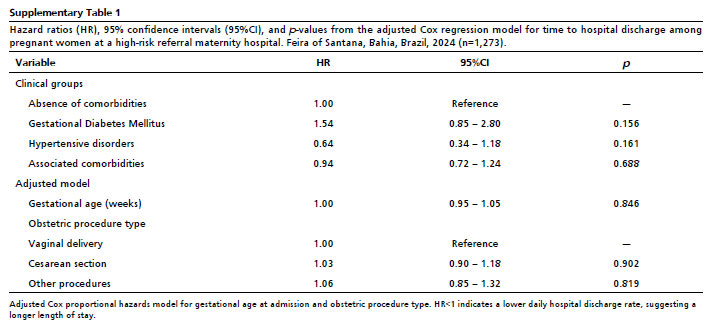
ResultsInitially, 1,333 medical records were identified during the study period. After excluding 25 records due to significant data inconsistencies, the study population for descriptive analysis consisted of 1,308 pregnant women. The detailed selection flow, including subsequent exclusions due to length of zero days (n=18) and missing data (n=17) for the final Cox model sample (n=1,273), is presented in Supplementary Table 1.
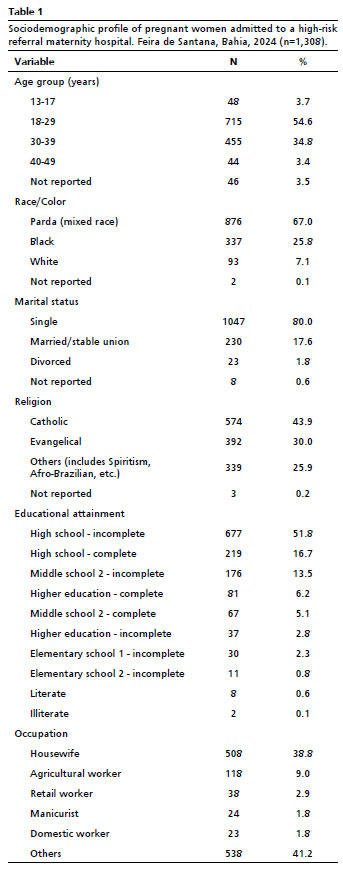
A predominantly young age profile was observed, with the highest concentration in the 18 to 29 age group (54.6%), followed by pregnant women aged 30 to 39 years (34.8%). Adolescents, aged 13 to 17, accounted for 3.7% of the sample, while women aged 40 years or older represented 3.4%. The median maternal age was 28 years, with an interquartile range (IQR) of 23 to 33 years.
Regarding sociodemographic characteristics, the majority of the pregnant women self-identified as
parda (mixed-race) (67.0%), followed by Black (25.8%) and White (7.1%). Regarding marital status, 80.0% reported being single, while 17.6% were married or in a stable union. Concerning education, completed high school was the most frequent (51.8%), followed by incomplete high school (16.7%). Only 9.0% of the pregnant women reported completed or ongoing higher education. The occupational profile was marked by a high proportion of informal labor, with a predominance of housewives and occupations categorized as "others," highlighting the greater socioeconomic vulnerability of the studied population. Forty-six records (3.5%) lacked information on maternal age (Table 1).
Regarding the clinical-obstetric profile of the total sample, most pregnant women had no clinical comorbidities recorded in their medical records, corresponding to 77.1% of the cases. Among those with a recorded clinical diagnosis, isolated hypertensive disorders were identified in 6.9% of admissions, while isolated gestational diabetes mellitus was present in 4.3%. The presence of associated comorbidities, including combinations of hypertensive disorders, gestational diabetes mellitus, and heart disease, was observed in 11.7% of the pregnant women.
Gestational age at admission showed wide variation, ranging from values consistent with early admissions to those near term. The median was approximately 34.7 weeks, with an interquartile range (IQR) of 27.0 to 38.3 weeks, indicating that half of the admissions occurred between the end of the second trimester and term.
In the total analyzed population, the length of hospital stay had a median of 4 days, with an IQR of 2 to 6 days. The distribution of the length of stay was right-skewed, with a predominance of short-term hospitalizations and the presence of prolonged stays, reflecting the clinical and care heterogeneity of obstetric admissions.
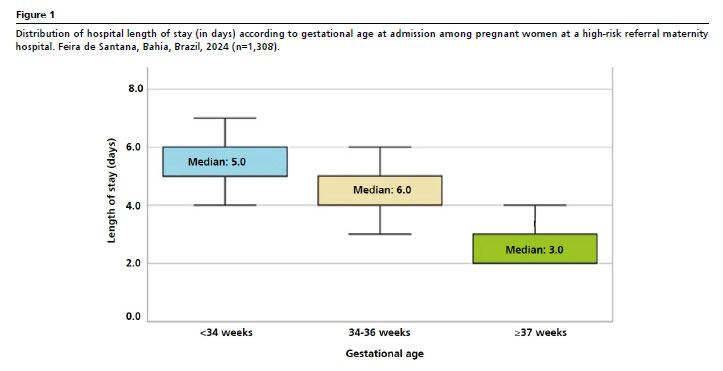
A statistically significant association was observed between gestational age at admission and length of hospital stay. Pregnant women admitted with a gestational age of less than 34 weeks had a longer length of stay, whereas those with a gestational age of 37 weeks or more remained hospitalized for a shorter period, with statistically significant differences between the groups (
p<0.001) (Figure 1).
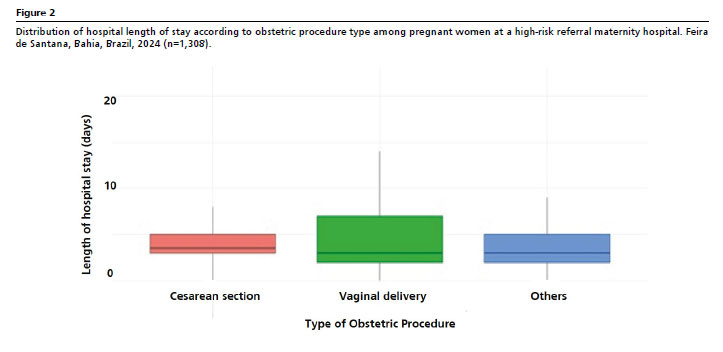
The type of obstetric procedure also influenced the length of hospital stay. Pregnant women undergoing cesarean sections had longer hospital stays compared to those undergoing vaginal delivery (
p<0.001). The "other obstetric procedures" category, which included admissions for clinical pregnancy complications, post-abortion curettage, and cervical cerclage, showed intermediate lengths of stay between the two groups. A greater dispersion in the length of stay was observed among women who underwent vaginal delivery, reflecting the clinical diversity of these admissions (Figure 2).
To analyze the time to hospital discharge, records with a length of stay of zero days—corresponding to admissions and discharges occurring on the same day—were excluded, as per the assumptions of survival models. The analytical subsample used for the survival analyses comprised 1,290 pregnant women.
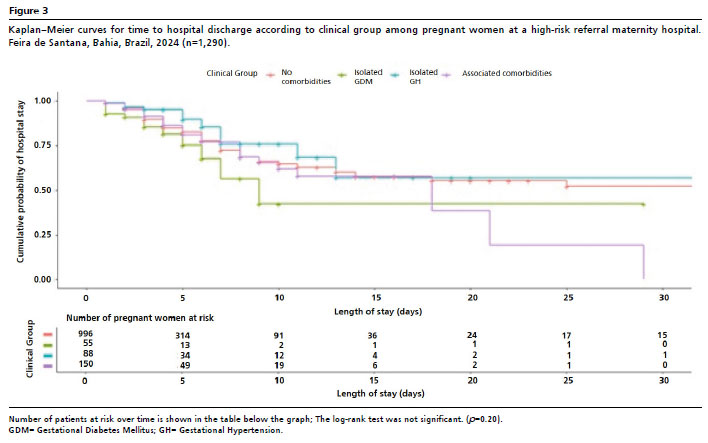
Pregnant women were classified into four mutually exclusive clinical groups: no comorbidities, isolated gestational diabetes mellitus, hypertensive disorders of pregnancy, and presence of associated comorbidities. Survival curves estimated by the Kaplan–Meier method showed no statistically significant differences in the time to hospital discharge among the clinical groups (log-rank test = 5.0;
df=3;
p=0.20), indicating similar hospital stay patterns over time (Figure 3). However, a marked reduction in the number of patients at risk was observed after the seventh day of hospitalization, particularly in the subgroups with comorbidities, which results in greater instability of the estimates at the tails of the curves.
In the multivariate analysis using the adjusted Cox regression model (n=1,273), no statistically significant association was observed between clinical conditions and time to hospital discharge. Model validity was confirmed by the Schoenfeld residuals test (
p=0.42). As shown in Table 2, gestational age (
HR=1.00; 95%CI=0.95–1.05;
p=0.846) and the type of obstetric procedure (Cesarean section:
HR=1.03; 95%CI=0.90–1.18;
p=0.902) also did not maintain a statistically significant association with the outcome in the final model.
A sensitivity analysis was performed to evaluate the potential mediation effect of the procedure type. In the model adjusted only for gestational age, hypertensive disorders showed a significant association with the length of stay (
HR=0.54; 95%CI=0.31–0.94;
p=0.028). In the full model, additionally adjusted for the type of procedure, this association was attenuated (
HR=0.64; 95%CI=0.34–1.18;
p=0.161), suggesting that part of the observed effect may be related to subsequent obstetric management, including the mode of delivery. The
post-hoc statistical power analysis revealed a power of 84.6% for the final model. Although this value indicates a numerically large sample, its interpretation must consider the limitations inherent to observed power in retrospective studies.
However, a trend toward a higher proportion of early discharges was observed in groups with a higher frequency of admissions for clinical pregnancy complications, reflecting the unit's care profile, in which a significant portion of admissions does not culminate in delivery and proceeds to discharge after clinical stabilization.
DiscussionThe present study analyzed the length of hospital stay for pregnant women admitted to a high-risk referral maternity hospital, demonstrating that the duration of hospitalizations varies according to maternal clinical characteristics, gestational age at admission, and type of obstetric procedure. These findings support the understanding of length of hospital stay as an indirect indicator of healthcare complexity in medium- and high-complexity settings, particularly in services that focus on the care of pregnant women with higher clinical and obstetric risk.
1,2Furthermore, social and contextual factors have been recognized as relevant determinants of perinatal outcomes and care complexity, which can indirectly influence the dynamics of hospital admissions.
11,13The length of stay analyzed reflected a heterogeneous set of clinical scenarios. A significant portion of admissions comprised pregnant women admitted for clinical complications who, after stabilization, were discharged within a short period. Conversely, a subset presented with persistent complications, requiring prolonged monitoring or obstetric intervention, resulting in longer stays. This heterogeneity is central to interpreting the length of stay as a multifactorial outcome influenced by clinical, obstetric, and organizational factors.
14-16In the descriptive analyses, a longer length of stay was observed among pregnant women with hypertensive disorders, those admitted at earlier gestational ages, and those who underwent cesarean sections. This pattern is consistent with guidelines recommending intensive monitoring in these cases.
6,17-20 However, in the adjusted multivariate analysis, no clinical condition maintained a statistically significant association with the time to discharge, which highlights the complexity of the phenomenon and the limitation of adjusted models in capturing relationships mediated by intermediate variables.
It is crucial to acknowledge the potential mediating role of delivery type and gestational age in the relationship between comorbidities and length of stay. As discussed in the epidemiological literature, adjusting for variables along the causal pathway between exposure and outcome can lead to overadjustment bias, resulting in the attenuation of true associations. In this context, premature delivery or surgical intervention often represents a direct consequence of the clinical severity of hypertensive disorders or diabetes; therefore, controlling for these variables in the Cox model may have artificially reduced the magnitude of the observed association.
Sensitivity analysis findings support this interpretation by demonstrating that, after excluding the type of procedure from the model, hypertensive disorders became statistically significantly associated with time to discharge. This result suggests that longer hospital stays do not result exclusively from the presence of the comorbidity, but rather from the interaction between the clinical condition and the obstetric management adopted, particularly those interventions involving greater care complexity and longer recovery times.
20Regarding hypertensive disorders of pregnancy, the loss of statistical significance in the final model reinforces that prolonged hospitalization results from a complex interaction between clinical severity, obstetric management, and hospital care organization. Individually, the adjustment covariates—gestational age and type of procedure—also did not show an independent association with the outcome, indicating that length of hospital stay cannot be understood through isolated determinants, but rather as the result of a dynamic, multifactorial arrangement.
Similarly, gestational diabetes mellitus did not show an independent association with the length of stay. However, robust evidence indicates that hyperglycemia during pregnancy is associated with adverse outcomes and a greater need for clinical monitoring,
21,22 which suggests that its influence on the length of stay may occur indirectly, mediated by clinical decisions, metabolic stability, and care organization.
Regarding gestational age at admission and mode of delivery, the lack of an independent association in the adjusted model suggests that, in high-risk contexts, these variables function more as markers of underlying clinical severity rather than as direct determinants of the length of stay.
It is noteworthy that the Kaplan–Meier curves did not show statistically significant differences between the groups. However, a marked reduction in the number of patients at risk was observed after the seventh day of hospitalization, especially in the gestational diabetes group, which leads to instability in the estimates at the tails of the curves, widening of confidence intervals, and limited statistical inference for more prolonged periods.
The internal validity of the model is supported by the fulfillment of the proportional hazards assumption (Schoenfeld
p=0.42). Although the
post-hoc statistical power analysis revealed a value of 84.6%, the use of this indicator to justify non-significant findings is widely questioned.
23In the same vein, Levine and Ensom
24 argue that post-hoc power calculation does not adequately assess sample sufficiency to detect relevant effects, being methodologically inadequate as a justification for the lack of an association.
Among the study's strengths, the large sample size and the application of appropriate statistical methods stand out. Presenting the sample selection flow according to the recommendations of von Elm
et al.
12 reinforces the methodological transparency and quality of the findings' reporting.
References1. Ministério da Saúde (BR). Manual de gestação de alto risco. Brasília (DF): Ministério da Saúde; 2022. [
Internet]. [access in 2025 Mai 5]. Available from:
https://bvsms.saude.gov.br/bvs/publicacoes/manual_gestacao_alto_risco.pdf2. Wolfson C, Angelson JT, Forrest AD, Michos ED, Ahmed S, Aina-Mumuney A,
et al. Comorbidities and pregnancy-related risk factors in patients with severe maternal morbidity: application of a validated obstetrical comorbidity scoring system to a surveillance-identified population. Healthcare. 2025; 13 (18): 2351. doi:10.3390/healthcare13182351
3. Oliveira NM, Santos GG. Mortalidade materna no Brasil entre o período de 2020 a 2023: estudo de base populacional. Gest Cuid Saúde. 2024; 1 (2): e13139. doi: 10.70368/gecs.v1i2.13139
4. Ministério da Saúde (BR). Política Nacional de Atenção Integral à Saúde da Criança (PNAISC). Brasília (DF): Ministério da Saúde; 2018. [
Internet]. [access in 2025 Mai 5]. Available from:
https://bvsms.saude.gov.br/bvs/publicacoes/politica_nacional_atencao_integral_saude_crianca_orientacoes_implementacao.pdf5. Rosa SMLG, Martins AG. Perfil epidemiológico das gestantes de alto risco no Amazonas: uma investigação de 2021 a 2022. Rev Eletr Acervo Saúde. 2023; 23 (11): e14337.
https://doi.org/10.25248/reas.e14337.20236. Ministério da Saúde (BR). Secretaria de Atenção Primária à Saúde. Nota Técnica Conjunta nº 251/2024. Brasília (DF): Ministério da Saúde; 2024. [
Internet]. [access in 2025 Mai 5]. Available from:
https://www.gov.br/saude/pt-br/centrais-de-conteudo/publicacoes/notas-tecnicas/2024/nota-tecnica-conjunta-no-251-2024-coemm-cgesmu-dgci-saps-ms-e-cgan-deppros-saps-ms.pdf7. Rio de Janeiro (Município). Secretaria Municipal de Saúde. Guia rápido do pré-natal 2025. Rio de Janeiro: Subpav; 2025. [
Internet]. [access in 2025 Mai 5]. Available from:
https://subpav.org/aps/uploads/publico/repositorio/Livro_GuiaRapido-PreNatal_PDFDigital_20250331.pdf8. Rio Grande do Sul (Estado). Secretaria Estadual da Saúde. Guia do pré-natal e puerpério na atenção primária à saúde (APS). Porto Alegre: SES/RS; 2024. [
Internet]. [access in 2025 Mai 5]. Available from:
https://atencaoprimaria.rs.gov.br/upload/arquivos/202404/25124004-guia-do-pre-natal-2024.pdf 9. Bolka A, Weldekidan Z. Length of hospital stay and its associated factors among women who gave birth by cesarean section in general hospitals of Sidama region, Ethiopia. PLoS Glob Public Health. 2025;5 (6): e0004582.
https://doi.org/10.1371/journal.pgph.000458210. Horwitz MEM, Dugas JN, McCloskey L, So-Armah K, Yarrington CD, de la Vega PB,
et al. Associations between Health-Related Social Needs and Postpartum Linkage to Care. Am J Prev Med. 2025; 68 (4):707-16.
https://doi.org/10.1016/j.amepre.2024.12.01311. Joseph NT, Stanhope KK, Geary F, McIntosh M, Platner MH, Wichmann HK,
et al. Social determinants of health needs and perinatal risk in socially vulnerable pregnant patients. J Health Care Poor Underserved. 2023; 34 (2): 685-702.
https://doi.org/10.1353/hpu.2023.0058 12. Von Elm E, Altman DG, Egger M, Pocock SJ, Gøtzsche PC, Vandenbroucke JP. Strengthening the reporting of observational studies in epidemiology (STROBE) statement: guidelines for reporting observational studies. BMJ. 2007 Oct 20; 335 (7624): 806-8. doi: 10.1136/bmj.39335.541782
13. Lansky S, Friche AAL, Silva AAM, Campos D, Bittencourt SDA, Carvalho ML,
et al. Birth in Brazil survey: neonatal mortality, pregnancy and childbirth quality of care. Cad Saúde Pública. 2014; 30 (Suppl. 1): S192-S207.
https://doi.org/10.1590/0102-311X0013321314. Admon LK, Winkelman TNA, Zivin K, Terplan M, Mhyre JM, Dalton VK. Racial and ethnic disparities in severe maternal morbidity in the United States, 2012–2015. Obstet Gynecol. 2018; 132 (5): 1158-66. doi: 10.1097/AOG.0000000000002937
15. Ministério da Saúde (BR). Portaria GM/MS nº 5.350, de 12 de setembro de 2024. Brasília (DF): Ministério da Saúde; 2024. [
Internet]. [access in 2025 Mai 5]. Available from:
https://bvsms.saude.gov.br/bvs/saudelegis/gm/2024/prt5350_13_09_2024.html16. Gestational Hypertension and Preeclampsia: ACOG Practice Bulletin, Number 222. Obstet Gynecol. 2020 Jun; 135 (6): e237-60. doi: 10.1097/AOG.0000000000003891.
17. Magee LA, von Dadelszen P, Rey E, Ross S, Asztalos E, Murphy KE,
et al. Less-tight versus tight control of hypertension in pregnancy. N Engl J Med. 2015; 372 (5): 407-17. doi:10.1056/NEJMoa1404595
18. Brown MA, Magee LA, Kenny LC, Karumanchi AS, McCarthy FP, Saito S,
et al. Hypertensive disorders of pregnancy: ISSHP classification, diagnosis, and management recommendations for international practice. Hypertension. 2018; 72 (1): 24-43. doi:10.1161/HYPERTENSIONAHA.117.10803.
19. Metzger BE, Lowe LP, Dyer AR, Trimble ER, Chaovarindr U, Coustan DR,
et al. Hyperglycemia and adverse pregnancy outcomes. N Engl J Med. 2008; 358 (19): 1991-2002. doi: 10.1056/NEJMoa0707943.
20. ElSayed NA, Aleppo G, Aroda VR, Bannuru RR, Brown FM, Bruemmer D,
et al. Management of diabetes in pregnancy: standards of care in diabetes—2023. Diabetes Care. 2023; 46 (Suppl 1): S254-66. doi:10.2337/dc23-S015.
21. Villar J, Papageorghiou AT, Knight HE, Gravett MG, Iams J, Waller SA,
et al. The preterm birth syndrome: a prototype phenotypic classification. Am J Obstet Gynecol. 2012; 206 (2): 119-23. doi: 10.1016/j.ajog.2011.10.866.
22. Betrán AP, Ye J, Moller AB, Zhang J, Gülmezoglu M,Torloni MR. The increasing trend in caesarean section rates: global, regional and national estimates: 1990–2014. PLoS One. 2016; 11 (2): e0148343. doi: 10.1371/journal.pone.0148343
23. Hoenig JM, Heisey DM. The abuse of power: the pervasive fallacy of power calculations for data analysis. Am Statistician. 2001; 55 (1): 19-24. doi: 10.1198/000313001300339897
24. Levine M, Ensom MH. Post hoc power analysis: an idea whose time has passed? Pharmacotherapy. 2001 Apr; 21 (4): 405-9. doi:10.1592/phco.21.5.405.34503.
Authors' contributionSouza Neta ANC, Rocha ARS, Rios JVGL, Campos MMB: contributed equally in conceptualization and study design, data collection and analysis, interpretation of results, and writing of the original draft.
Palma TF: advisor, project leader, supervision, provided technical support in statistical modelling, and critically reviewed the final version.
All authors approved the final version of the article and declare no conflicts of interest.
Artificial intelligence useThe authors declare that no artificial intelligence tools were used for data generation, statistical analysis, or the interpretation of results in this manuscript. Language support tools were used solely for grammatical review and text clarity. All bibliographic references were manually verified against primary sources (PubMed, SciELO, and journal portals) to ensure their traceability and accuracy.
Data availabilityAll datasets supporting the findings of this study are available upon reasonable request to the corresponding author, in accordance with patient confidentiality and data anonymity regulations.
Received on January 21, 2026
Final version presented on April 15, 2026
Approved on April 20, 2026
Associated Editor: Melania Amorim


 ; André Ricardo Silva Rocha2






 Ler em português
 Download PDF
 Imprimir
 Enviar este artigo por email
 Como citar este artigo
 Enviar um comentário
 Mendeley
 Pocket
 Compartilhar no Facebook
 Compartilhar no Twitter