

Mauro Hernani Pio Monteiro1 ; Zubaida Aissa Ibrahim2; Nádia Daudo Osman3; Nelson Justino Emílio Mugaua4
DOI: 10.1590/1806-9304202600000339 e20260339
ABSTRACT
OBJECTIVES: to evaluate the perceptions, practices, and attitudes of communities regarding maternal mortality in Tete province, Mozambique.
METHODS: a descriptive qualitative study of exploratory nature was conducted, with data collected in December 2024 from six districts of Tete province. Convenience sampling and a size determined by theoretical saturation included different community health workers and health professionals, such as traditional midwives, the so-called "model mothers", maternal and child health nurses, multipurpose health agents, members of community committees, community leaders, and relatives of women who died during pregnancy or within 42 days postpartum, using individual interviews and focus groups.
RESULTS: the first delay was influenced by religious beliefs, low autonomy of women in health decisions, and distrust towards younger professionals. The second delay was related to long distances, poor road conditions, and limitations of waiting areas. The third delay involved delays in care, mistreatment, illegal fees, and negligence by some health professionals.
CONCLUSION: the three delays reflect the need for integrated interventions at the community and institutional level. It is recommended to strengthen the role of traditional midwives and enhance the capacity of health services to ensure proper care.
Keywords: Maternal mortality, Three delays, Perceptions, Attitudes, Practices
RESUMO
OBJETIVOS: avaliar as percepções, práticas e atitudes das comunidades relacionadas à mortalidade materna na província de Tete, Moçambique.
MÉTODOS: realizou-se um estudo qualitativo descritivo, de caráter exploratório, com dados colhidos em Dezembro de 2024, em seis distritos da província de Tete. A amostragem por conveniência e tamanho definido pela saturação teórica incluiu diferentes atores comunitários e profissionais de saúde, como parteiras tradicionais, mães modelo, enfermeiras de saúde materno-infantil, agentes polivalentes de saúde, membros de comitês comunitários, líderes comunitários e familiares de mulheres que faleceram durante a gestação ou 42 dias pós-parto com entrevistas individuais e grupos focais.
RESULTADOS: a primeira demora foi influenciada por crenças religiosas, baixa autonomia das mulheres nas decisões de saúde e desconfiança em relação a profissionais mais jovens. Segunda demora esteve relacionada a longas distâncias, vias degradadas e limitações das casas de espera. A terceira demora envolveu atrasos no atendimento, maus-tratos, cobranças ilícitas e negligência de alguns profissionais de saúde.
CONCLUSÃO: as três demoras refletem a necessidade de intervenções integradas a nível comunitário e institucional. Recomenda-se o reforço do papel das parteiras tradicionais e fortalecimento da capacidade dos serviços de saúde para garantir cuidados apropriados.
Palavras-chave: Mortalidade materna, Três demoras, Práticas, Atitudes, Percepções
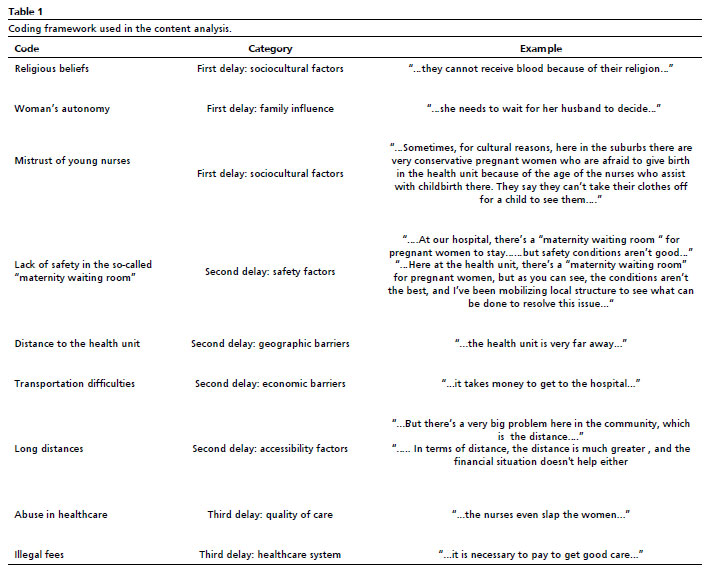
"... Now, from a religious standpoint, you can't donate blood, you can't receive blood, because of a certain religion. This also ends up having an influence; you can't get certain vaccines because the church forbids it…. We're talking about the Jehovah's Witnesses and Joahan Malangue…" (MCHN, Angónia)
Women's decision-making power does not belong to them, but is delegated to their guardians or older family members, which also contributes to delays in seeking services and additionally requires the presence of a partner during the first antenatal care visit, especially when the partner is absent or unavailable.
"…. Sometimes it's the husband who accompanies her… she has to wait until her husband returns to give her permission to go, or it's her mother-in-law, or her own mother, who decides whether she should go to the hospital…" (APS, Mutarara)
It was also observed that some older women expressed fear of receiving care from young nurses, associating age with a lack of clinical experience, which negatively affects their trust in and use of health services.
"… Sometimes, for cultural reasons, here in the outskirts there are very conservative pregnant women who are afraid to give birth at the maternity because of the nurses' age who assist with deliveries there. They say they can't take their clothes off for a child to see them..." (MCHN, Magoe)
"… Our community is a bit dismissive because it focuses more on the issue of age; they say I won't go there to be treated by a child, this is a major challenge we face..." (MCHN, Tsangano)
With regard to the community health workers, such as TMW and APS (Multipurpose Health Agents), they reported being aware of the operating guidelines for the referral system established by MISAU, but its implementation faces challenges such as the availability of registration resources, as well as the failure in the health sector to follow up on the community programs, compounded by the fact that the community also prefers not to travel due to long distances, lack of transportation, and economic factors.
"… We know that giving birth in the community is not recommended… it's a long way to the health center, because from where we are, the health center isn't close, and leaving here is very difficult and costs a lot of money…" (TMW, Tsangano)
"… They don't bring any documents. Only when they arrive here at the health center do they say that so-and-so sent them, and since we already know our community health workers and "model mothers", we just attend them…" (MCHN, Macanga)
Second Delay: Late arrival at health units
With regard to access to health services, it is observed that the difficulties faced by communities go beyond distance, also involving economic and structural factors that limit travel.
The second delay was found to be associated with geographic, economic, and structural barriers.
The long distances between health centers and communities hinder timely access to care, especially in hard-to-reach areas, causing some families to turn to traditional midwives.
"… Some of our communities are located far from the health unit, and given our lack of resources and the difficulty in accessing roads, it is sometimes hard to provide basic health services…" (Members of the community health committee, Doa)
"… We've faced several challenges because of the distance; there are certain childbirths that take place on the street…" ("Model Mothers", Angónia)
Financial constraints were also mentioned, hindering not only transportation but the entire process of traveling to health care services.
"… The distance is much greater, and financial constraints don't help either, because to get from here… to the hospital, you need money, which makes it very complicated. So, if we had a hospital nearby, it would be good for our community…" (Members of the community health committee, Tsangano)
Occupational barriers, such as farming, along with a lack of supporting infrastructure, such as the so called "maternity home rooms" for pregnant women, were cited by interviewees as factors influencing the use of health services for pregnant and postpartum women. Many of these women have to help their husbands and families in the farm fields that provide for the family's livelihood, which often forces them to travel to locations far from their usual homes. When this reality is compounded by the scarcity of the so-called "materity home rooms" for pregnant women or poor conditions of those that exist, which do not ensure safety and do not provide food, using these spaces becomes discouraging.
"… The lack of a "maternity home room" may be affecting childbirth in the community, since there are communities here that are very remote and difficult to access, especially during the rainy seasons…" (MCHN, Tsangano)
"… Our health unit has a "maternity home room", but it's in poor condition… you need money for transportation to get to the hospital, and once you arrive, you'll need food, soap…" ("Model Mothers", Doa)
"… Mothers need a "maternity home room"; for example, it's quite difficult for mothers living in the villages far away from here while they are in the active phase of labor, and besides, the access to the roads aren't good…" (Leaders, Magoe)
Third Delay: Receiving adequate care at the health units
Regarding care at the health units, the reports highlight weaknesses in the quality of care, which directly influence the trust in the community services. Negative experiences related to delays, the conduct of healthcare professionals, and informal fees tend to impact the decision to seek institutional care.
Regarding the third delay, interviewees reported issues related to the quality and timeliness of care, including delays, mistreatment, and illegal fees.
"… At the hospital, to avoid being treated badly, you have to give money to the nurses who assist with childbirths… only then, when she sees the money, you will deserve good care; without it, you'll get slapped even while in labor…" ("Model Mothers", Doa)
"…. We've seen nurses hitting women when they're in pain during childbirth… it's best to give birth in the community because going to the hospital doesn't help…" ("Model Mothers", Macanga)
Another issue identified during the interviews with family members of the pregnant women who died in the health units, before, during, or after childbirth,concerns their perception of the nurses' conduct. The three family members of deceased women interviewed reported that they could not identify any reasons that, in their point of view, would justify the deaths and attributed responsibility to aspects of the care received, including delays in care, inadequate care, or possible technical incompetence. This perception is reinforced by accounts such as:
"… Going to the hospital is very important, but the problem is in the care. I can go to the hospital when I'm feeling unwell, call a nurse, and still not receive help. Few nurses actually help, and that's one of the reasons we don't go to the hospital…" (A victim's relative, Angónia)
"…She had a normal delivery, it wasn't her first, and since we don't have a hospital nearby here, people give birth right here. And her death was due to the lack of postpartum care…" (A victim's relative, Doa)
Discussion
Delayed seeking of maternal health services remains a problem in Tete Province, contributing to maternal mortality. Studies show that these findings are consistent with other studies published in Sub-Saharan African countries.15,16 Regarding the first delay, studies have shown that there are religious norms that discourage medical procedures, such as the use of medications, vaccines, and blood transfusions, affecting adherence to prenatal visits and vaccination campaigns. These results are similar to studies highlighting the role of religion in seeking care, depending on the principles and involvement of religious leaders.
In Mozambique, Agadjanian and Cau found that religious beliefs and social norms can influence the decision to seek health services.17 In the context of East Africa, including Mozambique, a study shows that religious practices can act as barriers or facilitators.17 The requirement for a male partner to be present and dependence on the family during the first prenatal visit reveal women's low autonomy, which is already linked to lower use of health services and contributes to delays in seeking care. Several studies reveal that, in low- and middle-income countries, social and cultural factors continue to sideline women in family decisions, including those regarding their own health.15,18,19 Cultural barriers related to nurses' age and perceptions of a lack of experience have also emerged as determining factors, confirming that some older women are reluctant to receive care from young nurses, associating the age and experience of healthcare professionals with the quality of care. This perception reduces the demand for health services.15 Economic and occupational factors, such as farming, are essential for survival, forcing women to remain in areas far from health units. Results from previous studies confirm that women engaged in agricultural work are less likely to begin prenatal care early.18 Furthermore, poverty and direct and indirect costs, such as food and Transportation, are significant challenges.8,20
Regarding to the second delay, the study found that long distances, difficult access to roads, and a lack of transportation influence the use of health services. This finding is confirmed by several other studies, which indicate that the second delay is strongly influenced by geographic and structural barriers, with consensus regarding long distances,21–25 although, in the context of a different healthcare system, a study conducted in the United States also shows that geographic inequalities in access to obstetric services remain a challenge to timely access to maternal care.26 However, some of these articles also discuss the lack of community referrals, the absence of health units, and low income as factors contributing to the second delay,21 which, according to the classic definition of delays, are considered components of the first delay, as they cause women to remain at home. On the other hand, improvements to the so-called "maternity waiting rooms" influence adherence to prenatal visits and are considered an intervention associated with reducing the second delay. In this study, so-called "maternity waiting rooms" were classified as part of the second delay, as they are directly related to access to health services, especially in areas where travel is difficult. However, it was observed that, even when available, these structures often have poor conditions, such as a lack of food, safety, and basic comfor, which limits their use.
Finally, the third delay, whereas the findings of this study reveal delays in care, mistreatment, and illegal fees charged by healthcare professionals, reasons that erode pregnant women's trust in the health units and lead them to opt for home births. Studies conducted at Maputo Central Hospital and in district hospitals throughout the province found reports of disrespectful treatment, such as humiliation, shouting, lack of privacy, abandonment during labor, and the performance of procedures without consent.27 Similar findings have been observed in different regions of sub-Saharan Africa, including West Africa, where disrespectful practices, such as psychological and physical violence and illegal fees, negatively affect women during childbirth in health units.16,28,29 Studies conducted with health professionals indicate that these practices are related to overwork and a lack of resources in the health units, showing that measures should include courtesy training, increased staffing, and infrastructure improvements.30,31
Another crucial aspect is the lack of adequate support, including the so-called "maternity waiting rooms" for pregnant women. Even when such structures exist, they are often in poor condition, lacking food, privacy, and security, which discourages their use. Studies conducted in various African countries have found that the so-called "maternity waiting rooms" can reduce maternal and perinatal mortality, but only when they provide minimal conditions of comfort and logistical support.32
The findings of this study reveal limitations in the information regarding women's knowledge of warning signs during pregnancy and the postpartum period, as well as regarding prenatal visits and childbirth at the health units.
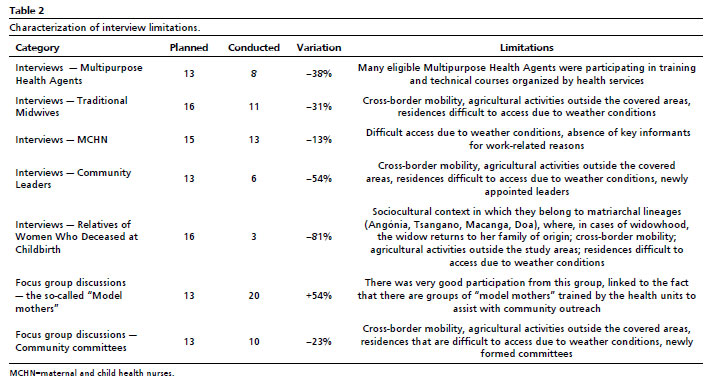
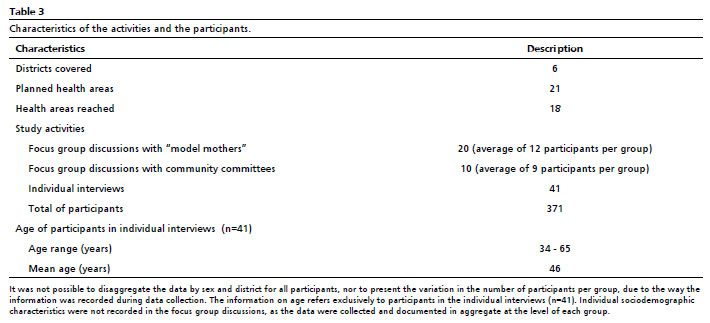
Furthermore, although 21 health areas were initially selected, only 18 could be reached due to adverse weather conditions, particularly heavy rains and deteriorated access to roads, which may have limited the scope of the data.
We also acknowledge the possibility of response bias in the focus group discussions, as participants may have been influenced by recent experiences or group dynamics.
Another relevant aspect concerns the age range of the 41 participants, which ranged from 34 to 65 years, with no younger individuals included. This finding may be related to the composition of the groups included in the study, which consisted predominantly of community leaders, traditional midwives, and other community health workers with greater experience in the communities.
On the other hand, positive aspects were identified, such as situations in which Multipurpose Health Agents, traditional midwives, community leaders, and the community health committees demonstrated knowledge that Health Units are appropriate settings for providing care to pregnant women; and they also understand the existence of Ministry of Health (MISAU) regulations that limit childbirth care at the community level. Additionally, motivational experiences were reported that improved pregnant women's adherence to Multipurpose Health Agents he so-called "maternity waiting rooms", such as the existence of a o-called "farming hospital" so that pregnant women can use to prepare their own food; although this finding was not prevalent in other health units, but it constitutes as an important fact.
The results of this study show that the three delays continue to pose a significant challenge to reduce maternal mortality in Tete Province. The first delay primarily reflects sociocultural influences and limitations on women's autonomy; the second is related to geographical and structural access difficulties; and the third highlights weaknesses in the quality and humanization of care.
Therefore, it is essential to strengthen strategies that promote community education and expand access to health services and improve the quality of care provided, which can guide community- and institution-based strategies with the potential to reduce barriers associated with maternal mortality.
Limitations
Data saturation was assessed globally, considering all participating groups together, rather than separately by category. Thus, it is not possible to ensure saturation in subgroups with fewer interviews, particularly among relatives of deceased women, who were represented by only three individual interviews.
No field notes were taken, and the transcripts were not returned to participants for validation of the findings, which may limit the reliability and confirmability of the qualitative interpretation.
It was found that the sociocultural organization of the family constituted a limitation in the districts of Tsangano, Angónia, and Macanga; since these are matrilineal families, in cases of widowhood the surviving spouse returns to their family of origin, making it difficult to locate them. The seasonal and cross-border mobility of traditional midwives, and community leaders, since the selected areas for the study are close to the borders, combined with geographical access challenges in the areas of study, also constituted a limitation for this study, given that the districts such as Doa and Mutarara, where the community depends on agriculture and livestock for subsistence, see residents moving to more remote areas during certain periods of droughts or shortages of natural resources are common.
In addition to climatic factors, there were other constraints: in the districts of Macanga and Tsangano, due to the degradation and erosion of access to roads during the rainy season, made it impossible to reach selected areas of study. Additionally, the temporary absence of Basic Multipurpose Health Agents, due to training and technical courses organized by the health services, lasting between three and six months, emerged as a limitation for this study.
References
1. World Health Organization (WHO). Trends in maternal mortality: 2000 to 2023: estimates by WHO, UNICEF, UNFPA, World Bank Group, UNDESA/Population Division. Geneva: WHO; 2025. [access in 2025 Nov 7]. Available from: https://www.who.int/publications/i/item/9789240108462
2. World Health Organization (WHO). Managing complications in pregnancy and childbirth: A guide for midwives and doctors. 2nd ed. Geneva: WHO; 2017. [access in 2025 Nov 7]. Available from: https://iris.who.int/server/api/core/bitstreams/3bda1306-da5d-487d-b2ad-aff995112a7a/content
3. United Nations Population Fund (UNFPA). State of World Population 2023. 8 billion lives, infinite possibilities. New York: UNFPA; 2023. [access in 2025 Nov 7]. Available from: https://www.unfpa.org/publications/state-world-population-2023-8-billion-lives-infinite-possibilities
4. Instituto Nacional de Saúde (INS). Sistema Comunitário de Vigilância em Saúde e Eventos Vitais (SIS-COVE): relatório sobre causas de morte em Moçambique, 2019 - 2021. Maputo: INS; 2023. [access in 2025 Nov 7]. Available from: https://ins.gov.mz/lancados-relatorios-sobre-causas-de-morte-em-mocambique/
5. Instituto Nacional de Estatística (INE), Ministério da Saúde (MISAU). Inquérito Demográfico e de Saúde 2022-2023: relatório final. Maputo: INE; 2024. [access in 2025 Nov 7]. Available from: https://www.ine.gov.mz/documents/20119/190711/01-%20Inqu%C3%A9rito%20Demogr%C3%A1fico%20e%20de%20Sa%C3%BAde%20-%20Relat%C3%B3rio.pdf/342a6a44-1c16-35bf-b65c-5b6104143bea?version=1.1&t=1693309521024&download=true
6. Ministério da Saúde (Moçambique). Estratégia para o fortalecimento das intervenções da parteira tradicional. Maputo: Ministério da Saúde; 2009. [access in 2025 Nov 7]. Available from: https://platform.who.int/docs/default-source/mca-documents/policy-documents/plan-strategy/MOZ-CC-10-03-PLAN-STRATEGY-2009-prt-Estrategia-Parteiras-Tradicionais.pdf
7. Teshale MY, Bante A, Belete AG, Crutzen R, Spigt M, Stutterheim SE. Barriers and facilitators to maternal healthcare in East Africa. BMC Pregnancy Childbirth.2025;25:111. doi:10.1186/s12884-025-07225-8
8. Assefa EM, Berhane Y. Delays in emergency obstetric referrals in Addis Ababa hospitals in Ethiopia: A facility-based, cross-sectional study. BMJ Open. 2020; 10 (6): e033771. https://doi.org/10.1136/bmjopen-2019-033771
9. Thaddeus S, Maine D. Too far to walk: maternal mortality in context. Soc Sci Med. 1994; 38 (8): 1091–110. doi:10.1016/0277-9536(94)90226-7
10. Vidler M, Kinshella MLW, Sevene E, Lewis G, von Dadelszen P, Bhutta Z, et al. Transitioning from the three delays to continuity of care. BMC Pregnancy Childbirth. 2023; 23: 748. doi:10.1186/s12884-023-06055-w
11. Guest G, Bunce A, Johnson L. How many interviews are enough? Field Methods. 2006; 18 (1): 59-82. doi:10.1177/1525822X05279903
12. Hennink MM, Kaiser BN, Weber MB. What influences saturation? Qual Health Res. 2019; 29 (10): 1483-96. doi:10.1177/1049732318821692
13. Malterud K, Siersma VD, Guassora AD. Sample Size in Qualitative Interview Studies: Guided by Information Power. Qual Health Res. 2016; 26 (13): 1753-60. https://doi.org/10.1177/1049732315617444
14. Hsieh HF, Shannon SE. Three approaches to qualitative content analysis. Qual Health Res. 2005; 15 (9): 1277-88.
15. Gebeyehu NA, Gelaw KA, Lake EA, Adela GA, Tegegne KD, Shewangashaw NE. Women's decision-making autonomy in maternal health. Women's Health. 2022; 18: 17455057221122618. doi:10.1177/17455057221122618
16. Kassa ZY, Tsegaye B, Abeje A. Disrespect and abuse during childbirth in sub-Saharan Africa. BMC Int Health Hum Rights. 2020; 20: 23. doi:10.1186/s12914-020-00242-y
17. Cau BM, Agadjanian V. Religion and Use of Institutional Child Delivery Services: Individual and Contextual Pathways in Mozambique. Int Perspect Sexual Reprod Health. 2019; 45: 35-43. https://doi.org/10.1363/45e7719
18. Munguambe K, Boene H, Vidler M, Bique C, Sawchuck D, Firoz T, et al. Health care seeking behaviours in Mozambique. Reprod Health. 2016; 13 (Suppl. 1): 31. doi:10.1186/s12978-016-0141-0
19. Olwanda E, Opondo K, Oluoch D, Croke K, Maluni J, Jepkosgei J, et al. Women's autonomy and maternal health decision making in Kenya: Implications for service delivery reform - a qualitative study. BMC Women's Health. 2024; 24 (1): 181. https://doi.org/10.1186/s12905-024-02965-9
20. Muhajarine N, Shakurun N, Ahmed MS, Andre F, Chicumbe S. Maternal healthcare utilisation in Mozambique. BMJ Glob Health. 2025;10:e018121. doi:10.1136/bmjgh-2024-018121
21. Geleto A, Chojenta C, Musa A, Loxton D. Barriers to access and utilization of emergency obstetric care at health facilities in sub-Saharan Africa: A systematic review of literature. Syst Rev. 2018; 7 (1): 183. https://doi.org/10.1186/s13643-018-0842-2
22. Dotse-Gborgbortsi W, Nilsen K, Ofosu A, Matthews Z, Tejedor-Garavito N, Wright J, et al. Distance is a "big problem": a geographic analysis of proximity to maternal health services in Ghana. BMC Pregnancy Childbirth. 2022; 22: 672. doi:10.1186/s12884-022-04998-0
23. Knight HE, Self A, Kennedy SH. Why are women dying when they reach hospital on time? A systematic review of the "third delay." PloS One. 2013; 8 (5): e63846. https://doi.org/10.1371/journal.pone.0063846
24. Eshetu D, Aschalew Z, Bante A, Negesa B, Gomora D, Ejigu N, et al. Delay in reaching emergency obstetric care. PLoS Glob Public Health. 2024; 4: e0002964. doi:10.1371/journal.pgph.0002964
25. Belay DG, Dunne J, Lassi Z, Mengistu TS, Alemu MB, Pereira G, et al. Healthcare access barriers and maternal healthcare service uptake in 14 sub-Saharan African countries (2017–2021): a propensity score matched analysis. BMJ Public Health. 2026; 4 (1): e001391. doi:10.1136/bmjph-2024-001391
26. Fontenot J, Brigance C, Lucas R, Stoneburner A. Access to obstetric hospitals. BMC Pregnancy Childbirth. 2024; 24: 350. doi:10.1186/s12884-024-06535-7
27. Galle A, Manaharlal H, Cumbane E, Picardo J, Griffin S, Osman N, et al. Disrespect during childbirth in Mozambique. BMC Pregnancy Childbirth. 2019; 19: 369. doi:10.1186/s12884-019-2532-z
28. Bradley S, McCourt C, Rayment J, Parmar D. Disrespectful intrapartum care in Africa. Soc Sci Med. 2016; 169: 157-70. doi:10.1016/j.socscimed.2016.09.039
29. Ahmed SAE, Mahimbo A, Dawson A. Intrapartum care experiences in Africa. BMC Pregnancy Childbirth. 2023; 23: 27. doi:10.1186/s12884-022-05319-1
30. Adu-Bonsaffoh K, Tamma E, Maya E, Vogel JP, Tunçalp Ö, Bohren MA. Mistreatment of women during childbirth. Reprod Health. 2022; 19: 82. doi:10.1186/s12978-022-01372-3
31. Lusambili AM, Obure J, Wisofschi S, Nyaga L, Mulama K, Temmerman M. Disrespectful maternity care in Kenya. BMJ Open. 2022; 12: e057515. doi:10.1136/bmjopen-2021-057515
32. Katangolo-Nakashwa N, Shilunga A, Mahoto S, Haufiku D, Alfeus A, Iita H, et al. Effectiveness of maternity waiting homes in Africa. J Glob Health Sci. 2025; 7: e18. doi:10.35500/jghs.2025.7.e18
Acknowledgments
We would like to thank the Government of Flanders and the Institute of Tropical Medicine (ITM) for their financial support.
Authors' contribution
Monteiro MHP: led the implementation of the study, coordinated data collection, and participated in the analysis and drafting of the manuscript.
Ibrahim ZA: contributed to the implementation, data analysis, and drafting of the manuscript.
Osman ND: provided technical support and contributed to the data analysis and revision of the manuscript.
Mugaua NJE: provided technical and scientific support, supervised data collection, and contributed to the analysis and drafting of the manuscript.
All authors approved the final version of the article and declare no conflict of interest.
Data availability
The data used and analyzed in this study are available upon request to the authors, in accordance with ethical standards and ensuring the confidentiality of the participants. During the storage process, the data did not contain any identifying information that would allow for the identification of participants. Each transcribed interview was coded so that it could not be linked to the individual's name, except by the research team. The information entered into the database was treated confidentially, and access was limited to authorized individuals.

Instituto de Medicina Integral
Prof. Fernando Figueira - IMIP
Rua dos Coelhos, 300 Boa Vista - Refice, PE, Brasil CEP: 50.070-902
E-mail: revista@imip.org.br
(81) 2122-4141


Copyright © 2026 Revista Brasileira de Saúde Materno Infantil Todos os direitos reservados.
Desenvolvido por: 


 Ler em português
 Download PDF
 Imprimir
 Enviar este artigo por email
 Como citar este artigo
 Enviar um comentário
 Mendeley
 Pocket
 Compartilhar no Facebook
 Compartilhar no Twitter