Wars and other forms of violence are historically recurrent phenomena in human experience and produce repercussions at multiple levels, crossing individual and collective dimensions and extending to future generations. The so-called “collective violence” includes collective traumas such as wars and genocides.¹ “Community violence” occurs within the context of a community (e.g., school, neighborhood, public spaces). “Domestic violence” takes place within households and is perpetrated by family members or individuals within the family circle.² These events have profound and long-lasting effects not only on the survivors but also on their descendants. These effects arise, in part, from gene–environment interactions across generations and have recently been investigated through translational research and observational studies.³ This article presents a conceptual synthesis and a thematic update on the repercussions of these forms of violence across biopsychosocial and ecological dimensions, with emphasis on the maternal and child context.
More than two decades after the completion of the Human Genome Project, which advanced knowledge beyond the study of single-gene effects, current efforts focus on understanding how the set of genes shapes health in response to environmental exposures. International research networks are already established and active, such as the International Human Exposome Network (IHEN).⁴
To understand this spectrum of inheritance related to environmental exposures, three concepts are fundamental: epigenetics, the exposome, and multimorbidity:
(i) Epigenetics is the field that studies heritable changes in gene expression that occur without alterations in the deoxyribonucleic acid (DNA) sequence. These inherited changes in gene expression influence which genes are activated or silenced in response to cellular and environmental signals; underlying mechanisms include changes in DNA methylation patterns, histone modifications, and regulation by non-coding ribonucleic acids (RNAs).1,3,5
(ii) The exposome refers to the measure of all exposures an individual experiences throughout life and how these exposures relate to health. It encompasses physical, chemical, biological, social, behavioral, and lifestyle environmental exposures, as well as epigenetic and metabolic biological responses.3,4
(iii) Multimorbidity is defined as the occurrence of two or more chronic health conditions in the same individual. It includes both physical and mental diseases, reflecting the complexity of experiences during life in the context of exposure to environmental factors that may interact to influence the onset and/or worsening of multiple diseases. There is no hierarchical ordering among conditions, as with comorbidities. The concept of multimorbidity emphasizes the complexity of health experiences, social and environmental determinants, and the challenges for comprehensive care.6,7
Fetuses, children, and adolescents are particularly susceptible to exposome-induced epigenetic alterations, as their organisms undergo rapid growth (cell division and proliferation) and development (increased functional level and complexity). Investigating the exposome offers an opportunity to explore multiple ecological layers that affect health, including environmental biomarkers, pathways of biological mechanisms, and adverse outcomes. Studies explore causal interactions within and between exposome components, aiming to develop effective prevention strategies.
2,6,8 Collective, community, and domestic violence constitute complex, chronic adverse exposures embedded in the exposome of affected individuals, potentially acting from critical developmental periods up to adulthood. These experiences, often cumulative and socially determined, may trigger epigenetic alterations that modulate gene expression associated with stress and inflammatory systems, with immunoneuroendocrine repercussions from a biopsychosocial and ecological perspective. Such biological alterations contribute to illness trajectories characterized by the co-existence of multiple physical and mental conditions, configuring multimorbidity. The biological and psychosocial effects of violence may extend beyond the directly exposed generation, either through potentially transmissible epigenetic mechanisms or through the perpetuation of adverse social contexts, thereby shaping intergenerational, transgenerational, and Multigenerational processes, of health vulnerability.
1,6,7Intergenerational, transgenerational, and multigenerational processes effect both gene–environment interactions and the persistence of psychosocial contexts across generations. Intergenerational inheritance occurs when environmental exposures related to pregnancy and child-rearing environments directly affect the offspring and their germ cells, resulting in phenotypic alterations during life and potentially in the second generation (grandchildren). Transgenerational refers to the transmission of biological effects to germline generations not directly exposed (e.g., great-grandchildren); it is usually associated with epigenetic mechanisms, for which evidence is robust in animal models but still limited and predominantly observational in humans. Multigenerational processes, in turn, describe the persistence of vulnerabilities across multiple generations, sustained by the accumulation of the exposome and by the continuity of adverse social contexts.
2,3For women, children, and adolescents exposed to violence, the articulation between violence, the exposome, and epigenetics provides a robust explanatory framework for understanding the production and persistence of multimorbidity along generations. From an intergenerational perspective, anxiety and stress during pregnancy may affect fetal brain regions responsible for cognitive and emotional regulation. Intimate partner violence is a strong predictor of maternal multimorbidity. Previous studies have also associated maternal stress with increased risk of neurodevelopmental disorders in children, such as attention-deficit/hyperactivity disorder (ADHD), intellectual disabilities, schizophrenia, and autism spectrum disorder (ASD). Maternal depression and anxiety in the peripartum period have also been associated with reduced white matter development in the newborn’s brain, with potential long-term effects on cognition and emotion.
2,3,5,8Fetal DNA methylation may be modified in response to maternal psychological status, regulating gene expression. Certain fetal brain regions are more vulnerable to damage: the cortex, prefrontal lobe, amygdala, and hippocampus. These areas are directly associated with memory, emotion, and cognition. Alterations may also occur in white matter, affecting cognitive skills, emotional regulation, language, behavior, and motor functions. Maternal exposure to severe stress resulting from traumatic or catastrophic events has been associated with increased amygdala volume in 11-year-old children, a change possibly related to behavioral problems.
5,6Adverse exposure to violence has been associated with signs of accelerated epigenetic aging measured by epigenetic clocks such as GrimAge. This is a DNA methylation-based biomarker of biological aging with strong predictive capacity for mortality and health-related outcomes, although it is not yet a diagnostic tool for individual trauma. In a study of Brazilian adolescents from a high-violence region, cumulative exposure to domestic and community violence was correlated with greater epigenetic acceleration according to GrimAge and with alterations in heart rate variability during stress tasks. This finding reinforces possible biological mechanisms linking adverse exposures to health during critical life stages.
7 In populations living in war zones, a potential unique epigenetic signature of trauma has been investigated. There is a probable molecular mechanism involved in the deceleration of epigenetic age associated with neurodevelopmental delay promoted by exposure to armed conflict.¹
In summary, evidence has demonstrated that experiences of collective, community, and domestic violence leave lasting marks on individuals’ health trajectories, influencing the exposome, epigenetic mechanisms, multimorbidity, and the transmission of disease to new generations. In the context of violent conflicts in various cities and countries and increasing exposure of populations to chronic stressors, a growing demand for healthcare related to complex chronic conditions is expected, with increased pressure on health systems and public budgets.⁹
Economic studies estimate annual financial burdens in the trillions of dollars associated with these events and their lifelong health effects.⁹ In the absence of robust public policies for violence prevention and response, direct costs of treatment, rehabilitation, and long-term care combined with indirect costs related to productivity loss and social impact are likely to increase, further straining public resources and expanding the burden of violence for present and future generations. This scenario reinforces the need for preventive approaches and policies promoting a culture of peace.
10 Preventive strategies include intersectoral actions integrating health, education, justice, social assistance, and urban infrastructure policies throughtout all life stages, particularly targeting pregnant women, children, and adolescents.
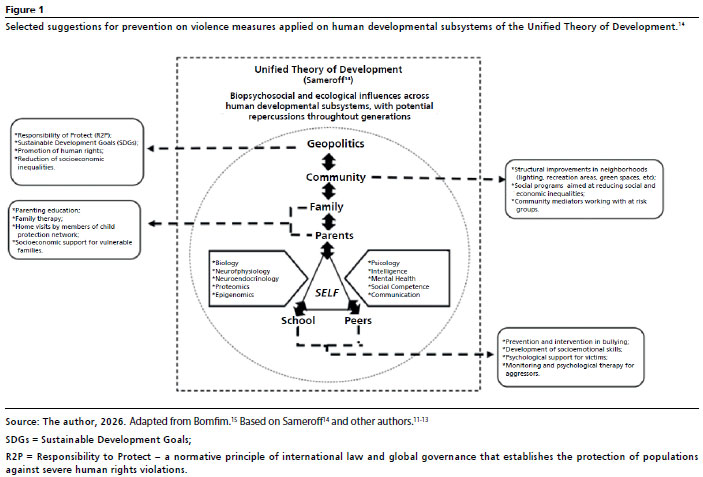
11-13According to the Unified Theory of Human Development published in 2010,
14 preventing violence in more proximal subsystems (family, school, and community) holds the potential to prevent violence emerging from more distal subsystems (geopolitical contexts), and vice versa (Figure 1). This occurs because each individual, while influenced by the environment in which they live, also becomes a source of biopsychosocial and ecological influence on themselves and others. Positive changes within these subsystems have the potential to improve the functioning of the entire system. Figure 1 presents a theoretical-integrative model with evidence-based intervention suggestions
11-13 applicable to each subsystem that influences and is influenced by the individual’s biopsychosocial and ecological self.
The synthesis presented reinforces that violence prevention requires intersectoral articulation among policies and actions at domestic, community, and geopolitical levels, since collective and other forms of violence may emerge from the interactions among these subsystems. In maternal and child health, this integrative approach highlights that effective and timely care directed toward women, pregnant individuals, children, and adolescents has the potential not only to mitigate immediate harm but also to prevent significant individual, social, and economic costs for the health systems and nations, both in the present and in the future.
References1. El-Khalil J, Makhoul J, Ghossoub E, Richa S, Kesrouani A, Khoury B. Impact of intergenerational trauma on second-generation descendants: a systematic review. BMC Psychol. 2025; 13: 668.
https://doi.org/10.1186/s40359-025-03012-42. Moog NK, Cummings PD, Jackson KL, Aschner JL, Barrett ES, Bastain TM,
et al. Intergenerational transmission of the effects of maternal exposure to childhood maltreatment in the USA: a retrospective cohort study. Lancet Public Health. 2023; 8 (3): e226-37.
https://doi.org/10.1016/s2468-2667(23)00025-73. Klibaner-Schiff E, Simonin EM, Akdis CA, Cheong A, Johnson MM, Karagas MR,
et al. Environmental exposures influence multigenerational epigenetic transmission. Clin Epigenetics. 2024; 16 (1): 145.
https://doi.org/10.1186/s13148-024-01762-34. The International Human Exposome Network (IHEN). Human exposome network: advancing global collaboration on exposome research. [access in 2025 Nov 27]. Available from:
https://humanexposome.net/5. Rubens M, Bruenig D, Adams JAM, Suresh SM, Sathyanarayanan A, Haslam D,
et al. Childhood maltreatment and DNA methylation: a systematic review. Neurosci Biobehav Rev. 2023; 147: 105079.
https://doi.org/10.1016/j.neubiorev.2023.1050796. Senaratne DNS, Thakkar B, Smith BH, Hales TG, Marryat L, Colvin LA. The impact of adverse childhood experiences on multimorbidity: a systematic review and meta-analysis. BMC Med. 2024; 22: 315.
https://doi.org/10.1186/s12916-024-03505-w7. Oliveira NCS, Katrinli S, Assis SG, Smith AK, Serpeloni F. Community and domestic violence are associated with DNA methylation GrimAge acceleration and heart rate variability in adolescents. Eur J Psychotraumatol. 2023; 14 (2): 2202054.
https://doi.org/10.1080/20008066.2023.22020548. Uy JP, Parks KC, Tan AP, Fortier MV, Meaney M, Chong YS,
et al. Maternal childhood maltreatment, development of amygdala volume, and anxiety symptoms in offspring. J Am Acad Child Adolesc Psychiatry. 2026; 65 (3): 420-31.
https://doi.org/10.1016/j.jaac.2025.03.0279. Peterson C, Aslam MV, Rice KL, Gupta N, Kearns MC. Systematic Review of Per Person Violence Costs. Am J Prev Med. 2024 Feb; 66 (2): 342-50.
https://doi.org/10.1016/j.amepre.2023.08.00910. Organização das Nações Unidas para a Educação, a Ciência e a Cultura (UNESCO). Declaração e Plano de Ação Integrado sobre a Educação para a Paz, os Direitos Humanos e a Democracia. Paris: UNESCO; 1995. 17 p. [access in 2025 Nov 27]. Available from:
https://unesdoc.unesco.org/ark:/48223/pf0000112874_por11. Brake TM, Razum O. Prevention of war: a scoping review on primary preventive measures in public health. Public Health Rev. 2024; 44: 1606201.
https://doi.org/10.3389/phrs.2023.160620112. Ahmed RS, Shaban M. Breaking the cycle: A systematic review of intergenerational transmission of child maltreatment and preventive parenting interventions. Child Abuse Negl. 2025;169:107743.
https://doi.org/10.1016/j.chiabu.2025.107743 13. Gautschi J, Lätsch D. The effectiveness of interventions to prevent and reduce child maltreatment in high-income countries: an umbrella review. Child Abuse Negl. 2024;153:106845.
https://doi.org/10.1016/j.chiabu.2024.10684514. Sameroff A. A unified theory of development: a dialectic integration of nature and nurture. Child Dev. 2010; 81 (1): 6-22.
15. Bomfim KDX. Construção do instrumento de detecção de risco para violência sexual doméstica em escolares de 9 a 11 anos (IDR-VSD): validação de conteúdo, confiabilidade e estrutura fatorial [thesis]. Recife: Universidade Federal de Pernambuco; 2023. [access in 2025 Nov 14]. Available from:
https://repositorio.ufpe.br/handle/123456789/53549Author’s contributionThe author was responsible for the conception of the article, conceptualization, drafting, and critical review of the content, and declares there are no conflicts of interest.
Data availabilityThe entire data set supporting the results of this study has been published in the article itself.
Received on January 28, 2026
Approved on April 22, 2026
At the invitation of the Editor-in-Chief: Melania Amorim









 Ler em português
 Download PDF
 Imprimir
 Enviar este artigo por email
 Como citar este artigo
 Enviar um comentário
 Mendeley
 Pocket
 Compartilhar no Facebook
 Compartilhar no Twitter